Italian Liberty is Italy’s Art Nouveau: an architectural and decorative movement that swept the peninsula between roughly 1890 and 1915, characterised by floral ornament in polychrome ceramic and wrought iron, curvilinear stone moulding, and a preference for residential and hotel commissions over civic infrastructure. It takes its name from the London shop whose decorative vocabulary transformed Italian fashion and design. Its built legacy stretches from Milan to Palermo, with concentrated chapters in Turin, Florence, Trieste, and the Venetian Lido.
What is Italian Liberty?
The international movement known as Art Nouveau reached the Italian peninsula in the late 1890s and found an immediate echo in a building culture already attuned to decorative inventiveness. Where the Belgian and French variants of the style foregrounded the unbroken whiplash line — Victor Horta’s Brussels interiors, Hector Guimard’s cast-iron Paris Métro entrances — Italian Liberty leaned harder into polychrome surface. Stone mouldings bloomed into sunflowers and peacocks. Ceramic panels by Galileo Chini (1873–1956) introduced colour fields that no earlier Italian architecture had attempted in structural positions. The balcony rail became a forest of iron vines.
The result is a style simultaneously of its European moment and distinctly its own: more eclectic, more chromatic, more residential than the northern versions, with a tendency to braid Liberty ornament into local historical references — Norman-Arab arches in Palermo, Byzantine mosaic echoes along the Adriatic, Piedmontese brick in Turin.
Why is it called “Liberty”?
The name comes from Arthur Liberty’s Regent Street shop in London, which from the 1870s onwards had been importing and commissioning the Japanese textiles, ceramics, and printed fabrics that fed the broader European appetite for ornamental exoticism. The shop’s silks and wallpapers circulated through Italian fashion ateliers and interior decorators before the name attached itself to the architectural movement. By the time the style had a public face in Italy — around the turn of the twentieth century — “Liberty” was the name in common use, distinct from the French “Art Nouveau,” the German “Jugendstil,” the Viennese “Secessionsstil,” and the Catalan “Modernisme.”
The alternative Italian term, Stile Floreale (“floral style”), captures the decorative programme more precisely but is used less commonly in everyday speech. In Italy the movement is referred to simply as Liberty — or stile Liberty — so “Italian Liberty” and “Italian Art Nouveau” are two names for exactly the same thing. Both describe the Italian branch of the international movement.
1902: The Year the Movement Found Its Platform
Italian Liberty found its public platform at the Prima Esposizione Internazionale d’Arte Decorativa Moderna, held in Turin in 1902. The exhibition was Italy’s counterpart to the great European showcases of applied art and design: a deliberate statement that Italy intended to lead, not merely follow, the new decorative culture. The main pavilion was designed by Raimondo D’Aronco, an architect from Udine who had spent years at the Ottoman court in Istanbul and brought a remarkable range of sources to the Liberty idiom. D’Aronco’s structure was exuberant to the point of extravagance: domes, towers, and curvilinear ornament stacked into a kind of exhibition fantasia that made the argument, in steel and plaster, that there was no natural ceiling on what Liberty ornament could do.
The 1902 exhibition positioned Italian Liberty as a national modern style and gave its practitioners a moment of collective visibility. The buildings that followed in the next decade — in Milan, Turin, Palermo, and the Lido — were its harvest.
The Decorative Grammar
Four materials define the Italian Liberty surface. First, polychrome ceramic: Liberty architects collaborated with ceramicists to produce tile inserts, panel frieze work, and surface cladding in greens, ochres, and blues, a chromatic emphasis the French and Belgian variants used more sparingly. Galileo Chini’s ceramic panels became a national vocabulary, appearing on Liberty buildings across Italy.
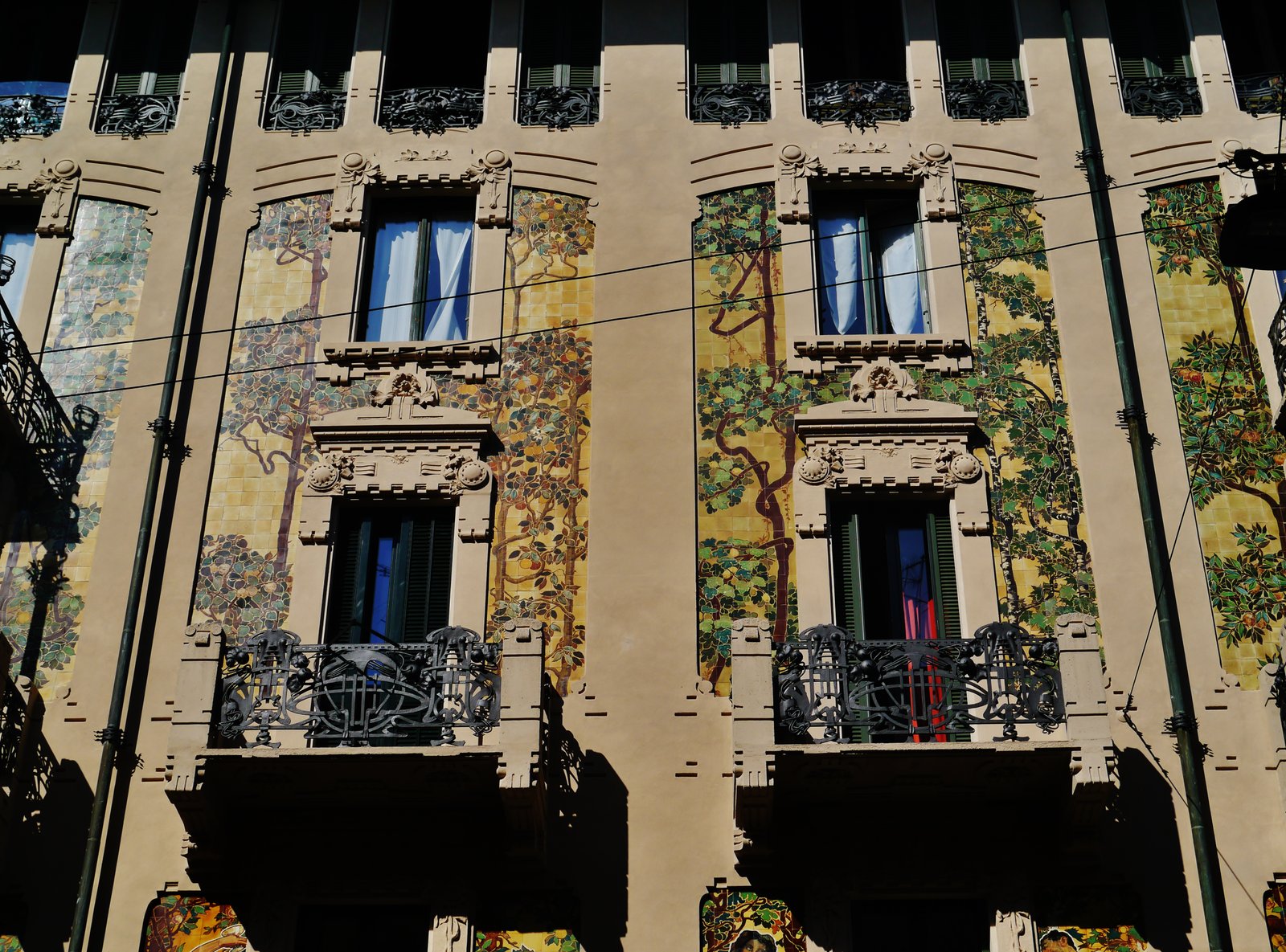
Second, wrought iron: not the engineering iron of Guimard’s Paris Métro but the artisan’s iron — balcony rails, window guards, gate leaves — hammered into botanical shapes (irises, wisteria, waterlilies) and set against rendered masonry. The ironwork is where the style reveals its hand most quickly from street level.
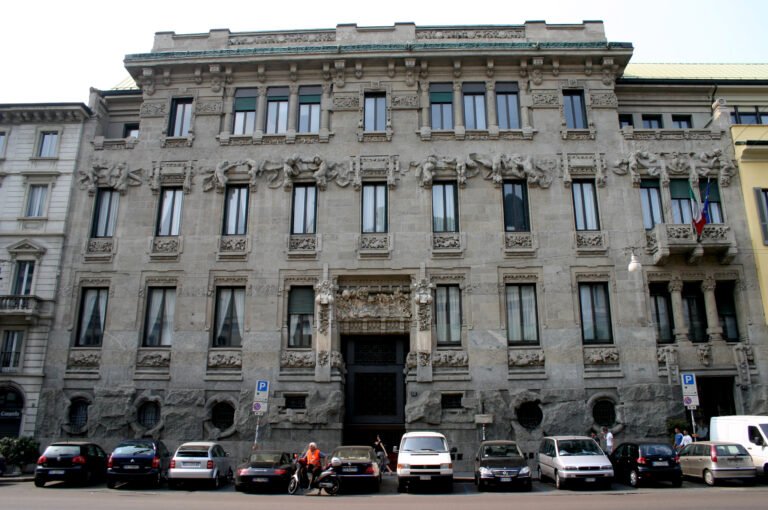
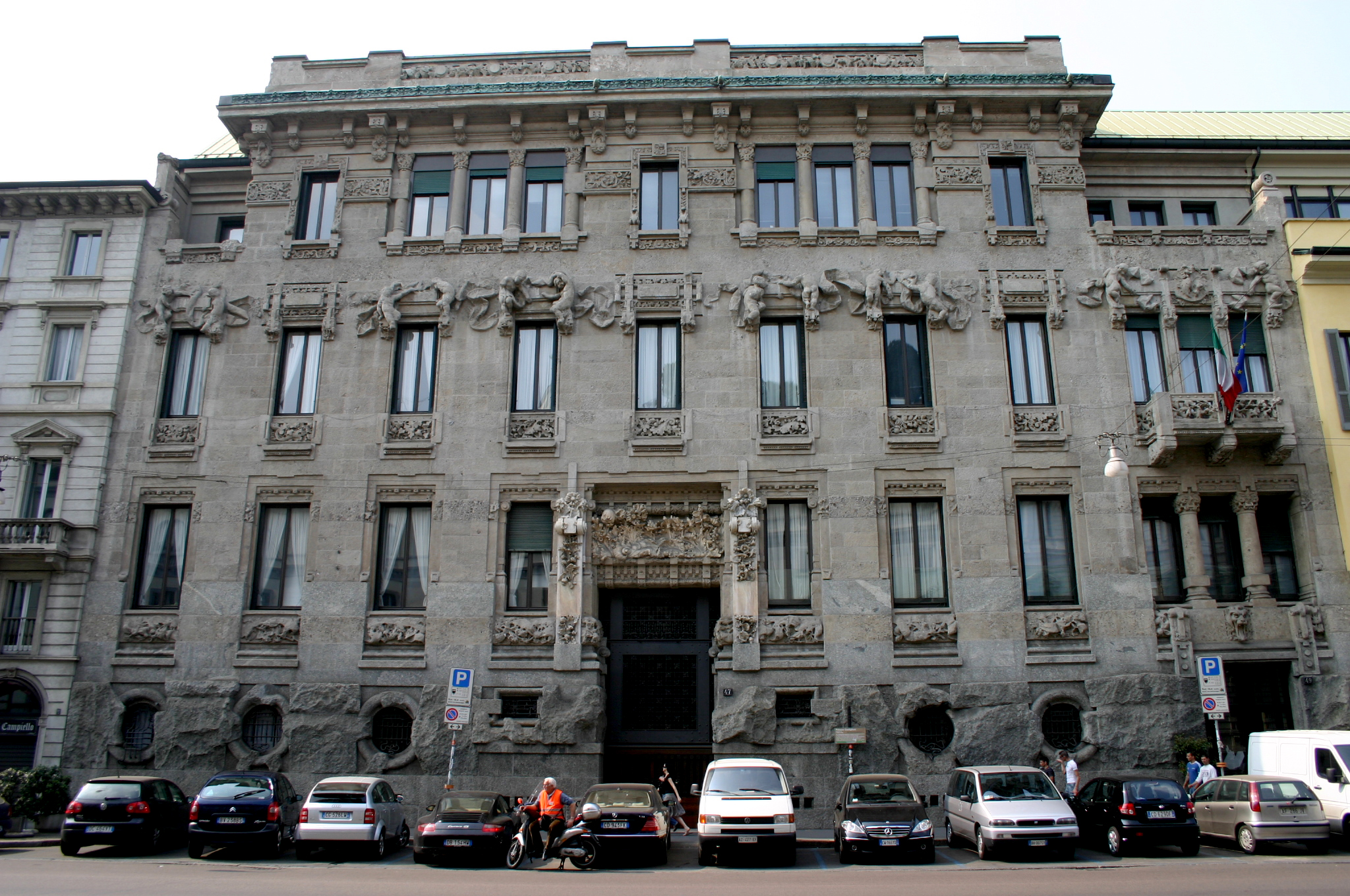
Third, sculpted stone moulding: figures, foliage, and zoomorphic forms carved in facade limestone or terracotta, running along cornices, framing windows, and building up around entry portals. Giuseppe Sommaruga’s Palazzo Castiglioni in Milan is the most theatrical example.
Fourth, painted and rendered interiors: Liberty interiors were frequently decorated with figurative programmes in the Symbolist idiom — murals, stained glass, painted ceilings — that extended the movement’s argument into enclosed space. Villa Igiea in Palermo preserves a dining-room programme by Ettore De Maria Bergler that is among the finest intact Liberty interiors in the country.
Five Architects Who Shaped the Movement
Giuseppe Sommaruga is the architect most associated with Milanese Liberty. His Palazzo Castiglioni, built on Corso Venezia between 1900 and 1903, set the standard for what a full-dress Italian Liberty facade could be: figurative sculpture at the portal level, dense low-relief ornament across the upper floors, and a resolved overall composition that manages its own exuberance without tipping into excess.
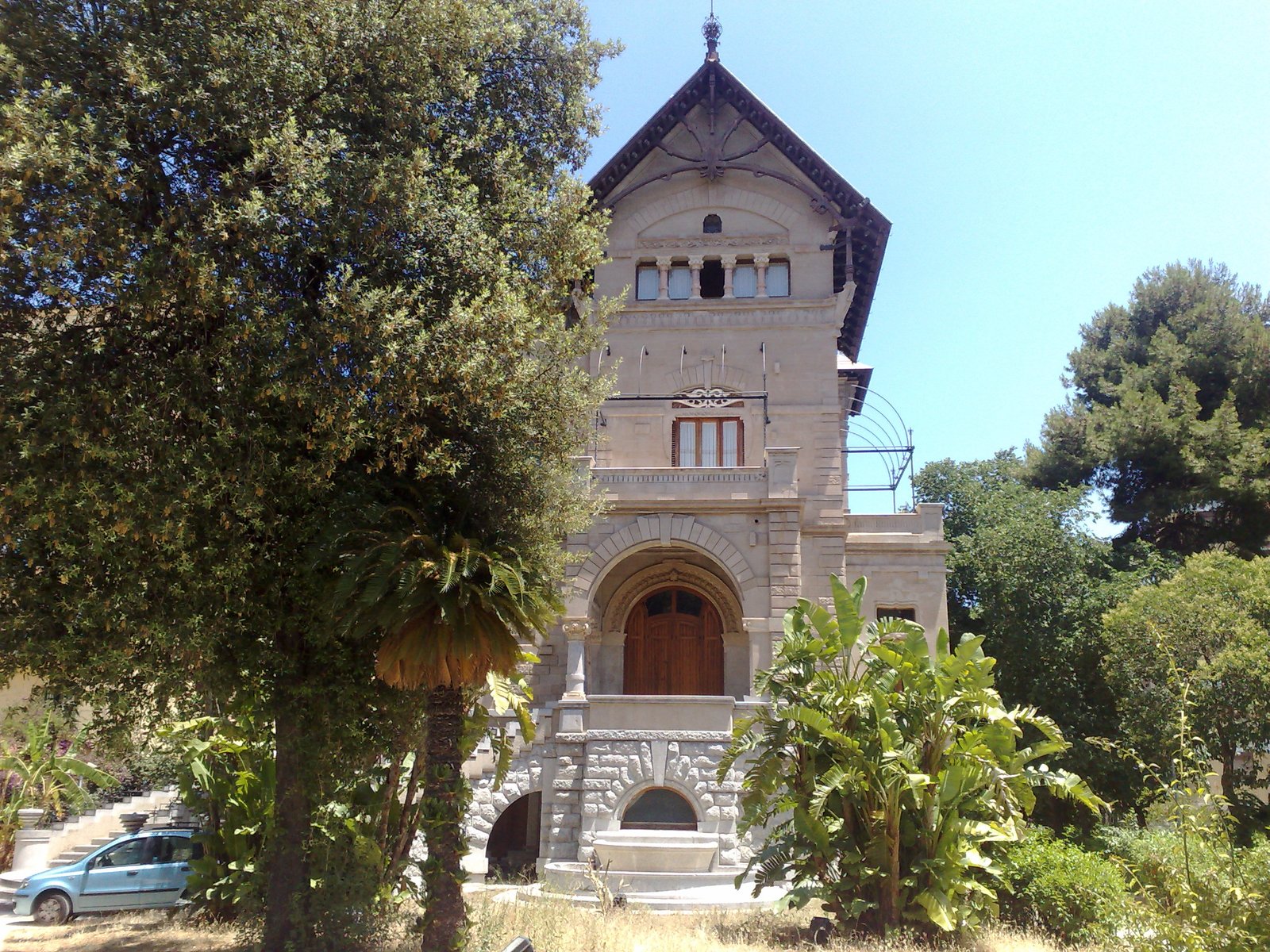
Ernesto Basile (1857–1932) is to Palermo what Sommaruga is to Milan. His commissions for the Florio dynasty — the industrial family whose fortune in tuna canning, steamships, and wine had made them the most powerful family in southern Italy — produced two of the movement’s defining buildings. Villino Florio all’Olivuzza, begun in 1899 for Vincenzo Florio, interweaves Art Nouveau ironwork with medieval and Norman-Gothic references particular to the island’s architectural tradition. Villa Igiea, reworked by Basile from 1899 from an earlier structure, remains an operating hotel whose preserved public rooms are among the most complete surviving Liberty interiors in Italy.
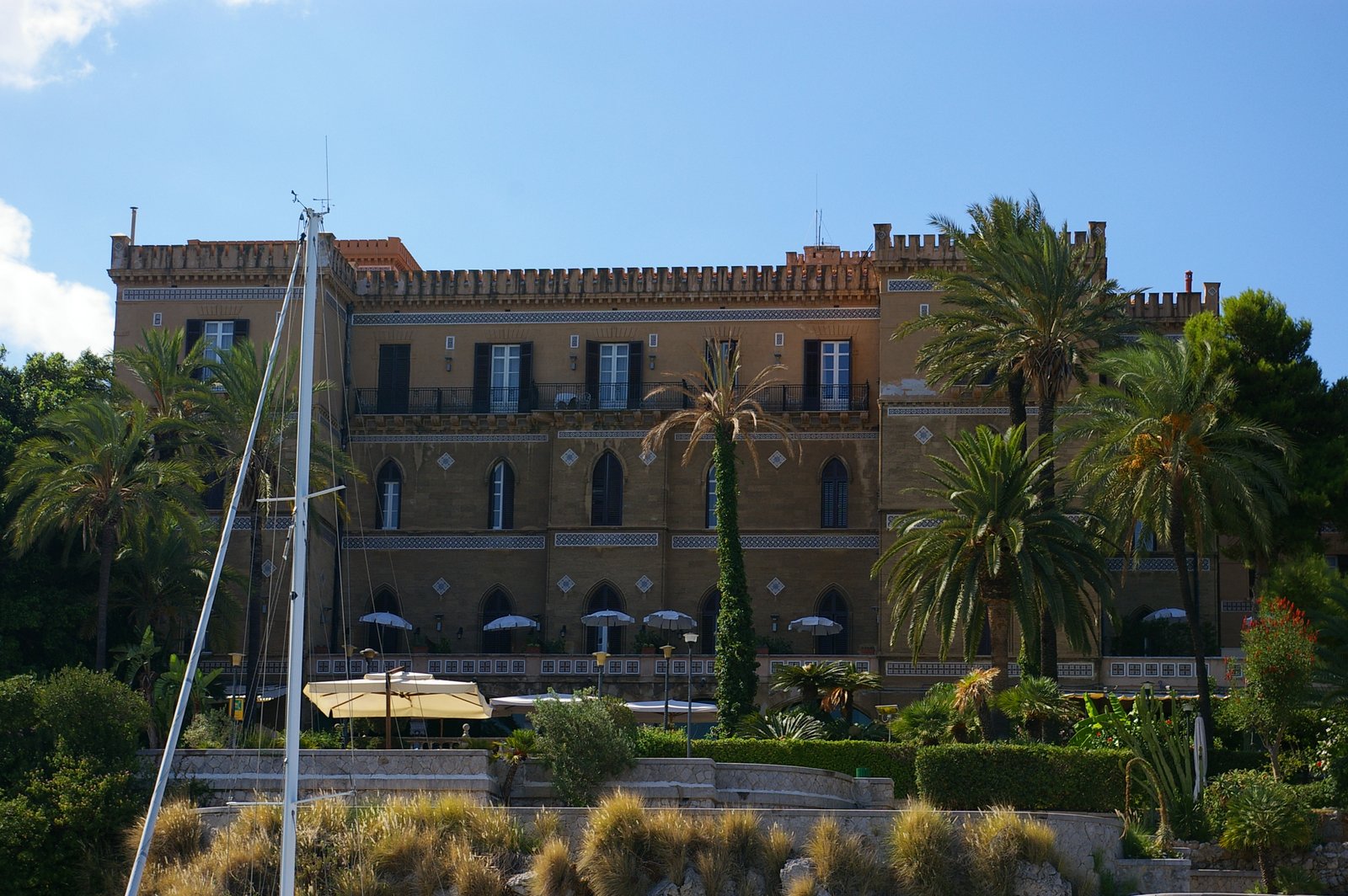
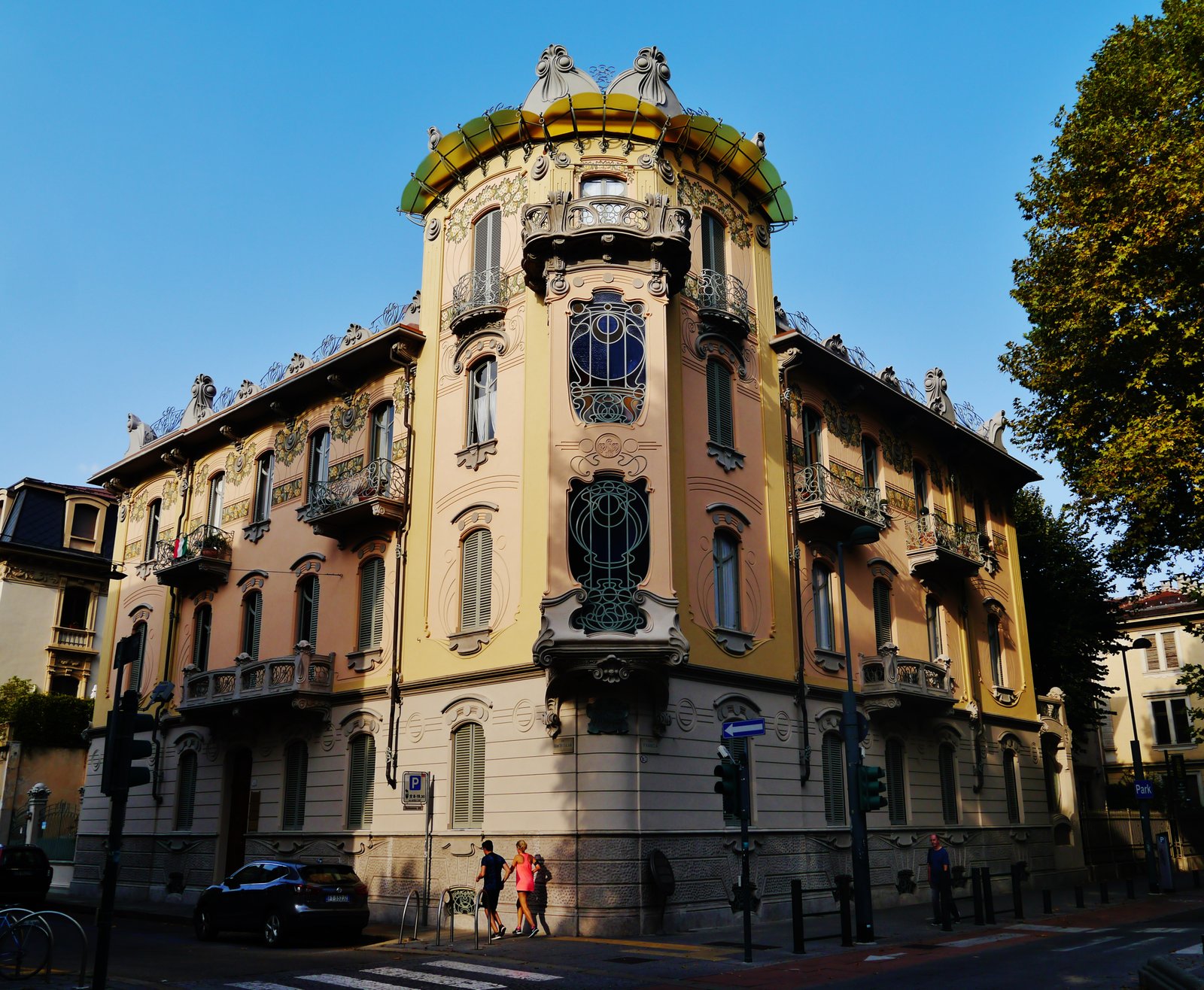
Pietro Fenoglio (1865–1927) defined Turin’s Liberty from a single corner. His Casa Fenoglio-Lafleur, built in 1902 on the corner of Via Principi d’Acaja and Corso Francia, is among the most photographed Liberty buildings in northern Italy: two wings turning a street corner in pale rendered masonry, the surfaces dense with ceramic inserts and wrought-iron botanical ornament, the roofline interrupted by curvilinear gables.
Raimondo D’Aronco is the movement’s international node. Based at the Ottoman court in Istanbul for much of the critical period (1893–1907), he returned to Italy to design the main pavilion of the 1902 Turin exhibition: a structure that synthesised Art Nouveau, Islamic ornamental geometry, and classical structure in a way no purely Italian Liberty architect attempted.
Gino Coppèdè is the movement’s latest and strangest chapter. His Quartiere Coppèdè in Rome, built between 1915 and 1927 around Piazza Mincio, assembles Liberty, medieval, and mannerist quotations into an urban quarter that reads simultaneously as architectural fantasy and perfectly liveable neighbourhood. It proves that Italian Liberty, unlike its French and Belgian counterparts, had no firm end date: it became something else rather than simply stopping.
City by City: Where to Walk the Style
Milan has the highest density of notable Liberty buildings in Italy. The core is Porta Venezia and the streets extending northeast: Palazzo Castiglioni on Corso Venezia, Casa Galimberti with its ceramic facade of painted figures, Casa Campanini on Via Vincenzo Bellini — Alfredo Campanini’s own house. The Milan city guide traces the full walking route.
Turin built its Liberty in the years immediately after the 1902 exhibition. The Cit Turin neighbourhood is the starting point: Casa Fenoglio-Lafleur at the corner of Via Principi d’Acaja and Corso Francia, Villa Scott on the Borgo Po hillside at Corso Giovanni Lanza 57, and a series of residential villas that constitute the most intact Liberty street fabric in Piedmont.
Palermo is the southern capital of Italian Liberty. The two Basile masterpieces — Villino Florio all’Olivuzza and Villa Igiea — are its anchors. The Villino Florio opens for cultural events and guided visits rather than on a fixed daily schedule; check ahead before travelling. The Kursaal Biondo on Piazza Ruggero Settimo adds a public theatre dimension to a Liberty landscape that is otherwise residential and hotel-driven. The Villino Favaloro, now a photography museum, is the smallest and most visited of the Palermo Liberty interiors.
Florence has a quieter Liberty chapter, and a single dominant author. Giovanni Michelazzi (1879–1920) is the master of Florentine Liberty, and the three villini that define the city’s output are all his: Villino Ravazzini (1907), Villino Broggi-Caraceni (1911), and Casa-Galleria Vichi (c. 1910–1911), widely regarded as his masterpiece. Together they document the Florentine variant: slightly more restrained than Milan, more attentive to garden integration, coloured by the city’s own strong craft tradition in ceramic and metalwork. All three are private residences and are viewed from the street.
Lido di Venezia produced one of the movement’s great buildings in the Grand Hotel des Bains, opened on 5 July 1900 by architects Raffaello and Francesco Marsich. Thomas Mann stayed here in 1911 and drew on the experience for Death in Venice (1912); Luchino Visconti filmed his adaptation on location in 1971. The hotel has been closed since 2010, its €200 million restoration pending, and is viewable from Lungomare Guglielmo Marconi. The Ausonia Hungaria nearby represents the Lido’s Art Nouveau hotel culture at a more intimate scale.
Trieste brings a Central European accent to Italian Liberty: proximity to Vienna, a Slovene and German architectural community alongside the Italian one, and the Austro-Hungarian administration that governed the city until 1918. Palazzo Viviani-Giberti and Casa Terni-Smolars document the Triestine variant of the style, where Liberty ornament sits on facades that would not look out of place in Zagreb or Vienna.
More Liberty Buildings to Explore
Beyond the anchors above, CHO documents the wider Liberty corpus with a dedicated editorial card for each building — architecture, history, visitor notes, GPS, and sourced photography:
Plan Your Liberty Grand Tour on the Map
CHO’s interactive map filters by architectural style. Open the Art Nouveau & Liberty layer to see over fifty documented sites across Italy and Europe in one view, each linked to its editorial card. Italian Liberty sites cluster in the six cities above; the map’s cluster view reveals the density of Milan’s Porta Venezia concentration and the linear Liberty walk along Turin’s Corso Francia.
Open the interactive Art Nouveau map →
Frequently Asked Questions
What is Italian Liberty style?
Italian Liberty is Italy’s Art Nouveau: a style of architecture and applied arts that flourished between roughly 1890 and 1915, characterised by floral ornament, polychrome ceramic inserts, curvilinear wrought-iron balconies, and sculpted stone moulding. The name comes from Arthur Liberty’s London shop, which was a reference point for Italian designers of the period.
Why is Italian Art Nouveau called “Liberty”?
Italian architects and journalists of the early 1900s adopted the name from Arthur Liberty’s Regent Street shop in London, whose fabrics and decorative goods had been circulating in Italian design circles since the 1870s. The name stuck. Other national variants used their own names: Jugendstil in Germany, Secessionsstil in Vienna, Modernisme in Catalonia.
Who were the main Italian Liberty architects?
The five central figures are Giuseppe Sommaruga in Milan (Palazzo Castiglioni, 1903), Ernesto Basile in Palermo (Villa Igiea, Villino Florio), Pietro Fenoglio in Turin (Casa Fenoglio-Lafleur, 1902), Raimondo D’Aronco (Turin 1902 Exposition pavilion), and Gino Coppèdè in Rome (Quartiere Coppèdè, 1915–1927).
Where can you see the best Italian Liberty architecture?
Milan’s Porta Venezia area has the highest concentration. Palermo’s Villa Igiea and Villino Florio are the finest individual buildings. Turin’s Cit neighbourhood around Casa Fenoglio-Lafleur has the most intact Liberty street fabric. The CHO interactive map shows all documented sites.
How does Italian Liberty differ from French Art Nouveau?
Italian Liberty arrived about a decade later, prioritised residential over civic commissions, used polychrome ceramic more extensively, and lasted longer — some examples stretch into the late 1920s. French and Belgian Art Nouveau prized the unbroken curvilinear line; Italian Liberty more readily mixed its ornamental grammar with local historical references. A full comparison: Liberty Italy vs French Art Nouveau: 7 Differences.
Further Reading
- Liberty Italy vs French Art Nouveau: 7 Differences
- A Grand Tour for Liberty Lovers
- The Italian Belle Époque: A Modern Map
Sources used in this article
- CHO place_card Palazzo Castiglioni, Milan — Sommaruga attribution, 1900–1903 dates (per Treccani DBI), Corso Venezia address. Source: Wikimedia Commons + Italian architectural bibliography cited in card.
- CHO place_card Villa Igiea, Palermo — Basile attribution, ~1900 date, De Maria Bergler frescoes.
- CHO place_card Villino Florio all’Olivuzza, Palermo — Basile (1857–1932), begun 1899 for Vincenzo Florio, arson 1962.
- CHO place_card Grand Hotel des Bains, Lido di Venezia — Raffaello and Francesco Marsich, opened 5 July 1900, Mann 1911, Visconti 1971, closed 2010, COIMA/Eagle Hills €200M 2025.
- CHO place_card Casa Fenoglio-Lafleur, Turin — Fenoglio (1865–1927), 1902, Via Principi d’Acaja 11.
- CHO magazine article Liberty Italy vs French Art Nouveau: 7 Differences — Galileo Chini dates (1873–1956), 1902 Turin Expo context, Coppedè 1915–1927, Fenoglio 300+ buildings, Basile Villino Florio 1899–1902.
Sources
- S1 — Bossaglia, Rossana. Il Liberty in Italia. Charta, 1997. ISBN 978-88-8158-144-3.
- S2 — Bairati, Eleonora, and Daniele Riva. Guide all'architettura in Italia: Il Liberty in Italia. Laterza, 1985. ISBN 978-88-420-2541-2.
Spotted an error? Write to editorial@culturalheritageonline.com and we correct it the same day.