
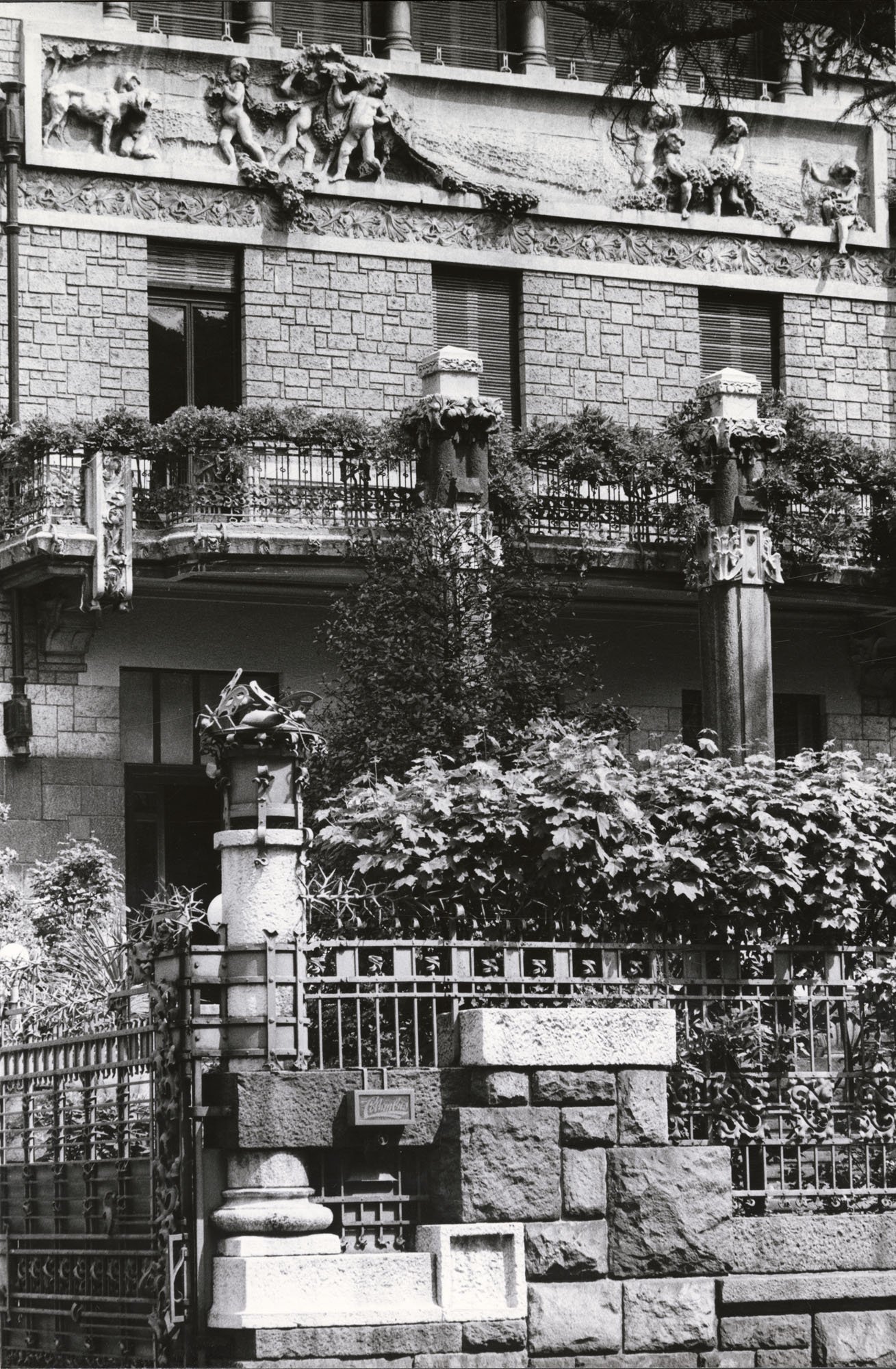
Designed by Giuseppe Sommaruga and completed in 1914, this Liberty masterpiece on Via Buonarroti shelters ironwork by Alessandro Mazzucotelli and sculptures once scandalous enough to be banished from Sommaruga’s celebrated Palazzo Castiglioni.
At a glance
Villa Romeo-Faccanoni stands at Via Michelangelo Buonarroti 48, in the Pagano quarter west of the city centre. Giuseppe Sommaruga built it between 1912 and 1914 for engineer Luigi Faccanoni, and it ranks among his major Milanese works. The three-storey stone façade is alive with sculptural ornament: wrought-iron balustrades, lanterns, gates and railings by the master blacksmith Alessandro Mazzucotelli frame every opening, while two female nude statues by Ernesto Bazzaro — removed from the portal of Palazzo Castiglioni after public protest over their nudity — found their permanent home here in 1914. The building is now the headquarters of Clinica Columbus, a private hospital. Its exterior and garden wall are visible from the street, and the entire complex is protected by the Soprintendenza per i Beni Architettonici.
Key facts
- Address: Via Michelangelo Buonarroti 48, 20145 Milan
- Architect: Giuseppe Sommaruga (1867–1917)
- Built: 1912–1914, for engineer Luigi Faccanoni
- Style: Italian Liberty (Art Nouveau)
- Ironwork: Alessandro Mazzucotelli (balustrades, lamps, railings, gates)
- Sculptures: Ernesto Bazzaro, 1914 (relocated from Palazzo Castiglioni)
- Current use: Clinica Columbus (private hospital); 1938–1940 addition by Gioà Ponti
- Protection: Vincolo Soprintendenza Belle Arti
History
In 1912 engineer Luigi Faccanoni commissioned Giuseppe Sommaruga to design a city villa that would reflect the ambitions of Milan’s industrial upper class. Sommaruga was at the height of his influence: Sommaruga’s celebrated Palazzo Castiglioni on Corso Venezia (1901–1904) had already made him the defining voice of Milanese Liberty, and the Faccanoni commission gave him room to refine the language on a residential scale. The building permit received legal approval in April 1913; the villa was completed the following year.
At the time of its completion two statues by sculptor Ernesto Bazzaro were installed on the façade. These were not new works: the same figures had originally adorned the entrance portal of Palazzo Castiglioni, where their frank nudity had provoked such public controversy that they were removed after public protest — earning Palazzo Castiglioni the ironic Milanese nickname “Ca’ di ciapp”. Sommaruga placed them here in 1914 without incident, perhaps because the Pagano neighbourhood was then less central and less scrutinised.
In 1919 the villa passed to Nicola Romeo, the engineer and industrialist who had acquired the Milanese carmaker A.L.F.A. in 1915 and renamed it Alfa Romeo in 1920. The property retained his name, and it is by the hyphenated form — Villa Romeo-Faccanoni — that the building is most commonly cited in heritage registers. Between 1938 and 1940, architect Gioà Ponti oversaw an extension and internal reorganisation that adapted the structure as a private clinic. The Clinica Columbus formally opened in 1949, named in honour of the Columbus Hospital founded in New York by the Lombard missionary Mother Cabrini at the close of the nineteenth century. The clinic has operated continuously on the site ever since, and the building has appeared in every edition of the FAI “I Luoghi del Cuore” campaign since 2016, a sign of persistent civic affection for a building that most Milanese know only from its street-facing facade.
What you see
The street facade rises three storeys in dressed stone, its surface animated rather than overwhelmed by ornament. Sommaruga works in the Liberty idiom without copying it from Paris or Vienna: the undulation is restrained, the mass solid, and the decoration concentrated at structurally legible points — cornices, window surrounds, balcony edges. Mazzucotelli’s ironwork is the building’s most tactile pleasure. Stand close to the gate on Via Buonarroti and the metalwork resolves into stems, tendrils and stylised leaves forged with a precision that makes cast iron look lazy by comparison. The two Bazzaro figures occupy a first-floor niche; stripped of their original scandal, they read now simply as confident sculpture in a confident facade.
The garden, which exceeds 2,000 square metres, creates an unusual urban breathing space around the building. The perimeter wall and gates are original, and the planting—visible above the wall in the warmer months—gives the complex a depth rare for a residential block this close to Milan’s inner ring. The Ponti extension to the rear is architecturally discrete: Ponti was too skilled to fight with what Sommaruga had built, and the clinical volumes he added are subordinated to the Liberty core from every public vantage point.
Practical information
- Access: Private clinic; interior not open to the public. The façade and gate are fully visible from the pavement on Via Buonarroti.
- Best viewing: Morning light falls on the main façade. The Mazzucotelli ironwork reads best from close range at the gate.
- Time needed: 10–15 minutes for an exterior visit; combine with the nearby Liberty route for a half-day walk.
- Photography: Permitted from the public pavement. No tripod required; the gate details reward a phone camera.
- FAI open days: The building occasionally opens for Giornata FAI d’Autunno (autumn); check fondoambiente.it for the annual programme.
Getting there
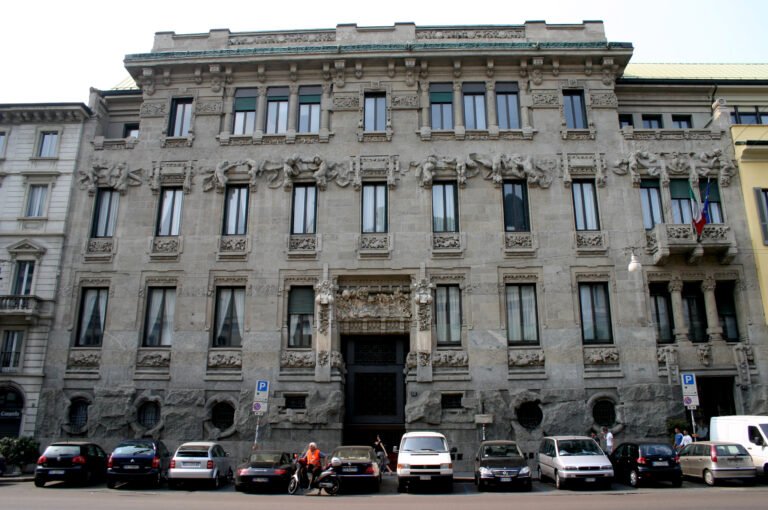
The villa is a five-minute walk from Pagano metro station (Line 2, green line). From the station exit on Via Pagano, head south-west along Via Buonarroti; number 48 is on the left after roughly 350 metres. By tram, lines 16 and 19 stop at Piazza Piemonte, a short walk east. Street parking is limited; arriving by public transport is strongly recommended. The building sits comfortably within a longer Liberty itinerary that takes in Palazzo Castiglioni (Corso Venezia) and Casa Galimberti, by Giovanni Battista Bossi, in the Porta Venezia district across the city.
Nearby
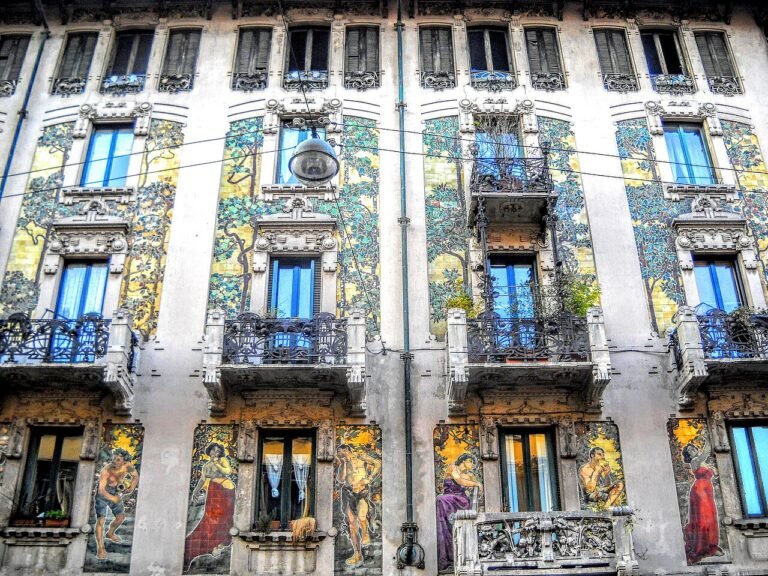
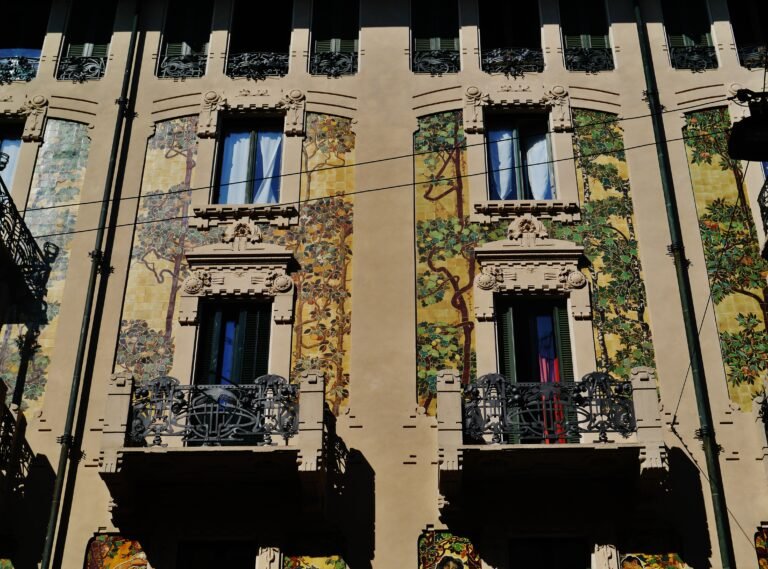
- Liberty Milano — CHO’s guide to the full Art Nouveau itinerary in the city, including Palazzo Castiglioni and Casa Galimberti (by Giovanni Battista Bossi, Porta Venezia).
- Palazzo Castiglioni (Corso Venezia 47, ~3.5 km) — Sommaruga’s most celebrated work, where the Bazzaro statues first stood.
- Parco Sempione (~800 m north-east) — Milan’s largest urban park, adjacent to the Castello Sforzesco and Triennale design museum.
- Fiera Milano City (Fieramilanocity, ~400 m) — the historic exhibition district that shaped this neighbourhood’s bourgeois residential character in the early twentieth century.
Sources
- Fondo Ambiente Italiano (FAI). I Luoghi del Cuore — Villa Romeo Faccanoni. fondoambiente.it. Accessed June 2026.
- Lombardia Beni Culturali. Villa Romeo Faccanoni, Via Michelangelo Buonarroti 48, Milano. lombardiabeniculturali.it. Accessed June 2026.
- Giuseppesommaruga.org. Villa Faccanoni Romeo. giuseppesommaruga.org. Accessed June 2026.
- Passipermilano. “Quattropassi nel Liberty: Villa Faccanoni Romeo, ora Casa di Cura Columbus.” passipermilano.com, 7 December 2021.
- Urbanfile. “Porta Vercellina — Villa Romeo capolavoro del Liberty.” blog.urbanfile.org, 14 February 2015.
Find it on the map
See this place and what’s around it →Record researched and written by Carla Szathvary for Cultural Heritage Online, 2026.

📷 Become a Cultural Heritage Online photographer
Share your photos of places: they stay published under your name as the author. The more they're seen, the more you get noticed — and soon a contest will reward the most appreciated photos.
Log in or sign up free to add a photoIs this page about you?
This page is read by travellers and heritage enthusiasts who find it on Google. Tell us how you are connected to this place and we will take it from there.