
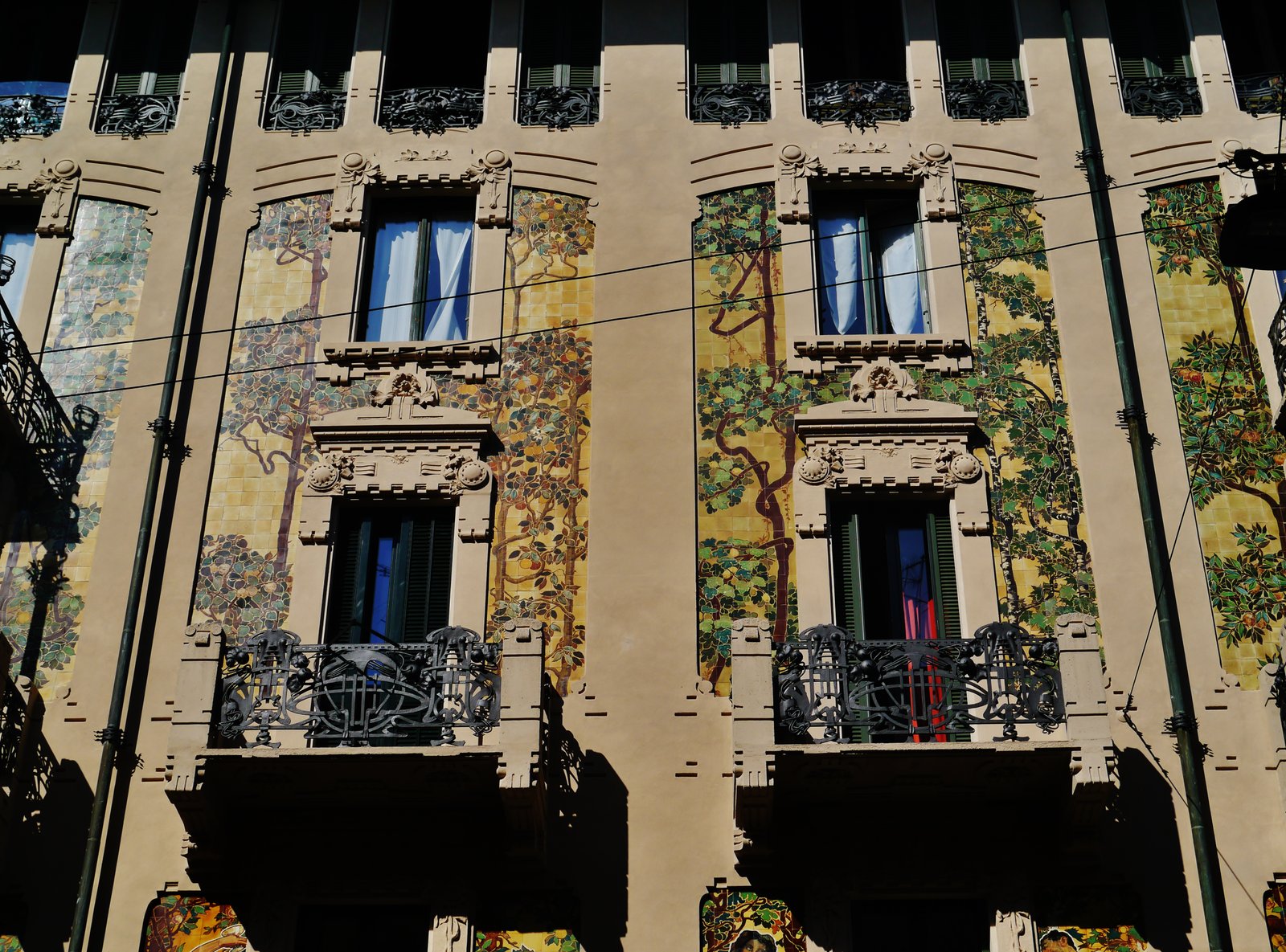
Milan holds the densest concentration of Italian Liberty — Italy’s name for Art Nouveau — of any city in the country. The buildings cluster in the Porta Venezia quarter northeast of the Duomo, where between roughly 1900 and 1915 a generation of architects turned residential facades into arguments in ceramic, wrought iron, and sculpted stone. This is a walking guide to the half-dozen buildings that define the route, part of CHO’s complete guide to Italian Liberty.
Start at Porta Venezia
Liberty Milan is a neighbourhood before it is a list of monuments. The streets radiating northeast from Porta Venezia — Via Malpighi, Via Melzo, Via Vincenzo Bellini — carry more Art Nouveau frontage per block than anywhere else in Italy. The style arrived here in the years around the turn of the century, when a prosperous bourgeoisie commissioned apartment buildings that announced their owners’ modernity through ornament rather than scale. The result reads as a single coherent chapter, walkable in an afternoon.
Four materials recur. Polychrome ceramic, hammered botanical ironwork, sculpted stone moulding, and frescoed surface. The ironwork is the quickest tell from street level, and one name lies behind much of it: Alessandro Mazzucotelli, the leading Art Nouveau blacksmith in Italy, whose iris-and-wisteria railings appear across the quarter.
Palazzo Castiglioni: the public face of Milanese Liberty
Palazzo Castiglioni on Corso Venezia 47–49 is where the style found its public voice. Giuseppe Sommaruga (1867–1917) built it between 1900 and 1903, and it set the standard for what a full-dress Italian Liberty facade could do: figurative sculpture at the portal, dense low-relief ornament across the upper floors, a composition that manages its own exuberance without tipping into excess. It argued, in stone, with the academic facades around it — and won.
Via Malpighi: ceramic and iron
A short walk away, two buildings face the Liberty visitor on the same street. Casa Galimberti at Via Malpighi 3, designed by Giovan Battista Bossi and completed in 1905, sheathes its entire five-storey front in polychrome majolica panels executed by the Milanese firm Brambilla e Pinzanti. Terracotta women in flowing robes and peacock-feather fields turn the building into a sustained statement in colour rather than a conventional apartment block.
At the corner of Via Malpighi and Via Melzo stands Casa Guazzoni, also by Bossi, built between 1904 and 1906 for Giacomo Guazzoni. Here Mazzucotelli’s wrought iron and Paolo Sala’s frescoed putti share a single decorative vision — the most disciplined Liberty corner in the quarter. The 2022 facade restoration brought its cement relief back to legibility.
Casa Campanini, by its own architect
Casa Campanini on Via Vincenzo Bellini 11, a block from La Scala, is the house Alfredo Campanini built for himself between 1904 and 1906. Given his own brief, the architect pushed every surface — portal, parapet, staircase — to its ornamental limit. Two allegorical figures in artificial stone frame the entrance; the tangled floral ironwork of the gate is attributed to Mazzucotelli. It is Milanese Liberty at its most confident, an architect designing for the one client he could never disappoint.
Villa Romeo-Faccanoni: Sommaruga’s late statement
West of the centre, in the Pagano quarter, Villa Romeo-Faccanoni at Via Buonarroti 48 closes the Milanese Liberty story. Sommaruga built it between 1912 and 1914 for the engineer Luigi Faccanoni, late in both his career and the movement. Mazzucotelli’s balustrades, lanterns and gates frame every opening of the three-storey stone facade. The building now houses the Clinica Columbus, a working hospital wrapped in one of the city’s richest Liberty envelopes.
Walk the route on the map
CHO documents each of these buildings with a sourced editorial card — architecture, history, GPS, and photography. The wider arc of the city, from Liberty through Rationalism to post-war design, is traced in the Milan city guide. To plan the walk, open the interactive map and let the cluster view reveal the Porta Venezia concentration.
Open the interactive Art Nouveau map →
Frequently Asked Questions
Where is the best Art Nouveau (Liberty) architecture in Milan?
The Porta Venezia quarter, northeast of the city centre, has the highest concentration. Casa Galimberti and Casa Guazzoni stand on Via Malpighi, Palazzo Castiglioni on Corso Venezia, and Casa Campanini on Via Vincenzo Bellini. Most are private residences viewed from the street.
Who were the main Milanese Liberty architects?
Giuseppe Sommaruga (1867–1917), who built Palazzo Castiglioni and Villa Romeo-Faccanoni; Giovan Battista Bossi (1864–1924), architect of Casa Galimberti and Casa Guazzoni; and Alfredo Campanini, who designed his own house on Via Bellini. The ironwork on several of these buildings is by the master blacksmith Alessandro Mazzucotelli.
Can you visit Milan Liberty buildings inside?
Most are private apartment blocks or active institutions, so the facades are the experience. Casa Galimberti, Casa Guazzoni, Casa Campanini and Palazzo Castiglioni are all admired from the street. Villa Romeo-Faccanoni now operates as the Clinica Columbus.
Sources used in this article
- CHO place_card Palazzo Castiglioni — Sommaruga (1867–1917), 1900–1903, Corso Venezia 47–49.
- CHO place_card Casa Galimberti — Giovan Battista Bossi, completed 1905, Via Malpighi 3, Brambilla e Pinzanti majolica.
- CHO place_card Casa Guazzoni — Bossi (1864–1924), 1904–1906, Mazzucotelli ironwork, Paolo Sala frescoes.
- CHO place_card Casa Campanini — Alfredo Campanini, 1904–1906, Via Vincenzo Bellini 11.
- CHO place_card Villa Romeo-Faccanoni — Sommaruga, 1912–1914, Via Buonarroti 48, now Clinica Columbus.


