
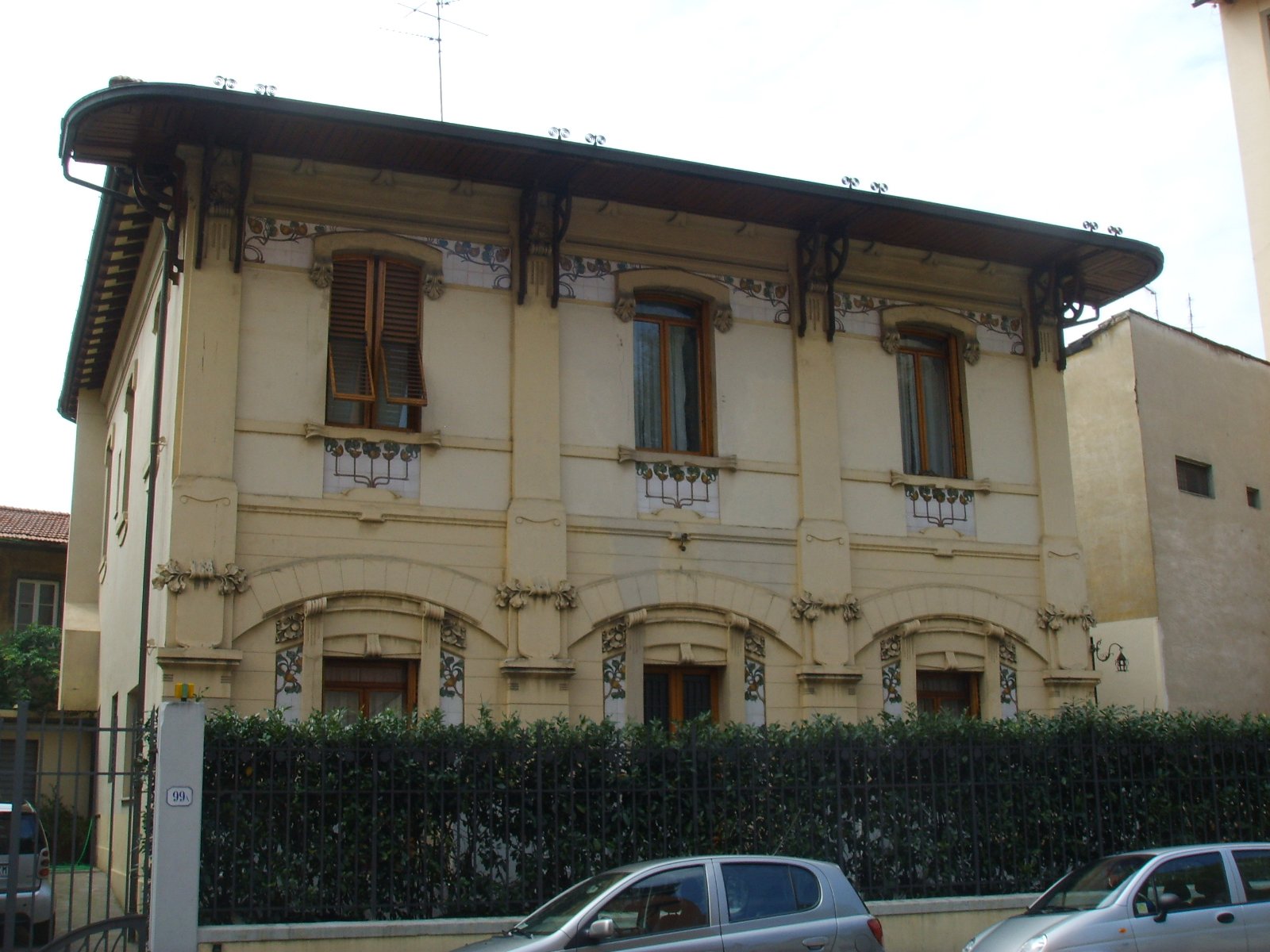
A rare survivor of Florentine Liberty: Giovanni Michelazzi’s 1907 villa for Ettore Ravazzini, its facade alive with Galileo Chini’s hand-painted ceramic blooms.
At a glance
Villino Ravazzini stands at Via Scipione Ammirato 101 in the Oltrarno district of Florence, a compact residential villa completed in 1907 to a design by Giovanni Michelazzi. Its three-bay facade is one of the most concentrated displays of Liberty ornament in the city: Galileo Chini’s polychrome ceramic panels animate every surface between the pilaster strips, while wrought-iron corbels carry a projecting eave cornice overhead. The building is privately owned and best admired from the pavement.
Key facts
- Address: Via Scipione Ammirato 101, 50132 Florence (Oltrarno)
- Architect: Giovanni Michelazzi (1879–1920)
- Ceramic artist: Galileo Chini (Arte della Ceramica)
- Built: 1907, by contractor Gherardelli & Co.
- Commissioner: Ettore Ravazzini
- Style: Italian Liberty / Art Nouveau
- Protection: Listed building (Decreto MiC), privately owned
History
Giovanni Michelazzi was born in Rome on 11 July 1879 and trained there before settling in Florence in the early 1900s, at a moment when the city’s prosperous bourgeoisie was eager to replace the stolid historicism of late-nineteenth-century residential architecture with something altogether more spirited. The Liberty movement — Italy’s inflection of the international Art Nouveau wave — offered exactly that: sinuous plant forms, the total integration of craft and construction, and a programmatic refusal to quote from the past. Michelazzi would become a leading figure of Florentine Liberty, completing a body of work between roughly 1905 and 1920 that ranks among the most consistent and inventive of any architect working in the city during those years.
The Ravazzini commission came in 1906. Ettore Ravazzini, a local entrepreneur, owned a plot in the quiet residential zone south of the Arno that had been opening up to development since the late nineteenth century. Michelazzi produced a design that retained the conventional volumetric envelope of a Florentine villino — three bays, two principal storeys above a rusticated base, a shallow pitched roof — while dissolving every surface between the structural elements into decorative incident. The construction contract went to the Gherardelli company, and the building was complete by 1907.
The ceramics were entrusted to Galileo Chini, whose firm Arte della Ceramica (later known as Fornaci San Lorenzo) had by then supplied decorative programmes to some of the most ambitious Liberty interiors in Tuscany. For Villino Ravazzini, Chini produced polychrome panels of stylised floral ornament — wisteria, iris, and abstract vegetal scrolls — that fill the spandrels and friezes between the four pilaster strips of the facade. The chromatic palette, running from warm terracotta through sage green and cobalt blue, gives the building a warmth and immediacy that photographs struggle to convey.
Like most of Michelazzi’s work, the villino passed out of public attention almost as soon as Liberty fell from critical favour after the First World War. Several of his buildings in Florence were demolished in the post-war decades. Villino Ravazzini survived, passing through private ownership without significant exterior alteration. It was eventually listed by the Ministero dei Beni Culturali as a building of historical and artistic interest, which has since protected it from unsympathetic modification. Scholarly attention returned in the 1980s and 1990s, when Italian architectural historians began reassessing the Liberty heritage; the villino now features in most serious accounts of Florentine fin-de-siècle architecture and in the itineraries published by Italia Liberty.
What you see
The facade is organised around four shallow pilaster strips that run the full height of the building and frame three bays. In the lower register, three arched windows sit within the central and outer bays; the arches spring from capitals decorated with carved floral motifs, and the spandrels between them carry Chini’s ceramic insets. A string course at first-floor level, picked out in a contrasting colour, separates the lower storey from the piano nobile, where three rectangular windows are framed by further ceramic bands and capped by a wrought-iron festoon. The projecting eave cornice above rests on iron corbels of foliate design.
The street-level enclosure — a low wall and entrance gate in refined wrought iron — belongs to the same aesthetic programme as the building itself, extending the Liberty vocabulary all the way to the pavement edge. The overall effect is tightly controlled: every element, from the rusticated plinth to the terminal cornice, contributes to a composition that is ornamental without being chaotic, and deeply Florentine in its chromatic restraint despite its stylistic exuberance.
Practical information
- Ownership: Privately owned — interior not accessible to visitors
- Viewing: Facade fully visible from the pavement of Via Scipione Ammirato
- Nearest bus: ATAF line 23 — stop Via Giosuè Carducci (3 min walk); line 38 — stop Via Maragliano
- Nearest tram: Tramvia T1 — Morgagni stop (~12 min walk)
- Recommended visit time: 10–15 minutes (exterior viewing)
- Best light: Morning hours (east-facing facade)
Getting there
From the historic centre, cross the Arno via Ponte alle Grazie or Ponte San Niccolò and head south-east along Via Giosuè Carducci, then turn left onto Via Scipione Ammirato. The villino is at number 101, roughly a ten-minute walk from the Ponte alle Grazie. By bus, ATAF line 23 from the city centre stops on Via Carducci within a short walk of the address. Parking is limited on the surrounding streets; arriving on foot or by public transport is strongly recommended.
Nearby
- Villino Broggi-Caraceni — another Michelazzi Liberty villa at Via Scipione Ammirato 99, next door (1911), with a notably different decorative programme
- Casa-Galleria Vichi — Michelazzi’s most celebrated Liberty building, at Borgo Ognissanti 26 near the Arno (1910–11), an essential companion piece
- Villino Lampredi (Via Giano della Bella 9 & 13) — two further Michelazzi Liberty villini with Chini ceramics, a short walk north-east in the same Oltrarno residential zone
- Piazzale Donatello — nearby garden square with the English Cemetery, a quiet green space for recovering from ornamental saturation
Sources
- Palazzo Spinelli, Repertorio delle Architetture Civili di Firenze — Villino Ravazzini, scheda ID 1877. palazzospinelli.org
- Italia Liberty, Villino Ravazzini a Firenze (with note on Galileo Chini ceramics). italialiberty.it
- Itinerario Liberty, Villino Ravazzini a Firenze. itinerarioliberty.it
- Google Arts & Culture, Villino Ravazzini in Florence, Italy — Giovanni Michelazzi. artsandculture.google.com
- Wikipedia (it), Villino Ravazzini. it.wikipedia.org
Find it on the map
See this place and what’s around it →Record researched and written by Carla Szathvary for Cultural Heritage Online, 2026.
📷 Become a Cultural Heritage Online photographer
Share your photos of places: they stay published under your name as the author. The more they're seen, the more you get noticed — and soon a contest will reward the most appreciated photos.
Log in or sign up free to add a photoIs this page about you?
This page is read by travellers and heritage enthusiasts who find it on Google. Tell us how you are connected to this place and we will take it from there.