Along the Adriatic south of Rimini stands one of the most peculiar building types Italian Rationalism ever produced: the colonia marina, the monumental seaside camp. Through the 1930s the regime sent hundreds of thousands of inland children to the coast for a few summer weeks of sun, salt water and political drill, and it housed them in vast modern structures designed by serious architects. Many now stand abandoned; a few have been spectacularly reborn. All of them are pure, strange Rationalism by the sea.
A building type invented for propaganda
The colonie marine were never only about health. By the late 1920s the Adriatic coast had become the favoured stretch for these summer camps, where children from inland provincial cities arrived by train to spend supervised weeks of beach, marches and indoctrination under the banners of the regime’s mass organisations. The brief was unusual for any architect: house hundreds or thousands of children at once, on an open shore, in a single building that had to function as dormitory, refectory and stage set. The answer, again and again, was Rationalism — reinforced concrete, ribbon windows, flat roofs, primary volumes — pushed to a scale no private client would ever commission.
Cattolica: a fleet at anchor
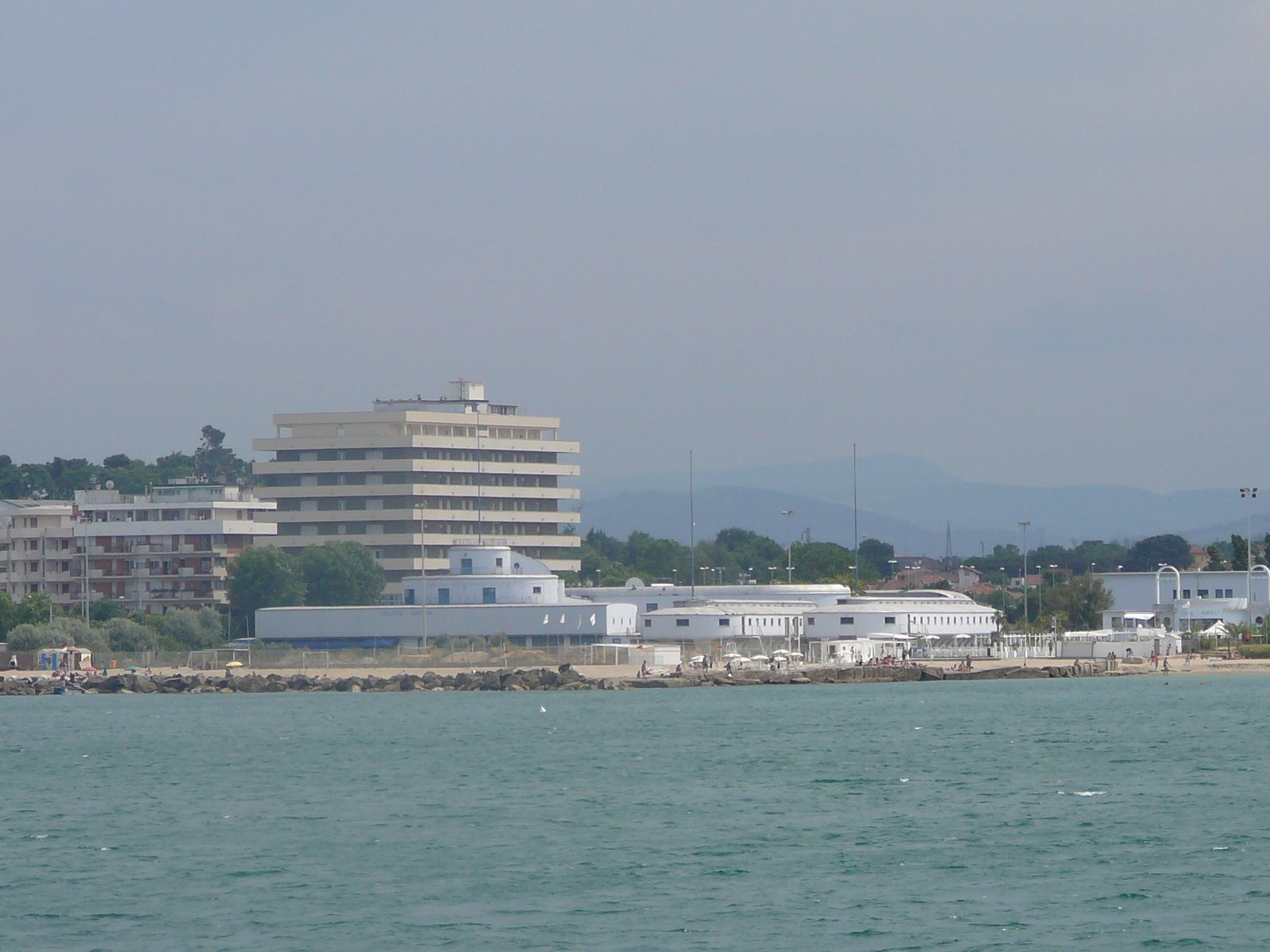
The most famous of them turns the metaphor literal. The Colonia XXVIII Ottobre at Cattolica, known simply as Le Navi — the ships — was designed by the Roman architect Clemente Busiri Vici and built between 1932 and 1934 for the Fascist Federation of Rome. Busiri Vici laid out five long pavilions in parallel, each with a curved prow facing the sea and a flat stern toward the pinewood, aligned with surgical precision like a squadron at anchor. Where Terragni in Como kept his geometry abstract, here the building was allowed to read as a literal fleet, ribbon windows running like decks along each hull. It is the clearest example of how Italian Rationalism could swing between pure modernist syntax and outright scenography. Today the five hulls hold the Acquario di Cattolica, the largest aquarium on the Adriatic — one of the few colonies of the period fully restored and re-used rather than left to rot.
Milano Marittima: Rationalism at liner scale
A few kilometres up the coast, the Colonia Varese shows the type at its most monumental. Designed in 1937 by Mario Loreti for the Fascist Federation of the landlocked province of Varese, and opened in 1939 just months before the war, it was built to host roughly a thousand children at a time on the pinewood-backed shore of Milano Marittima. Loreti organised the whole complex around an uncompromising central axis: a monumental reinforced-concrete core of ramps and stairs, flanked by service wings, with two five-storey dormitory blocks lined up like ocean liners alongside the trees. The plan reads almost as a diagram — rigorous symmetry, identical repeated bays, no ornament — and the result is one of the largest pieces of seaside Rationalism ever realised. For most of the post-war era it has stood empty, a giant beached on its own beach.
Riccione: industry by the sea
Not every colony came from a party federation. The Colonia Dalmine at Riccione was an act of paternalistic industry: in 1935 a welfare company tied to the Dalmine steelworks bought a coastal lot to give its workers’ children a summer by the sea, away from the smoke of the Bergamo factory town. The commission went in 1936 to Giovanni Greppi, who had already designed the Dalmine company town itself, and the building went up in just five months. Greppi belonged to the Milanese Novecento — the movement that pursued classical order against the avant-garde — and the Dalmine colony absorbs the Rationalist vocabulary of the coast without quite surrendering that gravity: flat, lightly framed elevations and ribbon openings, but calmer and more solid than Busiri Vici’s theatrical fleet. Listed as cultural heritage in 2002, it is now being converted into a luxury hotel.
Why they still matter
The colonie marine are the most honest record of how Italian Rationalism served the regime. They were machines for shaping children, and their architecture — clear, rational, sometimes beautiful — was bent to that purpose. Reading them now means holding two things at once: genuine architectural quality and the uses it was put to. The three on this stretch of coast make the lesson unusually vivid, from the reborn aquarium at Cattolica to the silent giant at Milano Marittima. They are well worth the short drive between them — and worth the discomfort.
Sources
- CHO place cards (verified): Colonia Le Navi, Cattolica; Colonia Varese, Milano Marittima; Colonia Dalmine, Riccione.
- Wikipedia (Italian) — Clemente Busiri Vici, Colonia marina, Mario Loreti, Giovanni Greppi.