
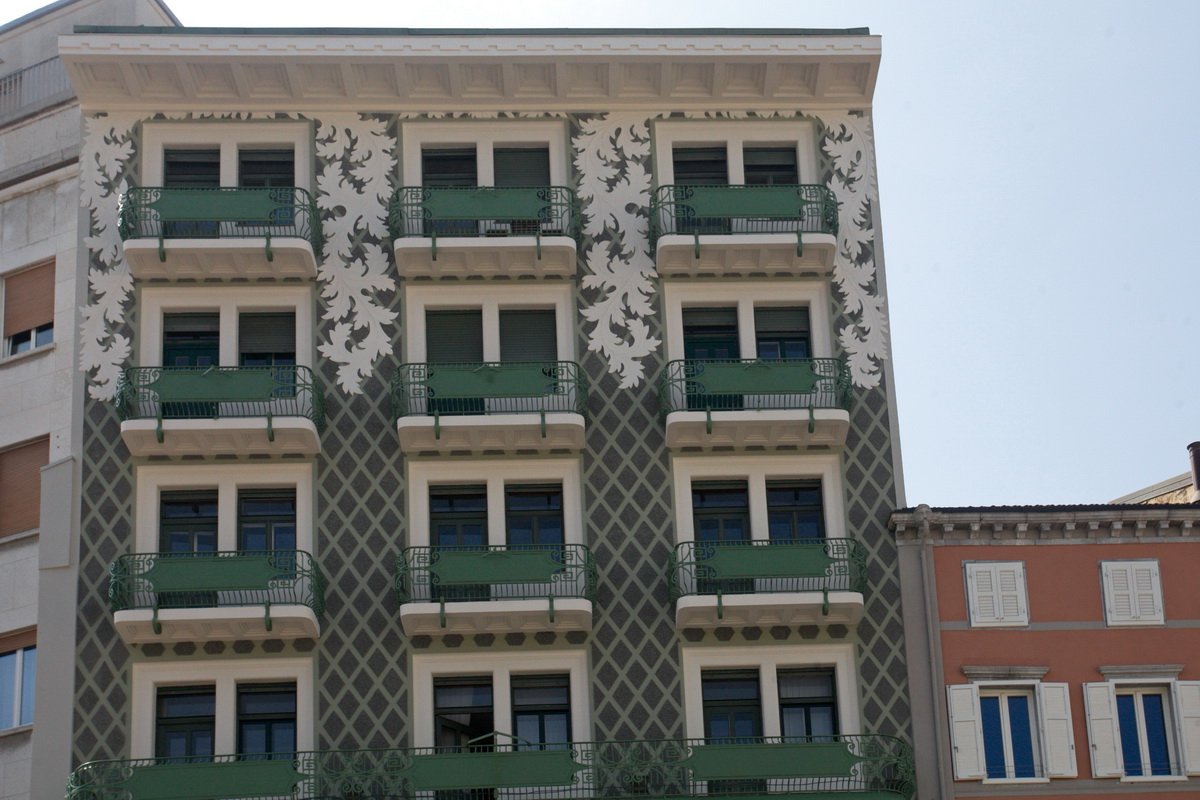
A landmark of Viennese Secession Liberty in Trieste, Casa Bartoli rises at Piazza della Borsa with cascading acanthus ornament and iron-lattice balconies that mark Max Fabiani at his most inventive.
At a glance
Completed in 1906 to a design by Max Fabiani, Casa Bartoli occupies a prominent corner on Piazza della Borsa in central Trieste. Its reinforced-concrete frame — novel for the period — is clad in a facade of diamond-patterned intonaco animated by four cascading stone acanthus-leaf columns and delicate green-painted iron railings. The building served as a mixed commercial and residential address from the outset, and it remains one of the clearest demonstrations of Central European Secession influence on the Adriatic coast.
Key facts
- Architect: Max Fabiani (1865–1962), assistant to Otto Wagner, Vienna
- Built: 1905–1906
- Address: Piazza della Borsa 7, 34121 Trieste (corner Via delle Beccherie)
- Style: Liberty / Viennese Secession
- Structure: Reinforced concrete with rendered (intonaco) facade — early use in Trieste
- Known locally as: “Casa Verde” (the green house), for its iron railings
- Current use: Mixed residential and commercial use, with ground-floor retail
History
Max Fabiani was born near San Daniele del Carso (Kobdilj, in present-day Slovenia) in 1865, trained at the Vienna Polytechnic, and went on to work as an assistant to Otto Wagner — the architect who defined the Viennese Secession’s built language of rational geometry and organic ornament. When the Bartoli family commissioned a new commercial building on Piazza della Borsa, they turned to Fabiani at a moment when Trieste, then the Habsburg Empire’s main Adriatic port, was hungry for modern prestige architecture. The result, completed in 1906, would become the building most often cited as the finest example of the Secession style in the city.
The building’s program was emphatically mixed-use. The lower three floors housed the depot of Antonio Bartoli & Figlio, a manufacturing merchant house whose name the building still carries, along with street-level shops. The glazed winter-garden verandah on the third floor accommodated a kosher restaurant that served Trieste’s substantial Jewish community, its glass walls allowing diners to look out across the busy square below. Upper floors provided residential apartments typical of the era’s bourgeois demand for urban living.
Through the 1930s the building’s commercial tenants shifted as Trieste’s economic position changed under Italian sovereignty. The original entrance, positioned on the left flank of the facade, was relocated to a side wall during this period, with a shop occupying the old opening. The political turbulence of the mid-twentieth century left the building physically intact; by the postwar decades it had settled into a quiet rhythm of retail and residential tenancy.
Today Casa Bartoli remains in mixed residential and commercial use. The building’s prominence on Piazza della Borsa, directly beside the Borsa Vecchia (the former stock exchange), ensures it remains a daily reference point for residents and visitors alike, its acanthus cascades as vivid today as they were at the building’s inauguration.
What you see
Standing in Piazza della Borsa and looking up, the eye is drawn first to the four vertical runs of carved stone acanthus leaves that flow down the upper facade like frozen waterfalls of foliage — a signature motif that links Fabiani’s design to the botanical ornament of the Vienna Secession while giving the building an almost sculptural weight. Between these cascades, the surface is dressed in a geometric diamond pattern of lightly textured intonaco, a contrast of restless surface and measured grid. The cornice above is coffered in lightweight cement, its shadow lines changing character as Trieste’s afternoon light swings in off the Adriatic.
At street level, three wide commercial openings span the ground floor in the manner of a late-Habsburg arcade front. Above, the iron balcony railings — painted a distinctive green, giving the building its local nickname — are filled with geometric latticework rather than the flowing vegetal curves one might expect: Fabiani is already leaning toward the rational discipline that would characterise later Secessionist work. The glazed verandah at the third floor, once a winter garden and restaurant, still reads as a transparent horizontal band slicing through the facade, its cast-iron detailing intact.
Practical information
- Privately owned; interior not open to the public
- Facade fully viewable from Piazza della Borsa (open square, no entry required)
- Best light for photography: morning, with the facade facing south-east
- Nearest bus: lines 6, 9, 10, 11 — stop Piazza della Borsa / Riva Tre Novembre
- Walking time from Trieste Centrale railway station: approximately 10 minutes on foot
Getting there
Casa Bartoli stands at Piazza della Borsa 7 in Trieste’s historic centre, a ten-minute walk from Trieste Centrale railway station heading south-west along Corso Cavour and then Via Cassa di Risparmio. The piazza is pedestrian-friendly and the building is immediately recognisable by its green iron railings and the cascading stone acanthus ornament on the upper floors. Street parking is limited in the area; the nearest car park is Garage Trieste Centrale (Via Ghega).
Nearby
- Liberty Trieste — the wider Liberty / Secession district of the city, with a concentration of early twentieth-century facades within walking distance
- Borsa Vecchia (Piazza della Borsa) — the neoclassical former stock exchange immediately adjacent, now the Chamber of Commerce
- Molo Audace — the historic pier on the waterfront, a five-minute walk, offering views back to the city skyline
- Museo Revoltella — Trieste’s gallery of modern art, approximately 600 m north, with works spanning the Habsburg and Italian periods
Sources
- Comune di Trieste — Beni Culturali: Fabbricato di Piazza della Borsa 7, Casa Bartoli, scheda ID 366139. beniculturali.comune.trieste.it
- InTrieste: “From a Kosher Restaurant to Independentists’ Headquarters: Casa Bartoli Remains the Art Nouveau Jewel of Trieste,” August 2024. intrieste.com
- Arte Liberty Italia: Trieste — Casa Bartoli. arteliberty.it
- Grande Flanerie: Trieste Secession (Liberty). grandeflanerie.com
- Trieste Metro POI 44 — Casa Bartoli. triestemetro.eu
Find it on the map
See this place and what’s around it →Record researched and written by Carla Szathvary for Cultural Heritage Online, 2026.
📷 Become a Cultural Heritage Online photographer
Share your photos of places: they stay published under your name as the author. The more they're seen, the more you get noticed — and soon a contest will reward the most appreciated photos.
Log in or sign up free to add a photoIs this page about you?
This page is read by travellers and heritage enthusiasts who find it on Google. Tell us how you are connected to this place and we will take it from there.