
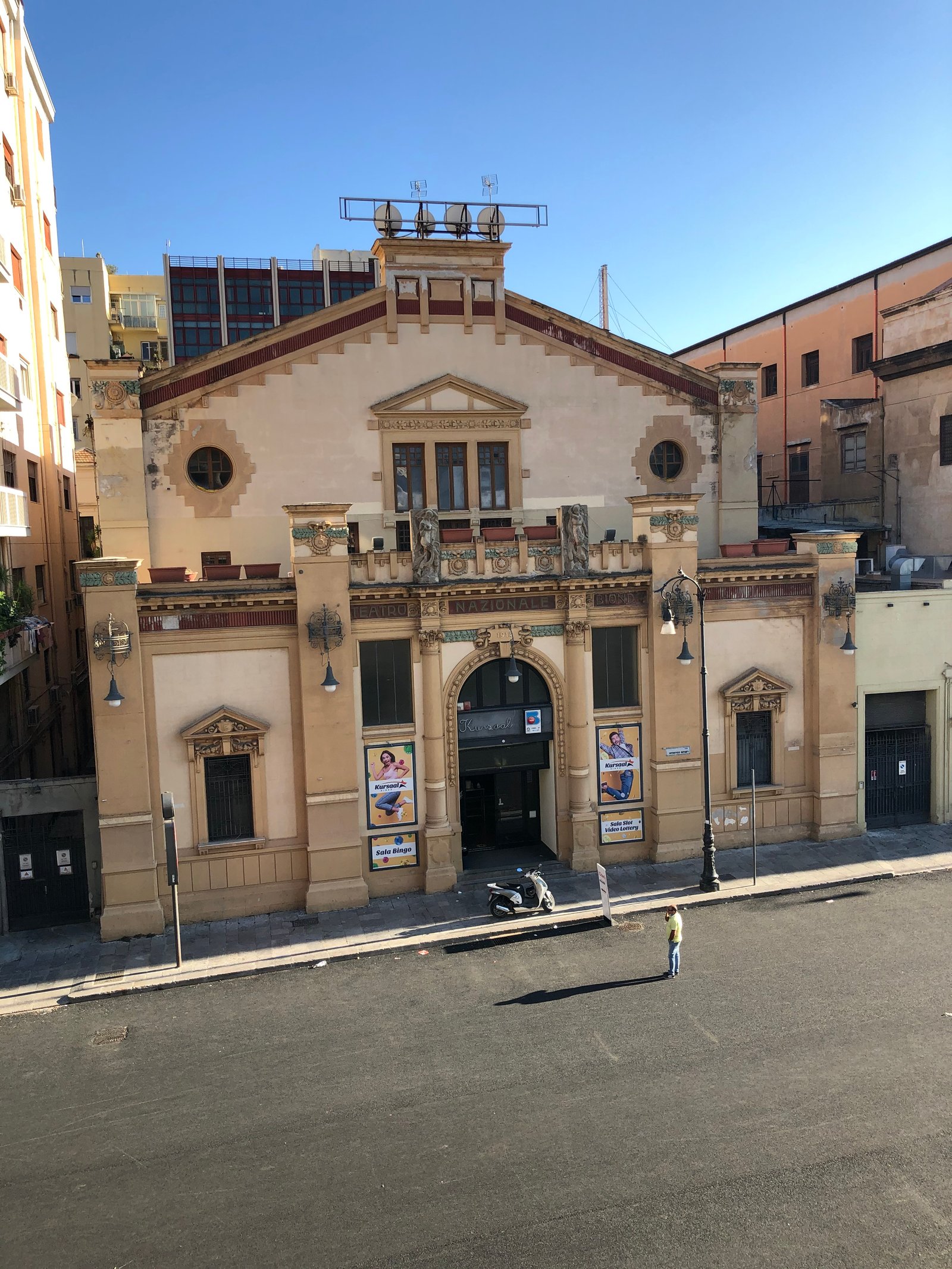
Ernesto Basile’s 1914 Belle Époque pleasure complex in Palermo—cinema, garden, café and concert loggia woven into one Liberty masterwork for the Biondo brothers.
At a glance
Inaugurated on 19 September 1914 at the corner of Via Emerico Amari and Piazza Ruggero Settimo, the Kursaal Biondo was Palermo’s most ambitious Belle Époque entertainment venue. Designed by Ernesto Basile for the Biondo brothers, the 4,520-square-metre complex brought together a cinema-theatre, a landscaped garden, a café, a restaurant, a billiard room and an open-air concert loggia under one unified Liberty vision. Two sinuous allegorical female figures—Allegories of Dance—placed as acroteria above the entrance attic wall give the facade its most celebrated ornamental accent; they are attributed to the sculptor Archimede Campini (attribution pending archival confirmation). The building survives as one of Basile’s few large-scale public entertainment works and a landmark of Sicilian Stile Liberty.
Key facts
- Architect: Ernesto Basile (1857–1932)
- Commissioned by: The Biondo brothers
- Construction: 1913–1914; inaugurated 19 September 1914
- Style: Stile Liberty (Italian Art Nouveau)
- Original area: 4,520 m²
- Address: Via Emerico Amari 168, 90139 Palermo
- Sculptor: Attributed to Archimede Campini (decorative figures on facade)
History
By the turn of the twentieth century, Palermo was undergoing one of its most sustained periods of architectural reinvention. The ruling bourgeoisie, enriched by trade and ambition, commissioned a generation of architects to dress the city in the sinuous ornament of the new Liberty style. Ernesto Basile, who had already transformed the Villino Florio and extended the Palazzo dei Normanni, stood at the centre of this movement. When the Biondo brothers approached him around 1912 with plans for a multi-programme leisure complex on Via Emerico Amari, they gave him an unusually open brief: build something that would anchor Palermo’s cultural life for a generation.
Basile answered with a design that wove pleasure, culture and sociability into a single organism. The main building housed a cinema-theatre of generous proportions, flanked by a café, a restaurant and a billiard room. Beyond the covered spaces, a landscaped garden provided outdoor respite, while a porticoed loggia served open-air concerts and performances. Every element was bound together by Basile’s confident Liberty hand: curved ironwork, floral ceramic panels, and the show-stopping pair of bronze-toned female allegories attributed to Archimede Campini, set against the entrance attic wall.
The Kursaal Biondo opened on 19 September 1914, barely six weeks after the outbreak of the First World War—an act of civic optimism against a darkening European sky. Through the silent-film era, the talkies, and the postwar decades of Italian cinema, the Biondo remained one of the principal entertainment venues in the city. Its programme ranged from film to live theatre to concerts, making it a genuine civic anchor rather than a mere commercial operation.
The twentieth century was less kind to many of its original functions. The garden pavilions disappeared, the restaurant closed, and successive owners rationalised the interiors. In July 2016, the venue was closed by authorities following investigations linked to the building’s ownership; it later reopened in a reduced form. Today the ground floor operates as a bingo hall, carrying the name Kursaal forward even as the cinema-theatre function lies dormant. The façade, with the allegorical dancers still presiding from their attic perch, remains one of Palermo’s most recognisable Liberty streetscapes.
What you see
The street elevation is organised as a bold two-storey composition with a projecting central avant-corps marking the main entrance. Above the doorway, the attic wall carries the allegorical figures attributed to Campini—two supple female figures with arms outstretched, their drapery caught mid-movement in the manner of Loie Fuller. The surrounding ornament plays on botanical motifs typical of Basile’s mature Liberty work: stylised tendrils, cartouches and ironwork balconettes that give the masonry surface a lively, handcrafted texture.
The interior retains fragments of its original configuration, including arched bays and decorative plasterwork in the theatre volume, though successive alterations have substantially modified the original plan. The garden to the rear, once integral to the complex’s identity, is now largely built over. The loggia arcade along the garden frontage, however, still reads in elevation, hinting at the outdoor spectacle culture that the Biondo brothers and Basile envisioned.
Practical information
- Current use: Ground floor operates as a bingo hall (Bingo Kursaal); the historic theatre is not in regular public use
- Address: Via Emerico Amari 168, 90139 Palermo
- Exterior viewing: Freely accessible from the street at any time
- Nearest transit: Bus stops on Via Emerico Amari (lines 101, 102, 103); Palermo Centrale railway station approx. 1.2 km on foot
- Suggested visit time: 10–15 minutes for the facade; combine with the Liberty circuit along Via Libertà
Getting there
The Kursaal Biondo sits at the edge of Palermo’s historic centre, a short walk north-west of the Politeama Garibaldi theatre and about eight minutes on foot from the Quattro Canti. From Palermo Centrale station, take bus 101 or 102 towards Via Emerico Amari, or walk the 1.2 km along Via Roma and Via Cavour in approximately 15 minutes. Paid street parking is available on adjacent streets; the ZTL (limited-traffic zone) boundary is a short distance to the south.
Nearby
- Liberty Palermo — the full Art Nouveau circuit
- Teatro Politeama Garibaldi (0.3 km north) — Palermo’s other great Belle Époque theatre
- Villino Florio all’Olivuzza (2 km west) — Basile’s finest residential Liberty work
- Palazzo dei Normanni / Cappella Palatina (1.5 km south) — Norman-Byzantine masterpiece
Sources
- Google Arts & Culture / UNESCO Italy Youth Committee, Ex Cine-Teatro Kursaal Biondo — artsandculture.google.com
- Wikimedia Commons, Category: Kursaal Biondo (Palermo) — commons.wikimedia.org
- Art Nouveau World, ex Kursaal Biondo — art.nouveau.world
- Soprintendenza Beni Culturali Sicilia / Visit Sicily, Treasure Maps vol. 13 — visitsicily.info
- Wikipedia, Ernesto Basile — en.wikipedia.org
Find it on the map
See this place and what’s around it →Record researched and written by Carla Szathvary for Cultural Heritage Online, 2026.
📷 Become a Cultural Heritage Online photographer
Share your photos of places: they stay published under your name as the author. The more they're seen, the more you get noticed — and soon a contest will reward the most appreciated photos.
Log in or sign up free to add a photoIs this page about you?
This page is read by travellers and heritage enthusiasts who find it on Google. Tell us how you are connected to this place and we will take it from there.