
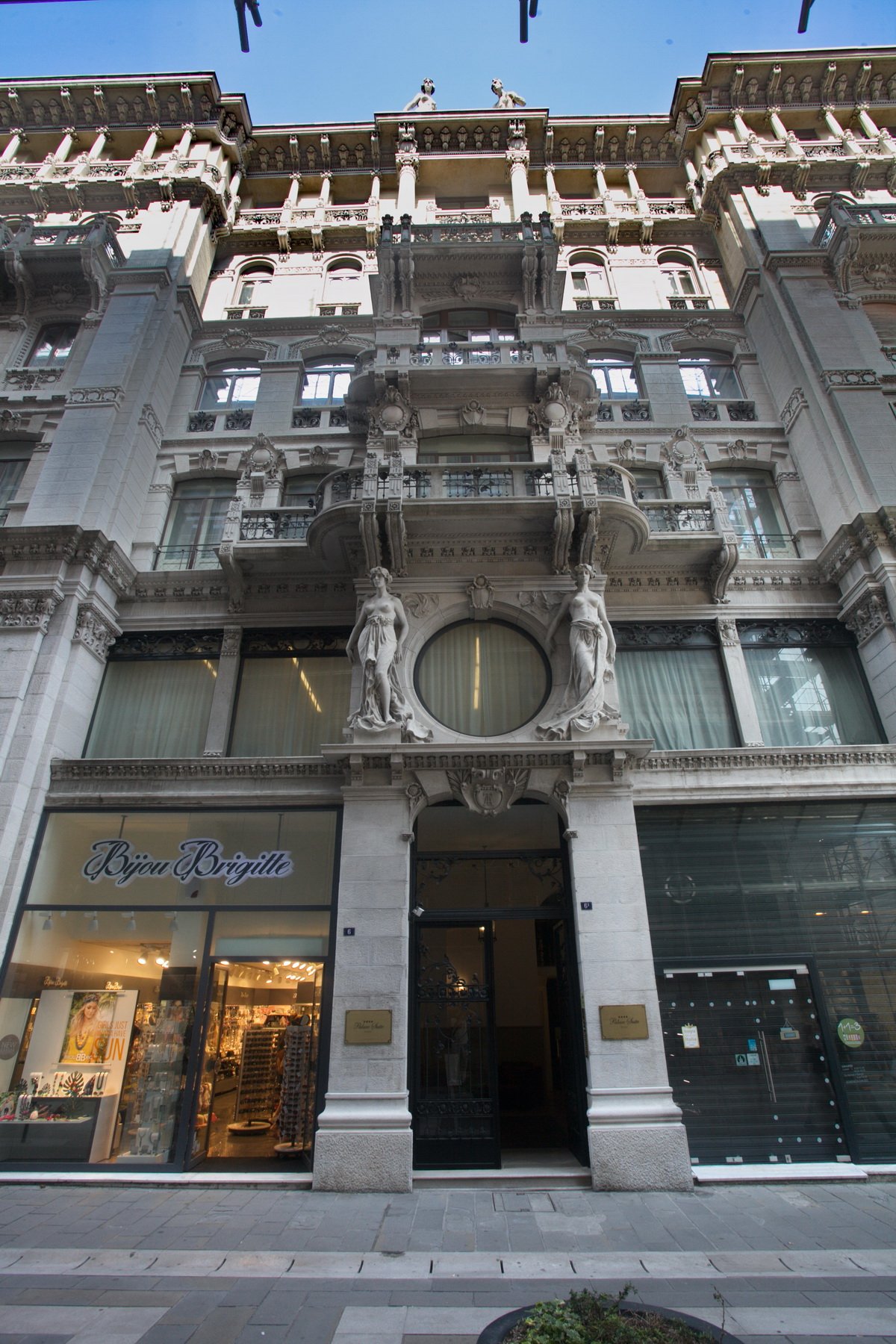
A showpiece of Triestine Liberty, Casa Terni-Smolars wraps its corner plot in sculptural reliefs and floral ornament — the mature signature of architect Romeo Depaoli.
At a glance
Completed in 1906 on Via Dante Alighieri 6 in Trieste’s Borgo Teresiano, Casa Terni-Smolars is one of the finest Art Nouveau buildings in the city. Designed by Romeo Depaoli — Trieste’s foremost Liberty architect — and embellished with sculptural work attributed to the sculptor Romeo Rathmann, the building commissioned by the Terni family stands as a landmark of the style where Italian floral Liberty meets the sobriety of Viennese Secession.
Key facts
- Architect: Romeo Depaoli (1876–1916)
- Sculptor: Attributed to Romeo Rathmann (facade reliefs)
- Commissioned by: The Terni family
- Year completed: 1906
- Address: Via Dante Alighieri 6, Trieste (corner Via Mazzini / Via San Nicolò)
- Style: Liberty / Art Nouveau with Secessionist accents
- Neighbourhood: Borgo Teresiano
History
When Romeo Depaoli drew up the plans for Casa Terni-Smolars in 1906, Trieste was an imperial port city at the crossroads of Italian, Central European, and Adriatic cultures — and its architecture reflected every tension of that position. The Austro-Hungarian administration had transformed the Borgo Teresiano quarter into an orderly grid of bourgeois palaces, and the Liberty movement had arrived just in time to clothe those palaces in exuberant ornament before the empire collapsed.
Depaoli was born in Trieste in 1876 and trained at the city’s technical school for arts and trades before completing his studies at the Vienna Polytechnic. That dual formation shaped everything he built: a structural classicism learned in Vienna, draped in the lush vegetative ornament then radiating outward from Milan and Turin. By 1904, working through the firm Piccin & Depaoli, he had developed what critics later called a distinctive “Depaoli vocabulary” — chiaroscuro reliefs, writhing plant forms, and facades that read as sculptural compositions rather than decorated surfaces.
Casa Terni-Smolars was commissioned by the Terni family, members of the city’s commercial bourgeoisie, and represents Depaoli’s mature period alongside Casa Polacco (1908). The building occupies a corner plot where Via Dante Alighieri meets Via Mazzini and extends toward Via San Nicolò, allowing Depaoli to deploy his decorative programme across multiple elevations and exploit the corner turn as a compositional device. The sculptural reliefs on the facade are attributed to the sculptor Romeo Rathmann, adding a figurative dimension to the floral ornament.
Depaoli died young — in January 1916, aged thirty-nine, following a prolonged illness — leaving a body of work concentrated in a single decade. Casa Terni-Smolars survived the twentieth century intact and stands today as a protected example of Triestine Liberty, a style that briefly reconciled the peninsula’s artistic innovations with the gravity of an empire on the edge of dissolution.
What you see
The facade of Casa Terni-Smolars is composed as a relief sculpture stretched across stone. Depaoli articulated the upper storeys with elongated windows set within ornate frames, their lintels dissolving into tendrils and stylised floral motifs that climb toward projecting cornices. Panels attributed to the sculptor Romeo Rathmann punctuate the surface at key structural moments — above the main entrance and at the piano nobile level — giving the building a narrative quality unusual even among Trieste’s rich Liberty stock. The corner solution is particularly confident: the building rounds its angle without a break, carrying the decorative programme around the curve.
At street level the entrance retains original ironwork details. Looking up from the pavement on Via Dante, the building reveals successive registers of ornament that grow denser toward the roofline, a hierarchy typical of Depaoli’s approach where the eye is drawn upward through gradations of relief. The overall tone sits between Italian floral Liberty and Secessionist restraint: richer than a Vienna building of the same date, more architecturally controlled than its Milanese contemporaries.
Practical information
- Current use: Residential and commercial (private building, exterior freely visible)
- Access: Exterior viewable from public street; interior not open to visitors
- Nearest transit: Piazza della Repubblica tram/bus stop (~80 m); Trieste Centrale railway station (~900 m)
- Suggested time: 10–15 minutes for exterior photography and observation
Getting there
Casa Terni-Smolars stands on Via Dante Alighieri 6 in the Borgo Teresiano district, a short walk south from Piazza Unità d’Italia along the commercial axis of the city centre. From Trieste Centrale station, the building is reachable on foot in around twelve minutes heading southwest along Via Ghega and Via Dante. The area is flat and walkable, well served by city buses and trams stopping at Piazza della Repubblica.
Nearby
- Liberty Trieste — Art Nouveau walking tour hub
- Piazza Unità d’Italia (~400 m north) — the monumental heart of Habsburg Trieste
- Canal Grande (~200 m west) — the old commercial waterway lined with neoclassical palaces
- Museo Revoltella (~600 m south) — Trieste’s gallery of modern art in a 19th-century palazzo
Sources
- Wikipedia (Italian): Romeo Depaoli — biography, training, major works, style analysis
- Wikimedia Commons: File:Trieste_Casa_Terni_Smolars_0085.jpg — building description, date 1906, architect Romeo Depaoli, sculptor Romeo Rathmann
- OASIS legacy database (BCOL, record 1819): address Via Dante Alighieri 6, commissioner listed as “Terni” (first name unverified), 1906
- OpenStreetMap / Nominatim: GPS 45.6504, 13.7736 — Via Dante Alighieri 6, Trieste (cross-verified)
- Google Maps record: Casa Terni Smolars, coordinates 45.6504586, 13.773608 (OASIS _oasis_google_maps meta)
Find it on the map
See this place and what’s around it →Record researched and written by Carla Szathvary for Cultural Heritage Online, 2026.
📷 Become a Cultural Heritage Online photographer
Share your photos of places: they stay published under your name as the author. The more they're seen, the more you get noticed — and soon a contest will reward the most appreciated photos.
Log in or sign up free to add a photoIs this page about you?
This page is read by travellers and heritage enthusiasts who find it on Google. Tell us how you are connected to this place and we will take it from there.