
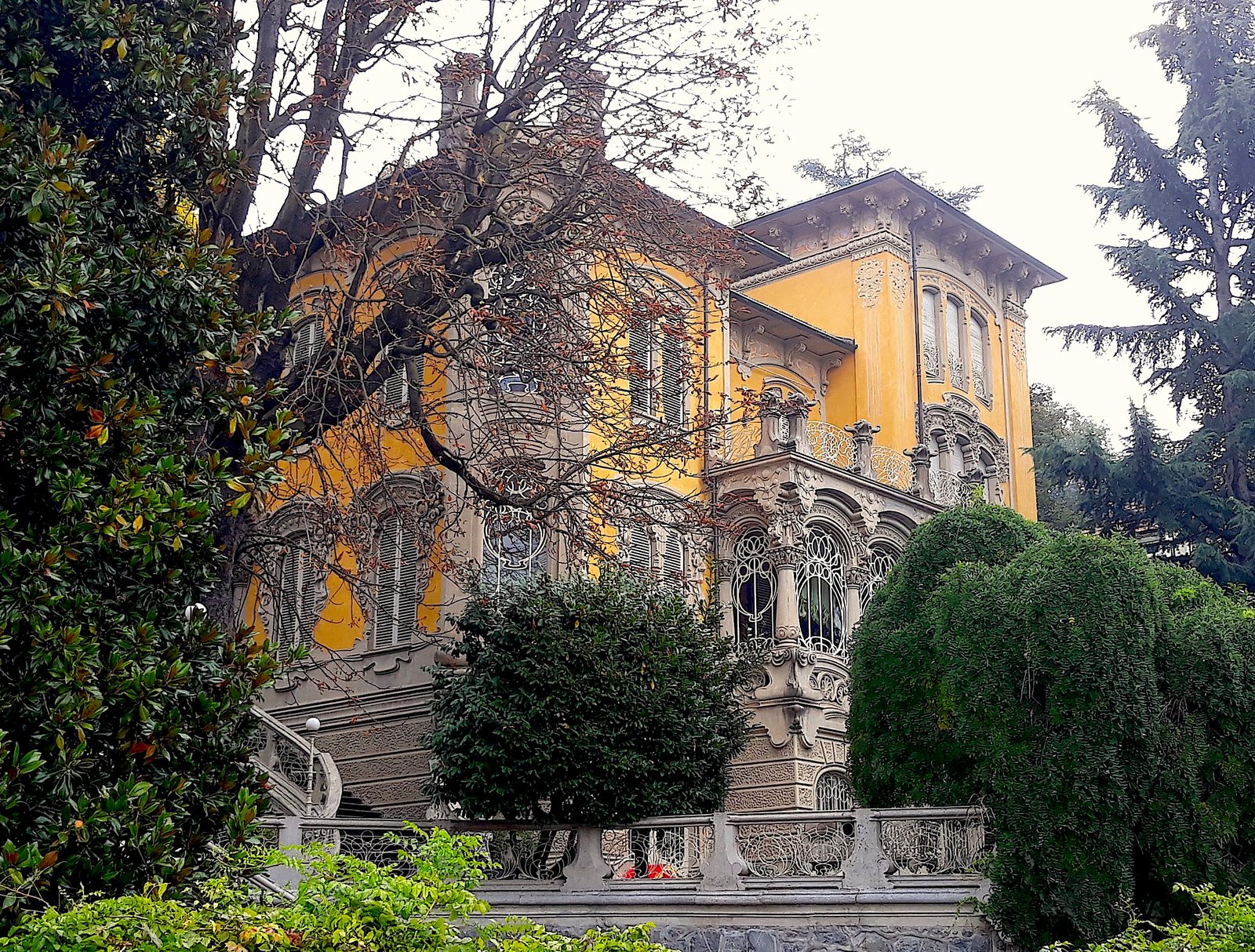
A fantasy of carved stone and wrought iron on the Po hill, Villa Scott is one of the most exuberant Liberty villas in Turin—and a quiet icon of Italian cinema.
At a glance
Designed by Pietro Fenoglio and Gottardo Gussoni in 1902, Villa Scott rises on the hillside of Borgo Po at Corso Giovanni Lanza 57. Commissioned by automotive executive Alfonso Scott, the villa deploys a profusion of floral stucco, polychrome stained glass, and projecting loggias that mark it as one of the most complete expressions of Stile Floreale in the city. The building is privately owned and best viewed from the street.
Key facts
- Architects: Pietro Fenoglio (1865–1927) with Gottardo Gussoni (1869–1951)
- Built: 1902
- Commissioner: Alfonso Scott, executive in the nascent Turin automobile industry
- Style: Stile Liberty / Art Nouveau, with Neo-Rococo ornamental inflections
- Address: Corso Giovanni Lanza 57, 10131 Turin
- Status: Private property; protected by the Soprintendenza per la Città Metropolitana di Torino
- Cinema: Location for several scenes in Dario Argento’s Profondo Rosso (1975)
History
In 1902, Turin was in full industrial bloom. As the city’s young automobile industry was expanding—FIAT had been founded in 1899—a new class of entrepreneurial patrons was commissioning homes that announced their modernity as loudly as their wealth. Alfonso Scott, an executive in this nascent sector, turned to Pietro Fenoglio—architect, engineer, and Liberty enthusiast—to build a hillside residence that would signal exactly this ambition.
Fenoglio, who the same year completed the Palazzina La Fleur on Corso Francia (Via Principi d’Acaja 11, corner Corso Francia), brought in fellow engineer Gottardo Gussoni as collaborator. Together they produced a structure of considerable scenic impact: loggias, external staircases, and turrets animate a silhouette that reads as deliberately theatrical against the green slope of Borgo Po. Inside, ornamental schemes in litocemento, wrought iron, and polychrome glass carry the Liberty vocabulary from facade to ceiling, including furnishings and decorative apparatuses that Fenoglio himself designed.
The stables, set at an angle to the main body, receive perhaps the most uninhibited Liberty treatment on the whole property. Where the villa’s facades occasionally soften the botanical exuberance with Neo-Rococo allusions—a concession to patrons still anchored to aristocratic precedent—the stables abandon all restraint. This internal asymmetry of tone makes Villa Scott a particularly instructive document of the period: it records, in stone and iron, exactly where a progressive client was willing to take risks and where caution prevailed.
After Alfonso Scott’s death, the property later passed to a religious institution, which operated it as a girls’ boarding school. By the late twentieth century the building had been vacant for an extended period before recent restoration work and transfer to private owners. Its long years of atmospheric neglect contributed to the aura that attracted Dario Argento, who used its exterior and interiors as a key location in Profondo Rosso (1975)—confirmed by MuseoTorino and the Ministero della Cultura’s own catalog of Fenoglio’s work. The villa is entered in the National Catalog of Cultural Heritage (code 0100006972) and protected by the Soprintendenza per la Città Metropolitana di Torino.
What you see
From the street the villa presents a restless, layered facade: stone carved into leaf and tendril forms, oriel windows that jut into the air like the prows of boats, iron railings whose stems and petals seem to have grown rather than been forged. The main entrance is framed by a particularly dense knot of botanical ornament, while the upper loggia opens a sudden lightness above the heavier ground floor. Roof edges dissolve into finials and decorative ironwork that continues the garden into the architecture.
The stables alongside are the less-visited but architecturally bolder element: here the Liberty vocabulary is applied with fewer compromises, the surface alive with relief work that anticipates the more radical experiments of the following decade. Both structures together give a clear sense of how Fenoglio and Gussoni calibrated tone across a single commission—restrained where the client needed social legibility, exuberant where the program allowed freedom.
Practical information
- Access: Privately owned; exterior viewable from Corso Giovanni Lanza (public pavement)
- Nearest transit: GTT bus line 56 (stop Lanza / Balbo), approx. 5 min walk from Piazza Vittorio Veneto
- Time needed: 10–15 minutes for exterior viewing; pair with nearby Liberty villas on the same corso
- Admission: No entry; no interior visits
Getting there
Villa Scott sits on Corso Giovanni Lanza 57 in the Borgo Po district, on Turin’s right-bank hillside. From Piazza Vittorio Veneto, cross the Po on the Gran Madre bridge and continue along Corso Moncalieri for one block, then turn onto Corso Giovanni Lanza heading uphill. The villa appears on the right after roughly 400 metres. The walk from Piazza Vittorio is pleasant and passes through the elegant residential fabric of Borgo Po, itself rich in early-twentieth-century architecture.
Nearby
- Liberty Torino — the broader Liberty heritage of Turin, including Fenoglio’s other major works
- Casa Fenoglio-Lafleur (Palazzina La Fleur), Via Principi d’Acaja 11 (corner Corso Francia) — Fenoglio’s own Liberty masterpiece, completed the same year as Villa Scott
- Villa Liberty, Corso Giovanni Lanza 65 — another Liberty villa a few steps away, documented by MuseoTorino
- Gran Madre di Dio church, Piazza Gran Madre — Neoclassical landmark at the foot of the hill, 5 min walk
- Borgo Po neighbourhood — quiet residential streets lined with early-twentieth-century architecture and river views
See the place
Sources
- MuseoTorino, Villa Scott: museotorino.it
- Ministero della Cultura — Catalogo Generale dei Beni Culturali, scheda 0100006972: catalogo.beniculturali.it
- Ministero della Cultura — itinerario Fenoglio e Liberty torinese: catalogo.cultura.gov.it
- MuseoTorino, Pietro Fenoglio (biographical entry): museotorino.it
- Catalogo Beni Culturali, Scuderie, Corso Giovanni Lanza 57, scheda 0100006975: catalogo.beniculturali.it
Find it on the map
See this place and what’s around it →Record researched and written by Carla Szathvary for Cultural Heritage Online, 2026.
📷 Become a Cultural Heritage Online photographer
Share your photos of places: they stay published under your name as the author. The more they're seen, the more you get noticed — and soon a contest will reward the most appreciated photos.
Log in or sign up free to add a photoIs this page about you?
This page is read by travellers and heritage enthusiasts who find it on Google. Tell us how you are connected to this place and we will take it from there.