
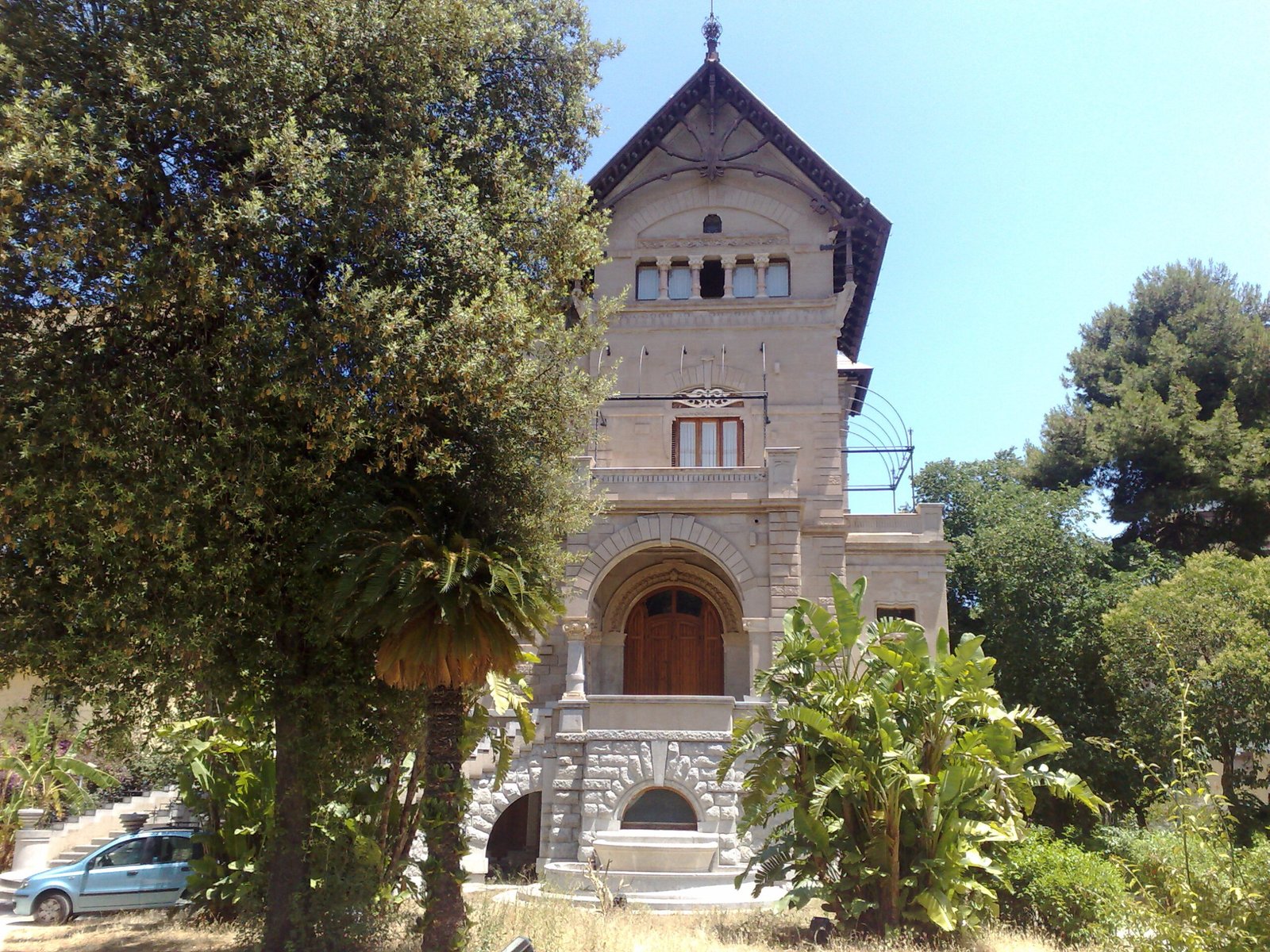
Ernesto Basile’s jewel of Sicilian Liberty — built for the Florio dynasty at the height of their power, where medieval ornament and sinuous Art Nouveau ironwork meet in a garden overlooking Palermo.
At a glance
Designed by Ernesto Basile and begun in 1899 for Vincenzo Florio (“Vincenzino”), the Villino Florio all’Olivuzza stands on Viale Regina Margherita in Palermo’s Olivuzza quarter. It is considered one of the defining statements of the Sicilian Liberty style, blending Art Nouveau fluency with medieval and Norman-Gothic echoes particular to the island’s architectural tradition. A deliberate act of arson in 1962 nearly destroyed the interior; subsequent restoration brought the villino back to life and allowed partial public access for cultural events.
Key facts
- Architect: Ernesto Basile (1857–1932)
- Built: begun 1899, completed in the early 1900s
- Client: Vincenzo Florio (“Vincenzino”), Florio family
- Address: Viale Regina Margherita 38, Palermo, Sicily
- Style: Sicilian Liberty (Art Nouveau / Eclectic, with neogothic elements)
- Fire damage: 1962 arson fire (doloso) — nearly destroyed the interior; furnishings almost entirely carbonised; building subsequently restored
- Current access: Partial, restored — hosted events and guided visits (verify opening schedule with Comune di Palermo)
History
The Florio family — Sicily’s most powerful industrial dynasty in the late nineteenth century — commissioned Ernesto Basile at what was arguably the peak of both the family’s fortunes and the architect’s career. Vincenzo Florio, known as “Vincenzino”, wanted something that felt both of the island and of its time: a personal residence that could hold its own beside the grand hotels and exposition pavilions being built across Europe in the new decorative language of Art Nouveau.
Basile, who had trained under his father Giovanni Battista Basile and gone on to shape the look of modern Palermo, delivered a building unlike any other in the city. Work began in 1899 and the villa was completed in the early 1900s. The plan is compact by villa standards, but the surfaces are dense with invention: terracotta panels, wrought-iron window guards with organic vegetal motifs, stone mouldings where floral and zoomorphic forms blur into each other. The tower element recalls Norman-Arab Sicily without quoting it directly — a self-conscious Sicilian accent within an international idiom.
The Florio empire began to unravel in the early twentieth century, and with it the family’s grip on the property. The building passed through various hands over the decades. In 1962, an arson fire (incendio doloso) devastated the villino’s interior: the furnishings were almost entirely carbonised, and the decorative programme that Basile had so carefully composed was nearly destroyed.
Restoration efforts in the late twentieth and early twenty-first centuries brought the villino back into a usable state. It has been open for cultural events and, following intervention by the Comune di Palermo, for visitor access to at least some of the restored spaces — making it again a living part of the city rather than a sealed ruin. For Sicilian Liberty, it remains the landmark against which Basile’s other Palermo works are measured.
What you see
From the street, the villino reads as a tightly composed asymmetric volume with a slender tower rising at one corner. The façade combines rendered masonry with decorative terracotta inserts, the window surrounds alive with the kind of slow-motion plant growth that defines mature Liberty ornament. The ironwork — balcony railings, window guards — is some of Basile’s finest: heavy enough to anchor the building visually but light enough in its line to give the surfaces a graphic quality that photographs unusually well even a century later.
Inside, the original decorative programme drew on Palermo’s layered heritage — Arabo-Norman geometric motifs, medieval pointed-arch references — woven into Art Nouveau interiors. Post-fire restoration has preserved or reconstructed sections of this scheme, but visitors should expect a space that has been through history rather than a pristine period reconstruction. The garden retains mature planting that frames the tower view and gives the building the semi-rural setting Basile designed it to occupy.
Practical information
- Visiting: Partial public access; the villino hosts cultural events and guided visits — confirm current schedule with the Comune di Palermo or local tourism office before visiting
- Address: Viale Regina Margherita 38, 90138 Palermo
- Nearest transit: Bus lines serving Viale Strasburgo / Olivuzza district; taxi from Palermo Centrale station (~15 min)
- Time needed: 45–60 minutes for exterior and garden; longer for guided interior visits
Getting there
The Olivuzza quarter sits northwest of central Palermo, roughly midway between Piazza Castelnuovo and the ring road. From Palermo Centrale railway station, take a taxi or city bus westward along Viale della Libertà and then northwest toward Viale Regina Margherita. By car, the address is Viale Regina Margherita 38; street parking is available in the surrounding residential streets. The building is not signposted prominently, so a GPS fix is useful — coordinates 38.1196° N, 13.3436° E.
Nearby
- Liberty Palermo — the city’s Art Nouveau heritage
- Villa Malfitano Whitaker, Palermo (~0.5 km) — another Florio-era aristocratic garden villa
- Palermo Botanical Garden (Orto Botanico), ~2.5 km south
- Palazzo dei Normanni and Cappella Palatina, ~2 km southeast — the Norman-Arab heritage that inflects Basile’s ornament
Sources
- palermoviva.it — confirms Vincenzo Florio (“Vincenzino”) as the patron who commissioned the villino as his personal residence. Note: the English Wikipedia article names Ignazio Florio Jr. as the patron; CHO follows palermoviva.it as the closer local authority on this point, so readers cross-checking Wikipedia will find a discrepancy in the patron’s name.
- English Wikipedia, “Villino Florio all’Olivuzza” — fire 1962, restoration (inline citation for public access: Comune di Palermo tourism site)
- Treccani Enciclopedia — Ernesto Basile entry; confirms Basile’s Liberty/eclectic Palermo villas including villini Monroy (1903) and Basile (1904) as context; Villino Florio not named individually in the entry consulted
- Wikimedia Commons — File:Villino_florio.jpg, CC BY-SA 3.0, Dedda71, 2008 (photo source)
- OpenStreetMap / Nominatim — GPS coordinates verified: 38.1196° N, 13.3436° E, “Via Antonio Pasculli, Olivuzza, Palermo”
- Comune di Palermo tourism information (via Wikipedia citation [1]) — confirms post-restoration visitor access
Find it on the map
See this place and what’s around it →Record researched and written by Carla Szathvary for Cultural Heritage Online, 2026.


📷 Become a Cultural Heritage Online photographer
Share your photos of places: they stay published under your name as the author. The more they're seen, the more you get noticed — and soon a contest will reward the most appreciated photos.
Log in or sign up free to add a photoIs this page about you?
This page is read by travellers and heritage enthusiasts who find it on Google. Tell us how you are connected to this place and we will take it from there.