
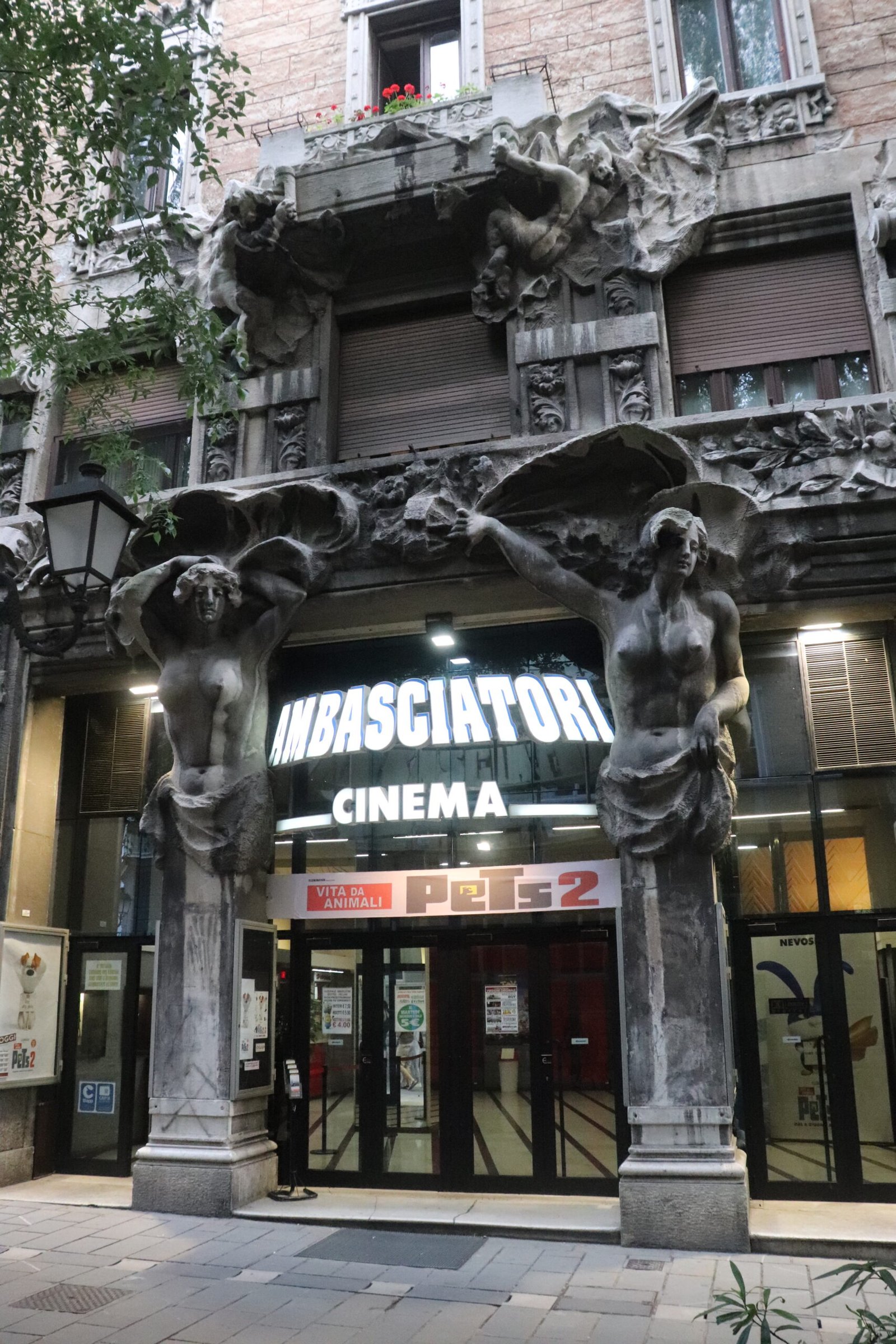
A boldly sculpted Liberty palace on Viale XX Settembre, Trieste, designed by Giuseppe Sommaruga — the only large Liberty palazzo in the city by a major Italian architect from outside the region — and renowned for its monumental portal with exuberant female figures in high relief, confirmed by the Comune di Trieste Beni Culturali.
At a glance
Palazzo Viviani-Giberti stands on Viale XX Settembre in central Trieste as a striking example of the Liberty style that swept the city in the first decade of the twentieth century, when Trieste was one of the most prosperous ports of the Habsburg Empire. The building is best known for its theatrical entrance portal, whose sculptural programme — monumental female figures with raised arms by sculptor Romeo Rathmann — captures the dramatic, body-centred ornamental language of Italian Liberty at its most confident. The building also houses the historic Cinema Ambasciatori, making it a living urban landmark that has served multiple cultural functions since its inauguration in December 1907.
Key facts
- Constructed: 1906–1907 (inaugurated December 1907)
- Style: Liberty (Italian Art Nouveau) with Secessionist sculptural accents
- Address: Viale XX Settembre (Venti Settembre) 35, Trieste
- Architect: Giuseppe Sommaruga (Comune di Trieste Beni Culturali, scheda 366299; MiC national catalogo, scheda 0600007641). Viviani and Giberti were the owners and clients who commissioned the palace; its double name commemorates them, not its designers.
- Portal sculpture: Female figures by Romeo Rathmann (Comune di Trieste Beni Culturali)
- Function: Residential palace; historic Cinema Ambasciatori on ground level
- Distinctive feature: Monumental portal with sculpted nude female figures in high relief — the only large Trieste Liberty palazzo by a major non-local Italian architect
- Heritage status: Protected under vincolo diretto since 1997 (Comune di Trieste Beni Culturali, scheda 366299)
History
Palazzo Viviani-Giberti was built in 1906–1907 and inaugurated in December 1907, at the height of the Liberty season in Trieste. The city, then the primary seaport of the Austro-Hungarian Empire and one of the wealthiest commercial centres on the Adriatic, was experiencing a construction boom driven by merchant families, shipping companies, and insurance firms — all eager to display their prosperity through ambitious architecture. The Liberty style, with its organic ornament, fluid lines, and celebration of craftsmanship, was the fashionable vocabulary for any patron wishing to make a statement.
The palace takes its double name from Viviani and Giberti, the owners and clients who commissioned it — members of Trieste’s commercial elite who sought a building combining residential quarters with commercially productive ground-floor uses. To design it they engaged Giuseppe Sommaruga, the Milanese architect whose Palazzo Castiglioni (1903) in Milan had already made him the pre-eminent practitioner of sculptural Italian Liberty. The commission was exceptional: Sommaruga’s practice was centred in Lombardy, and Palazzo Viviani-Giberti stands as the only large Trieste Liberty palazzo by a major Italian architect from outside the region. The Comune di Trieste Beni Culturali and the MiC national catalogo both record Sommaruga as architect, and the building has been under vincolo diretto protection since 1997.
The sculptural programme of the portal — its monumental female figures with raised arms, rendered in vigorous high relief — was executed by sculptor Romeo Rathmann, as documented by the Comune di Trieste. The motif, filtering the contemporary language of Viennese Secession through Italian Liberty, would have been read by contemporaries as a bold declaration of cultural ambition. The ground floor has long housed a cinema — today operating as Cinema Ambasciatori — embedding the palace firmly in the social life of the city’s central district.
Through the early and mid twentieth century — the turbulent decades of World War I, the transition from Habsburg to Italian rule in 1918, and the subsequent decades of Fascism and World War II — the palace remained a fixed point of Trieste’s urban fabric. Today Palazzo Viviani-Giberti is recognised as part of the dense cluster of Art Nouveau buildings that make central Trieste an open-air museum of early twentieth-century architecture.
What you see
The most arresting element of Palazzo Viviani-Giberti is its entrance portal on Viale XX Settembre: a composition of carved stone in which oversized female figures with raised arms — the work of Romeo Rathmann — emerge from the wall surface in vigorous high relief, their bodies and drapery dissolving into organic ornamental detail — floral tendrils, sinuous mouldings, and foliate capitals. The sculptural language is emphatically corporeal, placing this portal in the tradition of Italian Liberty that embraced the human body as architectural decoration, and directly comparable to the controversial portal figures Sommaruga deployed at Palazzo Castiglioni in Milan.
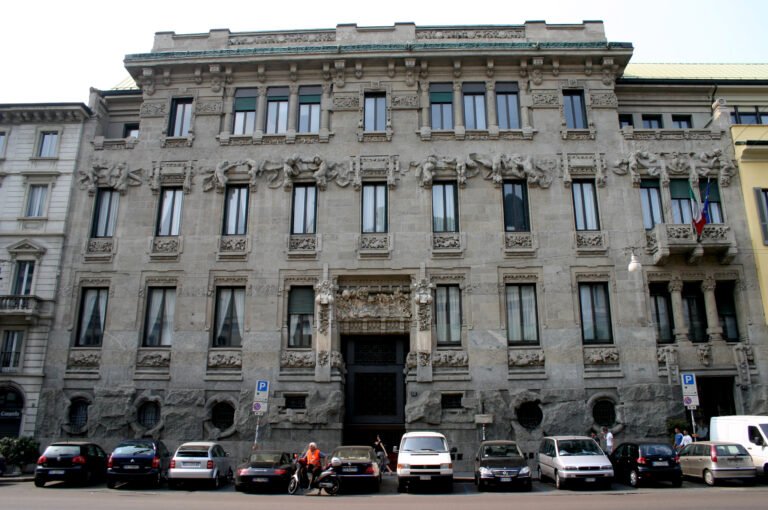
The overall facade presents an exuberant Liberty composition on Viale XX Settembre: curved window surrounds, iron balconies with foliate grilles, and a rhythmic play of surface texture and shadow. The building reads as a residential block of substantial scale, its multiple storeys stepping up behind the decorated facade in a sober mass that grounds the ornamental intensity of the street level. The interplay between the restrained upper floors and the theatrical portal is typical of Liberty palaces throughout Trieste, where civic decorum in the overall massing coexists with concentrated decorative intensity at the human-scale entrance.
Practical information
- Access: The exterior is freely visible from the street at all times; the portal on Viale XX Settembre can be approached on foot
- Interior: Residential apartments are private; Cinema Ambasciatori may be visited during screenings
- Nearest transit: Piazza Goldoni bus hub (multiple city bus lines), approximately 5 minutes on foot; approximately 10 minutes on foot from Trieste Centrale railway station
- Suggested visit time: 10–15 minutes to study the facade and portal sculpture; combine with a Liberty walking itinerary of central Trieste
Getting there
Palazzo Viviani-Giberti is located at Viale XX Settembre 35, in central Trieste. From Trieste Centrale railway station, the palace is reachable on foot in approximately ten minutes heading towards the city centre. Piazza Goldoni, one of the city’s main transport hubs with numerous city bus lines, is approximately five minutes on foot. The surrounding neighbourhood is flat and easily walkable, making the palace a natural inclusion in any self-guided Liberty architecture tour of central Trieste.
Nearby
- Liberty Trieste — the full CHO guide to Art Nouveau architecture in the city
- Piazza Goldoni — central Trieste square and transport hub, approximately 5 minutes on foot
- Piazza Unità d’Italia — the monumental Habsburg-era waterfront square, 10 minutes on foot
- Museo Revoltella — Trieste’s gallery of modern art, housed in a historic palace, a 10-minute walk
Sources
- Comune di Trieste Beni Culturali, scheda 366299 — architect Giuseppe Sommaruga, sculptor Romeo Rathmann, vincolo diretto 1997.
- MiC national catalogo, scheda 0600007641 — confirms Sommaruga attribution at national level.
- Wikimedia Commons, File:Trieste_Palac_Viviani-Giberti.jpg — building date 1907, CC BY-SA 4.0, photographer Andrzej Otrębski, 2019.
- OpenStreetMap / Nominatim — geographic coordinates and address context for Viale XX Settembre 35, Trieste (consulted June 2026).
Find it on the map
See this place and what’s around it →Record researched and written by Carla Szathvary for Cultural Heritage Online, 2026.
📷 Become a Cultural Heritage Online photographer
Share your photos of places: they stay published under your name as the author. The more they're seen, the more you get noticed — and soon a contest will reward the most appreciated photos.
Log in or sign up free to add a photoIs this page about you?
This page is read by travellers and heritage enthusiasts who find it on Google. Tell us how you are connected to this place and we will take it from there.