
Brussels invented Art Nouveau. Vienna refined it. Barcelona made it a city’s identity. Here the movement took a Catalan name, Modernisme, and three architects pushed it further than anyone in Europe: Antoni Gaudí, Lluís Domènech i Montaner and Josep Puig i Cadafalch. Between roughly 1885 and 1930 they covered a single neighbourhood in stone flowers, broken tile and exposed iron. This walk reads that neighbourhood, building by building, and connects each stop to its full place card in the CHO directory.
The block where three masters argued
Start on the Passeig de Gràcia, at the most argued-over plot of ground in modern architecture. Locals call it the Illa de la Discòrdia, the Block of Discord, because three rival architects each built a house here within a few years and none of them agreed on what a modern building should be.
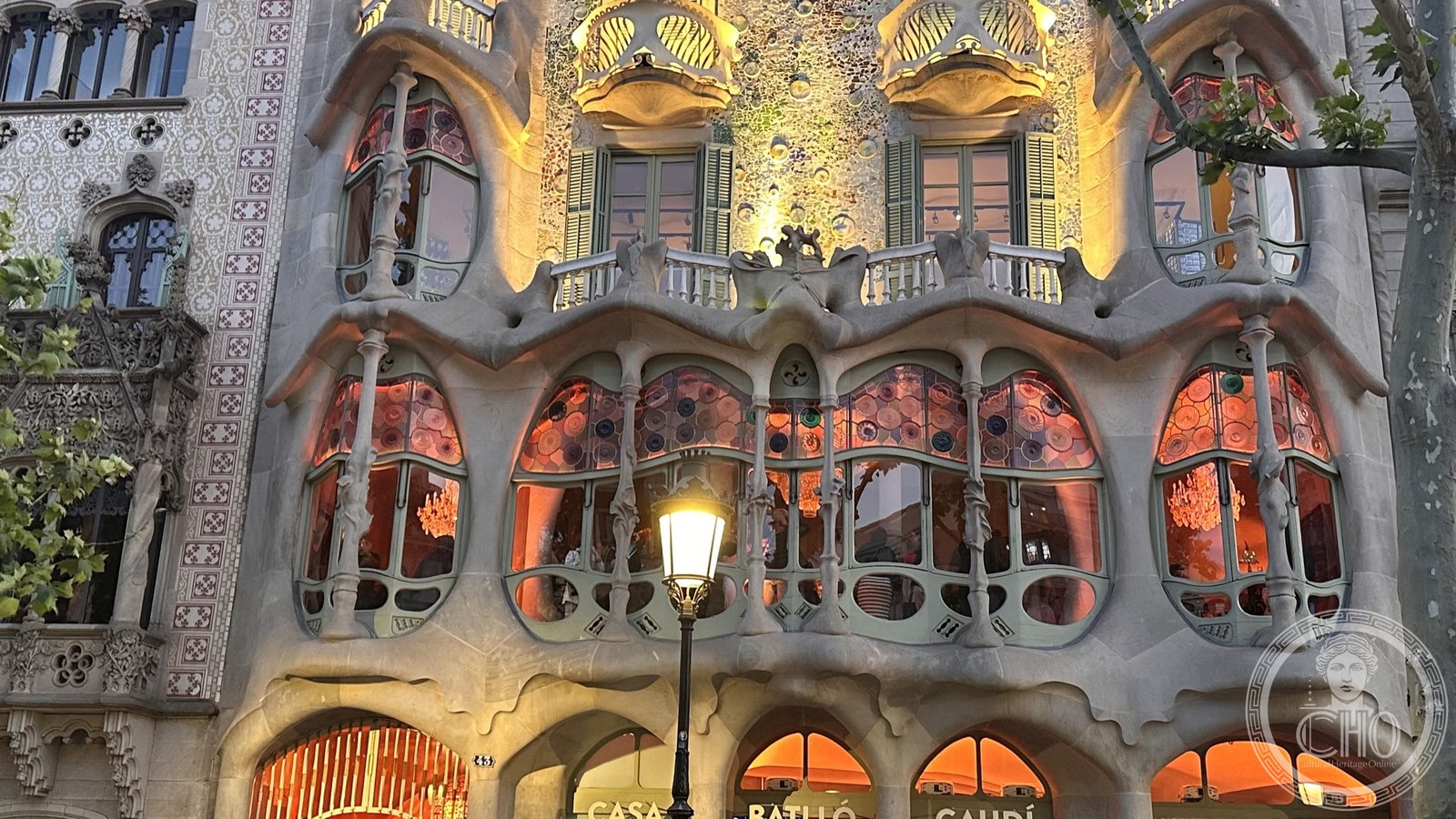
Gaudí’s Casa Batlló (1904–1906) is the famous one. He took a sober apartment block and turned its front into bone, water and scale; Barcelona calls it the house of bones, and the scaled roof reads as the back of a sleeping dragon. Two doors away stands Puig i Cadafalch’s Casa Amatller (1898–1900), its stepped Flemish gable lifted straight from medieval Bruges. Between them, Domènech i Montaner’s Casa Lleó Morera (1902–1906) hides the family name in plain sight: the mulberry tree of the Moreras is carved everywhere you look. Three houses, three tempers, one pavement. Stand back and read all three at once, because that argument is the whole movement in miniature.
Gaudí’s Barcelona
No architect has marked one city the way Gaudí marked this one. He began in 1883 with Casa Vicens (1883–1885), a summer house dressed head to foot in ceramic flowers and now, like much of his work, UNESCO World Heritage. Walk through the bohemian alleys off the Rambla and you reach Palau Güell (1886–1890), the town palace he built for his patron Eusebi Güell, where the dining-room ceiling is pierced with small holes so that lamplight could fake a starlit sky.
His maturity is uptown. Casa Milà (1906–1912), the apartment block everyone knows as La Pedrera, “the quarry”, carries a stone façade that ripples like a cliff and a roof of helmeted chimneys that look like sentries. Quieter and far less visited, Casa Calvet (1898–1900) is the most restrained thing he ever drew, and the only Gaudí building his own city ever gave a prize. Up on the slope, Torre Bellesguard (1900–1909) is a private house built as the memory of a king, raised on the ruins of the medieval residence of Martí the Humane.
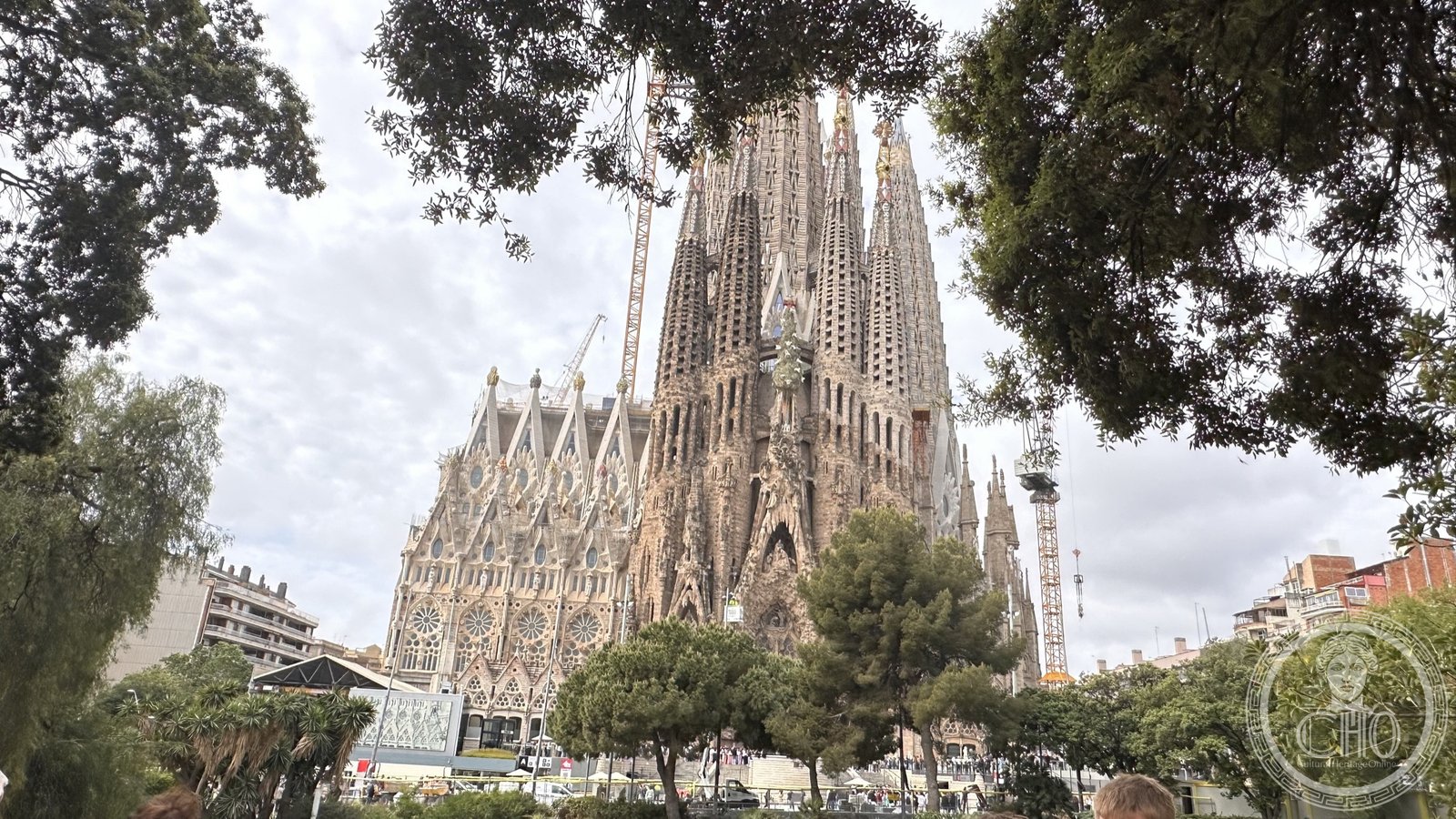
Two of his works stand apart because they swallowed his life. The Sagrada Família, begun in 1882 and his obsession from 1883 until his death in 1926, has now been under construction for more than 140 years: a forest of stone that is still growing. And Park Güell (1900–1914) was meant to be a garden suburb for the rich. Almost no one bought a plot, the scheme failed, and the city inherited the most joyful public park in Barcelona instead.
Domènech i Montaner: beauty as medicine
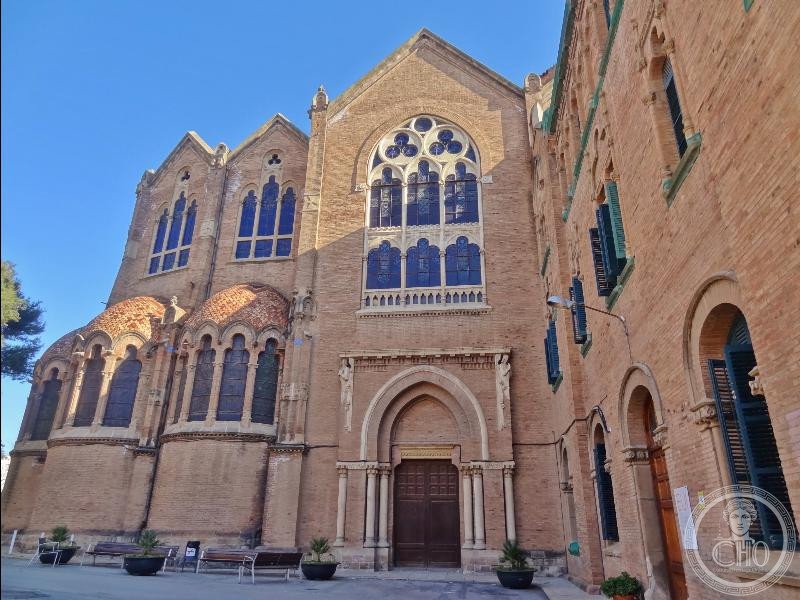
If Gaudí is the sculptor, Domènech i Montaner is the builder of interiors that take your breath. His Palau de la Música Catalana (1905–1908) is a concert hall hung on iron and filled with stained glass, lit in daytime by an inverted dome of coloured light; it remains the only Art Nouveau concert hall on the UNESCO World Heritage List. A short walk north, his Hospital de Sant Pau (1902–1930) was built on a radical idea: that beauty heals. Across 6.74 hectares he laid out polychrome pavilions linked by underground galleries, the largest ensemble of Catalan Modernisme ever constructed, and a working hospital until 2009.
Puig i Cadafalch and the medieval dream
The third master looked backwards to go forwards, fusing Modernista craft with the silhouettes of northern Gothic. His Casa de les Punxes (1905) is three houses for three sisters fused into one building that looks like a castle dropped into the grid of the Eixample, bristling with conical towers. Nearby, the Palau del Baró de Quadras (1903–1906) turns one face into a carved Gothic screen and the other into an almost modern wall, while the Palau Macaya (1898–1901) is a white palace scratched all over with sgraffito ornament. Puig also built the tavern that fed the movement’s mythology: Els Quatre Gats, in his Casa Martí, where in 1900 a teenage Pablo Picasso held his first show.
Why it all happened here
Modernisme was not only a style. It was Catalonia announcing itself. The 1888 World’s Fair gave Barcelona ambition and money; the city’s textile and industrial fortunes gave it patrons who wanted houses that read as modern rather than aristocratic. Above all, the engineer Ildefons Cerdà had drawn, from 1859, the vast gridded expansion called the Eixample, with chamfered corners and generous blocks. That grid handed the architects a blank, repeating canvas, and they filled it with a Catalan answer to Paris and Vienna. The movement carried the politics of the Renaixença, the revival of Catalan language and identity, which is why so much of it reaches for medieval Catalan and Gothic forms. To walk Modernista Barcelona is to walk a national argument written in stone.
How to walk it
The Passeig de Gràcia is the spine: the Block of Discord, Casa Milà and several Puig houses sit along or just off it, an easy half-day on foot. Use the metro for the outliers, Park Güell and Casa Vicens to the north, Sant Pau and the Sagrada Família to the east, all on a single day ticket. Book Casa Batlló, La Pedrera and the Sagrada Família online well ahead; same-day tickets sell out, and the Sagrada’s tower lifts go fastest. The Palau de la Música and Hospital de Sant Pau each ask for a separate visit and reward it. Two full days let you see the masterpieces without rushing; a third turns the walk into the pleasure it should be, with long lunches between Gaudí and Domènech.
This walk is one stop on the Art Nouveau capitals of Europe. If the thread holds you, follow it on to Brussels, Vienna, Paris, Riga, Glasgow.
Frequently Asked Questions
Is Catalan Modernisme the same as Art Nouveau?
Yes, Modernisme is the Catalan branch of the same European movement that was called Art Nouveau in France and Belgium, Jugendstil in Germany and Austria, and Stile Liberty in Italy. It shares the curving lines, natural motifs and craft revival, but it leans harder on colour, broken-tile mosaic (trencadís) and medieval Catalan forms than its northern cousins.
Which Gaudí buildings in Barcelona are UNESCO World Heritage?
Seven works by Antoni Gaudí are inscribed under “Works of Antoni Gaudí”. The original 1984 listing covered Park Güell, Palau Güell and Casa Milà; the 2005 extension added the Nativity façade and crypt of the Sagrada Família, Casa Vicens, Casa Batlló and the crypt of the Colònia Güell. The Palau de la Música Catalana and Hospital de Sant Pau, both by Domènech i Montaner, form a separate UNESCO listing of 1997.
What is the Block of Discord?
It is a single stretch of the Passeig de Gràcia where three leading architects built clashing houses within a few years: Gaudí’s Casa Batlló, Puig i Cadafalch’s Casa Amatller and Domènech i Montaner’s Casa Lleó Morera. The contrast between them gave the block its nickname, Illa de la Discòrdia.
Do you need to book tickets in advance for Gaudí’s buildings?
For the major sites, yes. Casa Batlló, Casa Milà (La Pedrera) and the Sagrada Família routinely sell out their timed entries, and the Sagrada’s tower lifts in particular need booking days ahead in high season. Park Güell’s central Monumental Zone is also ticketed and capped.
Who were the three main Modernisme architects?
Antoni Gaudí, Lluís Domènech i Montaner and Josep Puig i Cadafalch. Gaudí is the sculptor of organic form; Domènech i Montaner the master of luminous interiors and structural iron; Puig i Cadafalch the scholar who fused Modernista craft with medieval Gothic silhouettes.
How many days do you need to see Modernista Barcelona?
Two days cover the essential masterpieces along and around the Passeig de Gràcia, plus the Sagrada Família, Park Güell, the Palau de la Música and Hospital de Sant Pau. A third day lets you slow down and add the quieter Puig and Gaudí houses without rushing between timed tickets.
Sources
- S1 — Hughes, Robert. Barcelona. Alfred A. Knopf, 1992. ISBN 978-0-394-57727-2.
- S2 — Zerbst, Rainer. Antoni Gaudí: The Complete Buildings. Taschen, 2002. ISBN 978-3-8228-2171-8.
Spotted an error? Write to editorial@culturalheritageonline.com and we correct it the same day.


