
Charles Rennie Mackintosh was born in Glasgow in 1868 and died there in all but the most literal sense long before 1928. The buildings he designed between 1895 and 1909 — his Glasgow decade — are among the most important produced by the Arts and Crafts movement anywhere, were recognised as such in Vienna and Darmstadt and Turin before they were in Edinburgh or London, and were largely built for clients who offered him less creative freedom than the work deserved. He spent the last two decades of his life unable to build at any significant scale. What remains in the city is what he managed to make in a narrow window, by an architect who worked faster and more completely than he was given time or opportunity to show.
The buildings are spread across Glasgow — from George Square to Bellahouston Park, from the Victorian civic centre to a working-class school and a north-Glasgow church — in a way that requires a full day and some commitment to transit. They do not form a tidy itinerary. But walking from the City Chambers of 1888 to the House for an Art Lover of 1901 (built 1996), with everything Mackintosh built between them, gives you something a single building cannot: the sense of a career that developed rapidly and was cut short, and of a city that produced this and then largely moved on.
[FIGURE_1]
Michael D Beckwith · CC0 · Wikimedia Commons
What Glasgow Built Before Him
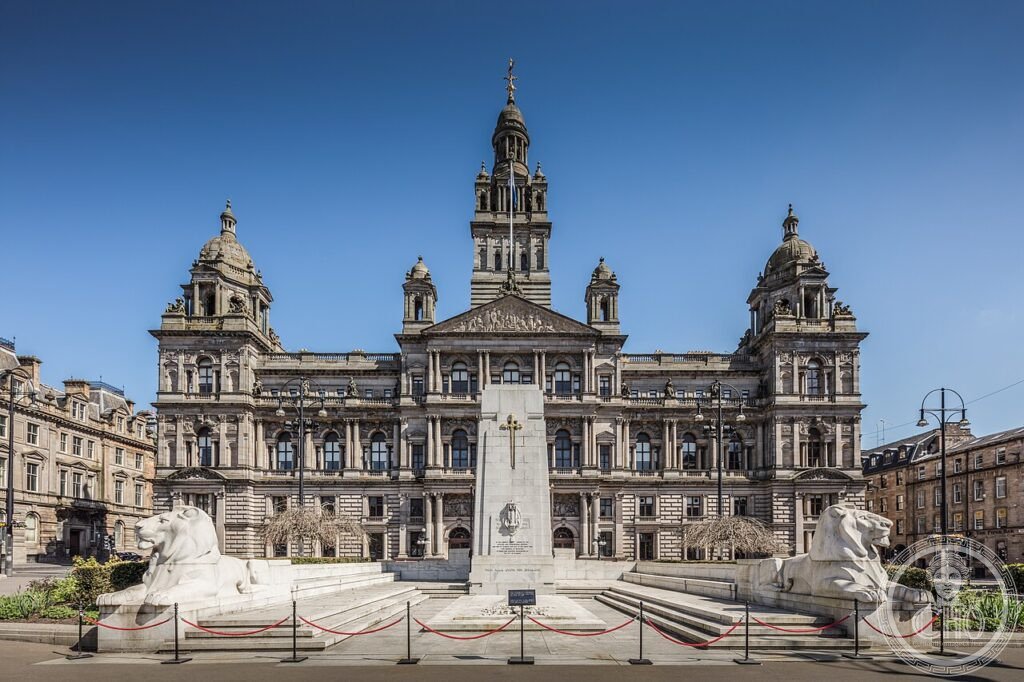
The logical beginning is George Square: William Young’s City Chambers of 1888 is the building that tells you what Mackintosh was departing from. Three storeys of Carrara, alabaster and Numidian marble on a staircase reportedly more extravagant than the Vatican’s, a banqueting hall painted by the Glasgow Boys with the city’s history as civic scripture, a facade that stacks classical orders to a central tower in the confident language of a city that had decided it was the second most important in the world. Young built it well; it is a handsome and serious piece of Victorian public architecture. It is also completely inert. There is nothing in it that grew from the ground up, nothing that responds to the Scottish weather, nothing that uses the building’s programme to generate a new form rather than drape an old one over a modern purpose.
Mackintosh began his response eight years later and four minutes’ walk away, in Mitchell Lane.
[FIGURE_2]
The Lighthouse and the School
The Glasgow Herald Building of 1895 — now the Lighthouse, Scotland’s centre for architecture and design — was Mackintosh’s first significant public commission, won while he was still a draughtsman at Honeyman & Keppie. The corner tower handles the acute angle of the lane with a decorative confidence that is already not like anything his employers had done before him. The tower carries a water tank for the building’s internal fire protection system, which is why it rises above the roofline in that particular way. Utility and form in the same decision, which would be the characteristic of every building he produced over the next fifteen years.
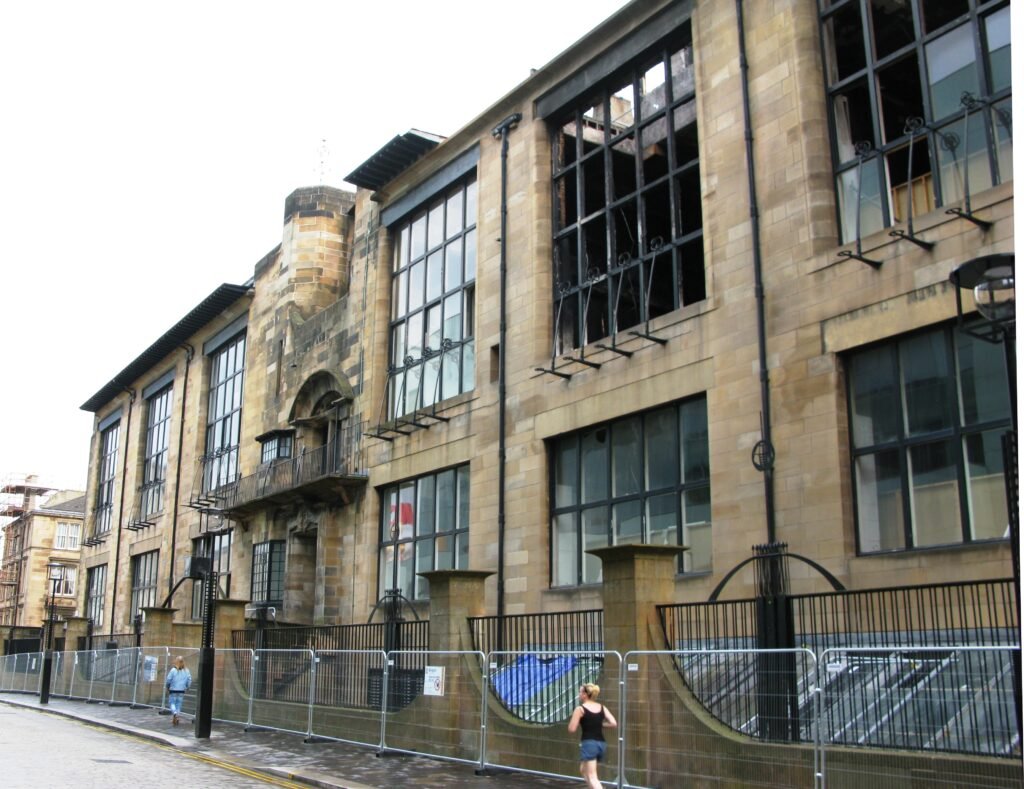
Walk north and uphill to Renfrew Street. The Glasgow School of Art, designed in 1897 and delivered in two phases — the east wing and main entrance in 1899, the west wing and library in 1909 — is the building by which Mackintosh is finally and irreversibly judged. The entrance facade on Renfrew Street, with its deep-set arch and its ironwork studio window brackets, is the east wing’s argument: a building that derives its form from its programme (studios facing north, offices facing south) and acknowledges its steep hillside site in every decision it makes about massing and level. The west wing, built eight years later, is more restrained, more sure of itself, and in the Mackintosh Library — a double-height room of hanging timber galleries and pendant light fittings — produced what many critics considered the finest interior room of the British Arts and Crafts movement.
Two fires, in 2014 and 2018, have made the library a past tense. The second fire destroyed it almost entirely. The restoration is ongoing. What you see from Renfrew Street today is the east wing, which survived, and the west wing’s blackened exterior. The building is still the School of Art and still the best thing Mackintosh built. That it is also now a ruin is the fact you carry with you for the rest of the walk.
[FIGURE_3]
The Tea Room and the Church
Kate Cranston was the patron who gave Mackintosh the closest thing to unlimited authority that he experienced in Glasgow. At the Willow Tea Rooms on Sauchiehall Street, designed in 1903, she handed him the building facade, the room layouts, the furniture, the textiles, the menus, the cutlery, the everything. The name came from the street — “Sauchiehall” derives from the Scots Gaelic for “avenue of willows” — and Mackintosh ran the willow motif through the building from ground floor to ceiling: abstracted in the stencilling, literal in the metalwork, suggested in the high-backed chairs of the Room de Luxe. That room on the first floor — mirrored frieze, purple and silver palette, the chairs that became his most famous piece of furniture — is the most complete surviving Mackintosh interior in the city. The building was badly treated in the late twentieth century and carefully restored between 2014 and 2018.
North of the city centre, on Maryhill Road, stands the only church Mackintosh ever built: Queen’s Cross, completed in 1899. It was designed simultaneously with the first phase of the School of Art and shares almost nothing with it except its author. Queen’s Cross draws on Gothic structure, Scottish vernacular tradition, and the Arts and Crafts naturalism that Mackintosh had absorbed from Ruskin and from his study of Japanese design. The tower — which changes silhouette as you move around it — is the key. The interior nave, stencilled and quietly lit, is the most genuinely spiritual space Mackintosh produced. The congregation has gone; the building is owned by the Mackintosh Society. It is precisely the kind of work that Glasgow should have built more of, and did not.
[FIGURE_4]
David Mackay · CC BY 2.0 · Wikimedia Commons

The Lighthouse tower in Glasgow, the former Glasgow Herald building by Charles Rennie Mackintosh
The School, the House, and What Was Never Built
Scotland Street School, completed in 1906, is best known for the twin glass staircase towers on its north elevation: semicircular oriels of glass and stone that pull daylight into the school’s interior and present, from the street, a facade of structural transparency that the School of Art, for all its sophistication, never quite achieved. The school is now a museum of Scottish education, and the twin towers light an empty staircase where children once streamed up and down between classes. Mackintosh managed to make a perfectly ordinary Edwardian elementary school into an argument about light and structure that still reads fifty years after the last child left it.
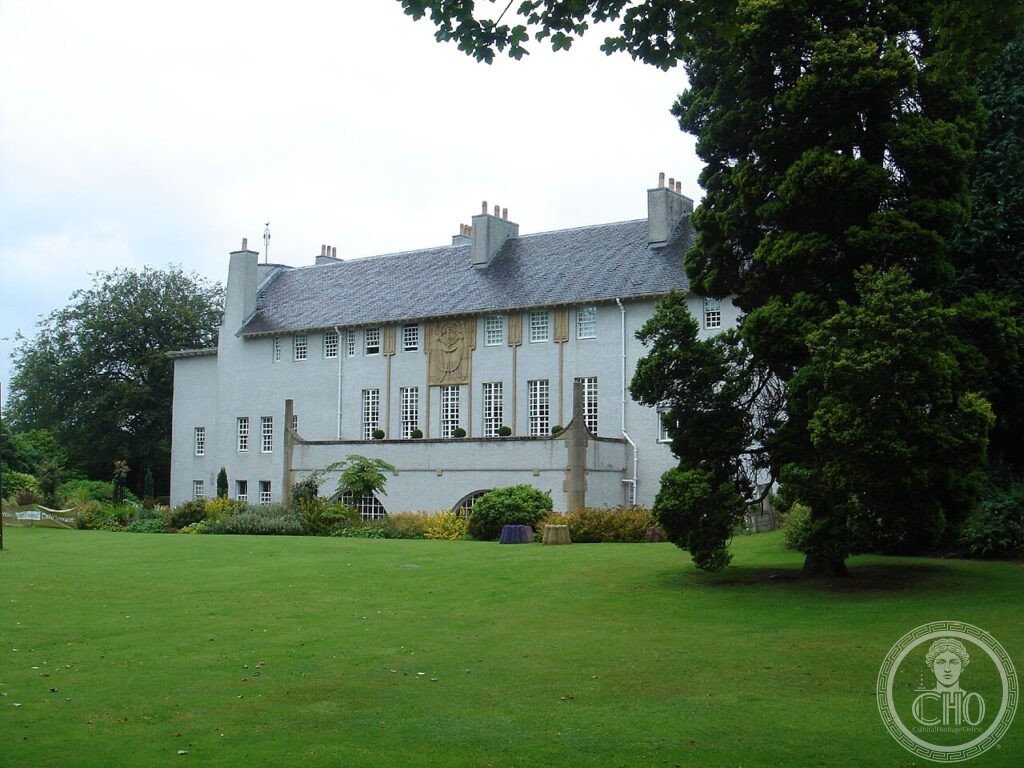
The day ends in Bellahouston Park at the House for an Art Lover, where the question of what Mackintosh might have built — given clients with the resources and vision to let him design at full residential scale — is answered as completely as it could be. He entered Alexander Koch’s 1901 competition for a “highly individual country house in a thoroughly modern style” and was disqualified on a technicality. The drawings were published in Koch’s journal, where they influenced Hoffmann and the Viennese Werkstätte more directly than anything Mackintosh built in Glasgow. The house itself was not completed until 1996, based on his competition drawings. It was never touched by his hand. It is also the most spatially realised expression of his domestic programme: horizontal, landscape-oriented, its interiors organised around the art of living rather than the display of status, the music room shaped as an oval in deference to sound rather than to planning convention.
The music room panels are by Margaret Macdonald Mackintosh, his wife and equal collaborator, whose contribution to the rose motif that runs through their shared work has been underacknowledged for a century. The House for an Art Lover is the place where this is most legible: the building is the work of two people, and the room where both of them are most fully present is the best one.
Continue the Arts and Crafts thread with the Vienna Art Nouveau RoadBook (the Secession that Mackintosh influenced) and the Riga Art Nouveau RoadBook (Eisenstein and the Jugendstil at its most concentrated).
Walk this itinerary: Glasgow Mackintosh RoadBook — 7 stops, maps and insider notes.