
Alberta iela is eight buildings long. You can walk from one end to the other in three minutes. In those three minutes you pass one of the densest concentrations of Jugendstil architecture anywhere in Europe — apartment facades built in the first decade of the twentieth century, decorated with masks, faces, garlands, mythological figures, and bands of ornament that cover every surface from the ground floor to the roofline. Riga is often described as the capital of Art Nouveau. Alberta iela is where that description becomes literal.
The city earned its place on the UNESCO World Heritage List in 1997, with its Art Nouveau quarters singled out for particular recognition. At its peak between 1896 and 1913, Riga was growing faster than almost anywhere else in the Russian Empire, and the new apartment buildings going up across the Quiet Centre were built almost entirely in the new style. Architects trained in Berlin, Vienna, Helsinki, and Saint Petersburg all worked here simultaneously, producing a neighbourhood of unusual stylistic variety within a single idiom. More than 800 buildings survive. Most are still in use as apartments. The facades have been patched and repainted over a hundred years of occupation, war and independence, but the stucco ornament has mostly outlasted the politics.

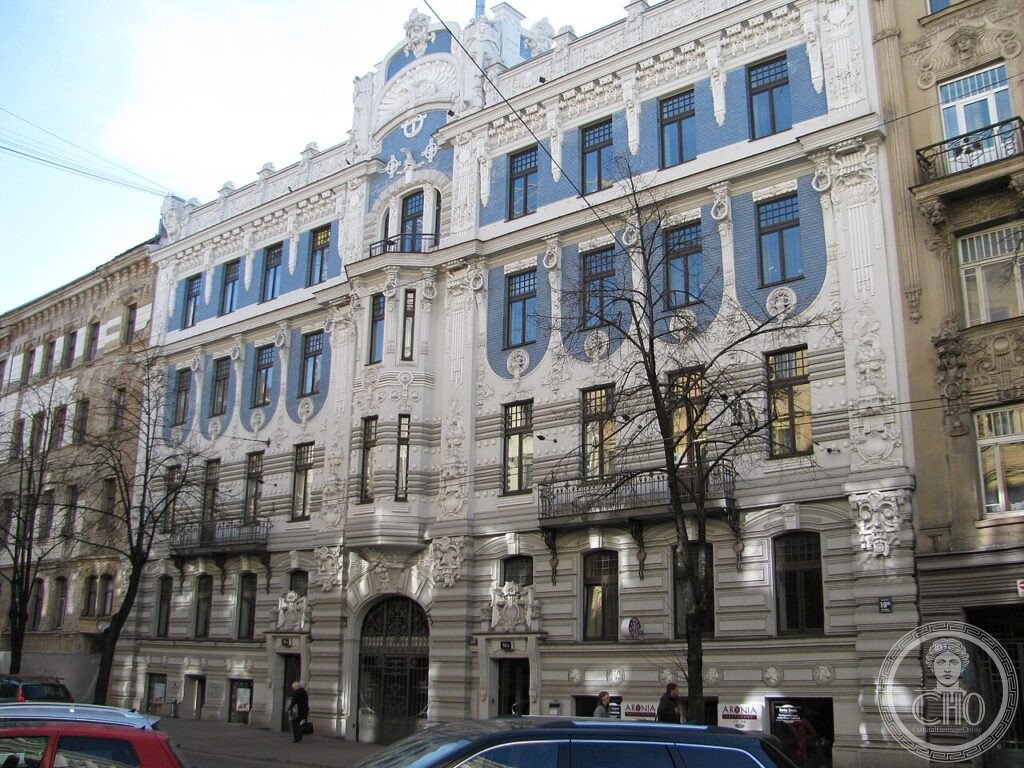
Richly decorated Art Nouveau apartment facade at Alberta iela 8 in Riga, attributed to Mikhail Eisenstein
The Apartment That Explains the Street
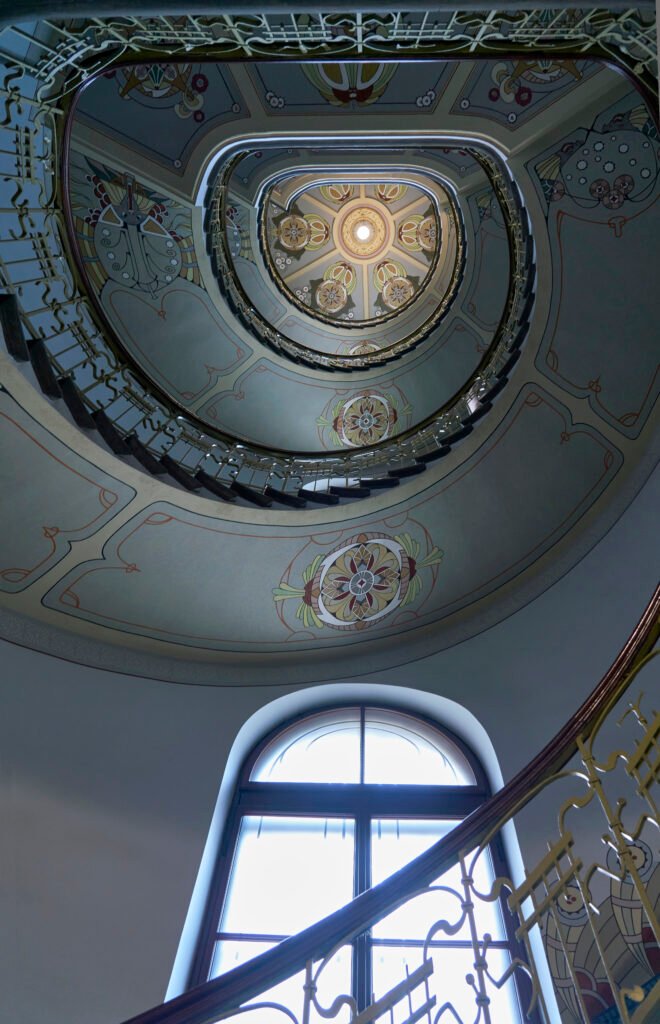
Konstantīns Pēkšēns (1859–1928) designed more than 250 buildings in Riga, covering the full arc from historicism through the Jugendstil peak to his later work. Alberta iela 12, completed in 1903 in collaboration with the young Eižens Laube, was his own home — the house he built to live in, decorated to the standard by which he wished to be judged. He moved out in 1907. The painter Janis Rozentāls, who also lived here, may have painted the spiral staircase murals that are now the most photographed interior in the Art Nouveau quarter.
The Riga Art Nouveau Museum opened in Pēkšēns’s restored apartment in 2009 and works best as a key to the district rather than a destination in itself. It explains the vocabulary — the masks and mascarons, the floral relief, the sinuous iron balustrades — that then repeats along Alberta iela and the surrounding streets. The spiral staircase beneath its painted ceiling is the building’s real argument: designed not for display but for daily use, and therefore evidence that the Jugendstil generation in Riga was not decorating for exhibitions but for life.
One Man, One Street
Cross the street from the museum and you are looking at Alberta iela 13, built in 1904 and attributed to Mikhail Eisenstein — civil engineer, architect, and father of the filmmaker Sergei Eisenstein, who was born in Riga in 1898. Eisenstein produced perhaps ten or more buildings in the Alberta iela area over a period of barely a decade, turning the short street into the most concentrated display of his work in the city. He had no formal architectural training in the academic sense, which may explain the freedom of his decorative language. The faces stare from the upper storeys, the garlands cascade from cornice to lintel, the overall effect is of ornament applied without anxiety about whether it is too much.
Alberta iela 8, a few steps west, shows a different register of the same moment — the ornament more disciplined, the proportions more vertical, the hand of a different architect working in the same idiom. Reading the two buildings side by side makes visible the range within the decorative phase: Eisenstein’s street was never a single note. Alberta iela 2a, at the far end, was built two years later and carries the style with the confidence of a mature idiom — the choices are surer, the proportions more settled, the excess of the earlier buildings modulated without being abandoned.
Around the corner on Strēlnieku iela, No. 4a is now a music academy. On a weekday you hear scales from the open windows, arpeggios and fragments of chamber music drifting past a facade of concentrated ornament. Art Nouveau in Riga was always about performance — the building as act of display, the street as audience. The accident of the academy’s presence makes this visible.
Voll · CC BY-SA 4.0 · Wikimedia Commons
Elizabetes iela and the End of the Boom
Walk south to Elizabetes iela, a broader street where the facades are designed for a different kind of reading — wider, more distant, more theatrical. Eisenstein’s building at No. 10b, completed in 1903, uses two-tone stucco in blue and white: an unusual move in a city where most Jugendstil facades were rendered in grey or beige. The larger scale of the faces at the upper storey, the looser arrangement of garlands and frames, the poster-like clarity of the two-tone composition — these are answers to a wider street, adjustments of scale and legibility that show Eisenstein thinking not about ornament as such but about how a building reads across fifty metres of space.
Elizabetes iela 33, a few doors along, introduces a different architect and a different starting position: ornament concentrated at cornices and windows rather than spread across the whole surface, the overall effect more vertical and more restrained, closer to the Viennese Secession than to the exuberant decorative phase that Eisenstein represented. Riga’s Art Nouveau was not a single style. It was a conversation between architects trained in different European cities, all building simultaneously in a capital that would be independent for barely twenty years of its twentieth-century life.
The Riga building boom ended with the First World War. By 1914 construction had slowed dramatically; by 1917 the German advance had emptied the Quiet Centre of most of its original residents, who were evacuated east. The apartments that had been built in such concentrated exuberance between 1896 and 1913 were emptied, then occupied, then abandoned, then occupied again. The stucco ornament survived because ornament is harder to destroy than the society that produced it.
Virtual-Pano · CC BY-SA 4.0 · Wikimedia Commons
The Monument That Came After
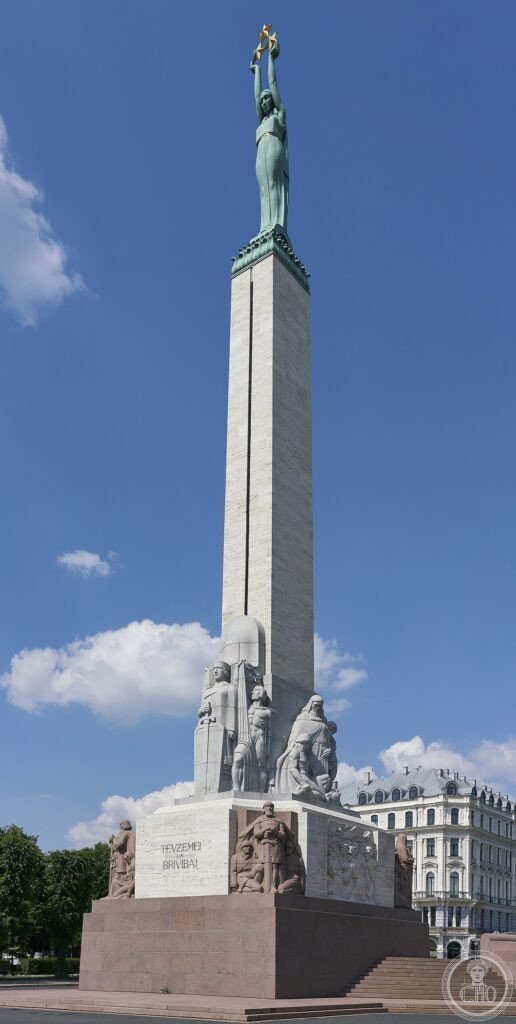
Walk south-west from Elizabetes iela to the Freedom Monument, inaugurated on 18 November 1935 — the seventeenth anniversary of Latvian independence, and twenty years after the last of the Alberta iela buildings were completed. Sculptor Kārlis Zāle’s 42-metre travertine shaft, paid for by private subscription from tens of thousands of individual donors, was built on the site of a statue of Tsar Peter the Great, removed as a deliberate symbolic act. The figure of Milda at the summit holds three gold stars — Vidzeme, Latgale, Kurzeme — above the city.
The stylistic distance from Alberta iela to this shaft is barely twenty years and almost impossible to cross. The language of Art Nouveau — its sinuous line, its ornamental abundance, its claim that beauty was a civic good — had given way to something harder, more vertical, more certain of itself. The Jugendstil had been a style for a city that was prosperous and growing and still officially part of someone else’s empire; the Freedom Monument is a style for a nation that has just finished fighting for its existence. Both are expressions of what Riga wanted to be. Only one is still there on the street, standing watch over the civic life below, on every important day of the Latvian year.
Continue the Art Nouveau thread with the Brussels Art Nouveau RoadBook (Horta, van de Velde and the invention of the style) and the Vienna Art Nouveau RoadBook (Wagner, the Secession and the imperial city remade).
Walk this itinerary: Riga Art Nouveau RoadBook — 8 stops, maps and insider notes.