
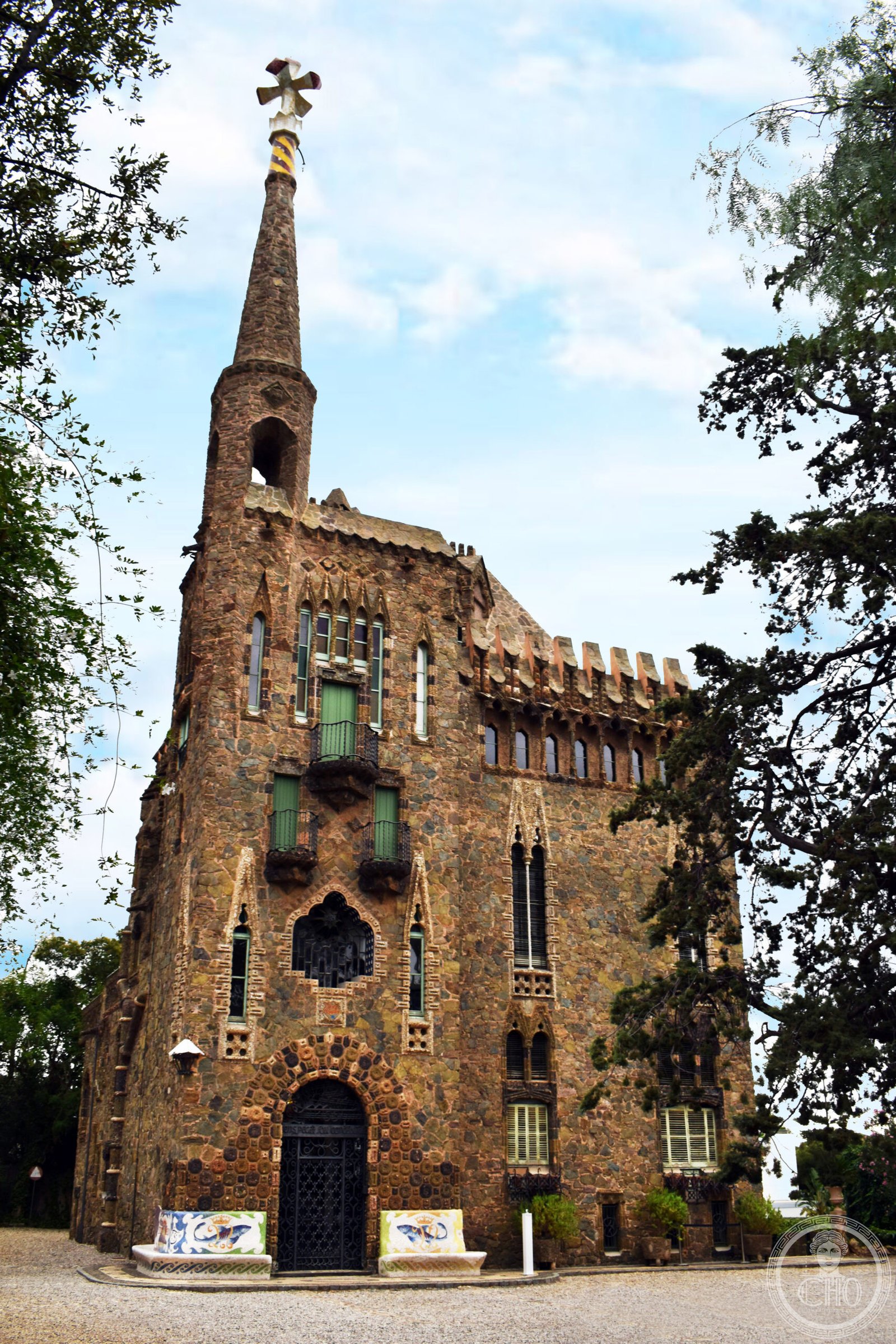
Gaudí built a castle on the ruins of a real one — a private house disguised as the memory of a king.
At a glance
Torre Bellesguard, also called Casa Figueras, is a Modernista manor house in the Sarrià-Sant Gervasi district of Barcelona, designed by Antoni Gaudí and built between 1900 and 1909. Its name means “beautiful view”. The ground it stands on was once the site of a country residence of Martin the Humane, king of Aragon and count of Barcelona, in the early fifteenth century. Gaudí honoured that history by giving the house the look of a medieval castle, with battlemented walls, narrow windows and a tall, slender spire — while building it with the structural daring of his own time.
Key facts
- Architect: Antoni Gaudí
- Built: 1900–1909
- Also known as: Casa Figueras
- Site: a former castle of Martin I of Aragon
- Collaborators: Joan Rubió; mosaics by Domènec Sugrañes
- District: Sarrià-Sant Gervasi, Barcelona
History
The estate carried deep meaning for Catalonia: in the early fifteenth century King Martin the Humane kept a residence here, and when he died without an heir in 1410 the medieval Crown of Aragon effectively came to an end.
By the time Jaume Figueras and his wife bought the land in 1900, only a few walls and a courtyard of the old castle survived. They commissioned Gaudí, who chose to evoke the lost castle rather than copy it, building from 1900 to 1909.
He was assisted on the project by Joan Rubió, while Domènec Sugrañes created the mosaics that decorate the house. Bellesguard is now open to visitors.
What you see
The house rises as a tall, narrow block of local stone and brick, its straight, castle-like walls topped by crenellations and a steep spire crowned with the four-armed cross Gaudí favoured. Pointed windows and a sober palette reinforce the medieval mood.
The Gothic look is only skin-deep: behind it Gaudí used brick vaulting and inclined supports with great structural invention, and trencadís mosaics enliven the gatehouse and details. It is a meeting of romance and engineering, a castle reasoned out as much as imagined.
Practical information
- Bellesguard is open to visitors; check current days, hours and guided-tour times.
- The terraces give wide views over Barcelona, true to the name.
- Time needed: 1–1.5 hours with a guided visit.
Getting there
Bellesguard sits on the lower slopes of Tibidabo in Sarrià-Sant Gervasi, in the upper part of Barcelona, reached by city bus or a walk from the FGC suburban railway.
Nearby
- Park Güell, across the upper city.
- The Collserola hills and the Tibidabo summit.
- The Modernista villas of the Sarrià district.
Sources
- Wikipedia (EN), “Bellesguard”.
- Catalan cultural heritage inventory.
Find it on the map
See this place and what’s around it →Record researched and written by Luigi De Marchi for Cultural Heritage Online, 2026.

📷 Become a Cultural Heritage Online photographer
Share your photos of places: they stay published under your name as the author. The more they're seen, the more you get noticed — and soon a contest will reward the most appreciated photos.
Log in or sign up free to add a photoIs this page about you?
This page is read by travellers and heritage enthusiasts who find it on Google. Tell us how you are connected to this place and we will take it from there.