
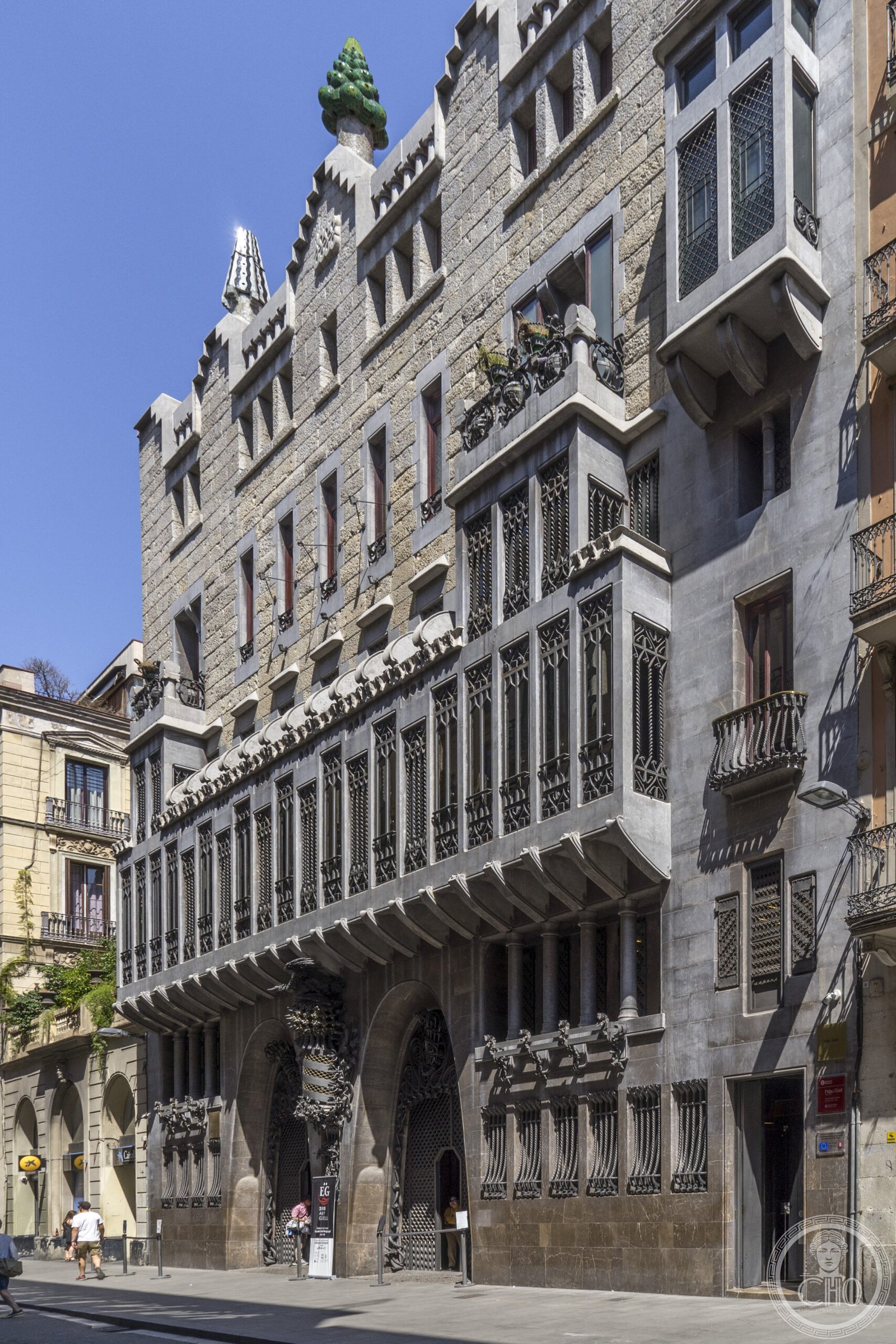
A town palace built to impress, where a coffered ceiling is pierced with holes so lamplight could fake a night sky.
At a glance
Palau Güell is a mansion designed by Antoni Gaudí (1852–1926) for the industrial magnate Eusebi Güell, built between 1886 and 1890 on Carrer Nou de la Rambla in the El Raval quarter. It is one of the architect’s early masterpieces and forms part of the UNESCO World Heritage Site “Works of Antoni Gaudí”. The house turns on a great central hall for receiving high society, and on the inventive theatrics — hidden viewing windows, a pierced dome — that Gaudí used to stage the life of a wealthy household.
Key facts
- Architect: Antoni Gaudí
- Built: 1886–1890
- Patron: Eusebi Güell, industrialist
- Address: Carrer Nou de la Rambla, El Raval
- Feature: parabolic-arch entrance gates in forged iron
- Status: UNESCO World Heritage; restoration completed 2011
History
Eusebi Güell, Gaudí’s most important patron, wanted a residence close to his family’s house on the Rambla. The result, raised between 1886 and 1890, was an urban palace organised around entertaining: carriages drove in through the iron gates, animals were led down a ramp to the basement stables where the servants lived, while guests climbed to the receiving rooms above.
Between the two entrance gates Gaudí set a bronze phoenix, an emblem of the cultural and economic revival of Catalan society. The walls of the receiving room concealed small high windows, from which the owners could preview arriving guests and adjust their welcome accordingly.
Public visits were suspended in 2004 when weak original stone was found to have cracked, causing structural problems. Restoration was completed in April 2011, and the palace is once again fully open.
What you see
The street front is austere for Gaudí: grey stone, twin parabolic arches, and ironwork patterned like seaweed and, in places, a horsewhip. The drama is saved for inside.
The main party room rises through several floors to a tall dome perforated with small holes; at night, lanterns were hung outside so the points of light read as stars. On the roof, a forest of chimneys and the central spire are sheathed in coloured tile, an early outing for the broken-ceramic technique Gaudí would make famous.
Practical information
- Palau Güell is open to the public as a museum; check current hours and closing days.
- Allow time for the roof terrace and its tiled chimneys.
- The street is narrow; the facade is best read from across the road.
- Time needed: about an hour.
Getting there
The palace is on Carrer Nou de la Rambla, a minute from the Rambla itself and close to the Liceu and Drassanes metro stations in central Barcelona.
Nearby
- The Rambla and the Gothic Quarter.
- El Raval, with the MACBA contemporary art museum.
- The Eixample Modernisme cluster, a short ride north.
Sources
- Wikipedia (EN), “Palau Güell”.
- UNESCO World Heritage List, “Works of Antoni Gaudí”.
- Palau Güell official site.
Find it on the map
See this place and what’s around it →Record researched and written by Luigi De Marchi for Cultural Heritage Online, 2026.

📷 Become a Cultural Heritage Online photographer
Share your photos of places: they stay published under your name as the author. The more they're seen, the more you get noticed — and soon a contest will reward the most appreciated photos.
Log in or sign up free to add a photoIs this page about you?
This page is read by travellers and heritage enthusiasts who find it on Google. Tell us how you are connected to this place and we will take it from there.