Italian Rationalism is the country’s great modern paradox. In barely fifteen years between the wars, a generation of young architects gave Italy some of the cleanest buildings in twentieth-century Europe — glass-walled, white, geometric, stripped of every cornice and column — and did so under a regime that elsewhere demanded marble eagles and imperial arches. The result is a built landscape you can still tour today, from a Como lakefront to a drained marsh south of Rome. This is the map.
A manifesto written by twenty-somethings
The movement has a birth certificate. In 1926 and 1927 a group of seven recent graduates from the Politecnico di Milano — remembered simply as Gruppo 7 — published a series of articles arguing that Italy needed a modern architecture of its own: rational, honest about its materials, indebted to the new European avant-garde but rooted in the clarity of the Mediterranean tradition. Among them was Giuseppe Terragni, who would become the movement’s purest talent and die young, at thirty-nine, in 1943.
What set the Italians apart was the tension they lived inside. Their Razionalismo ran in parallel with the heavier, monument-minded Novecento favoured by the establishment, and the two competed for public commissions throughout the 1930s. That competition is the real subject of any rationalist grand tour: nearly every building below is an argument about what a modern nation should look like.
Como: the laboratory
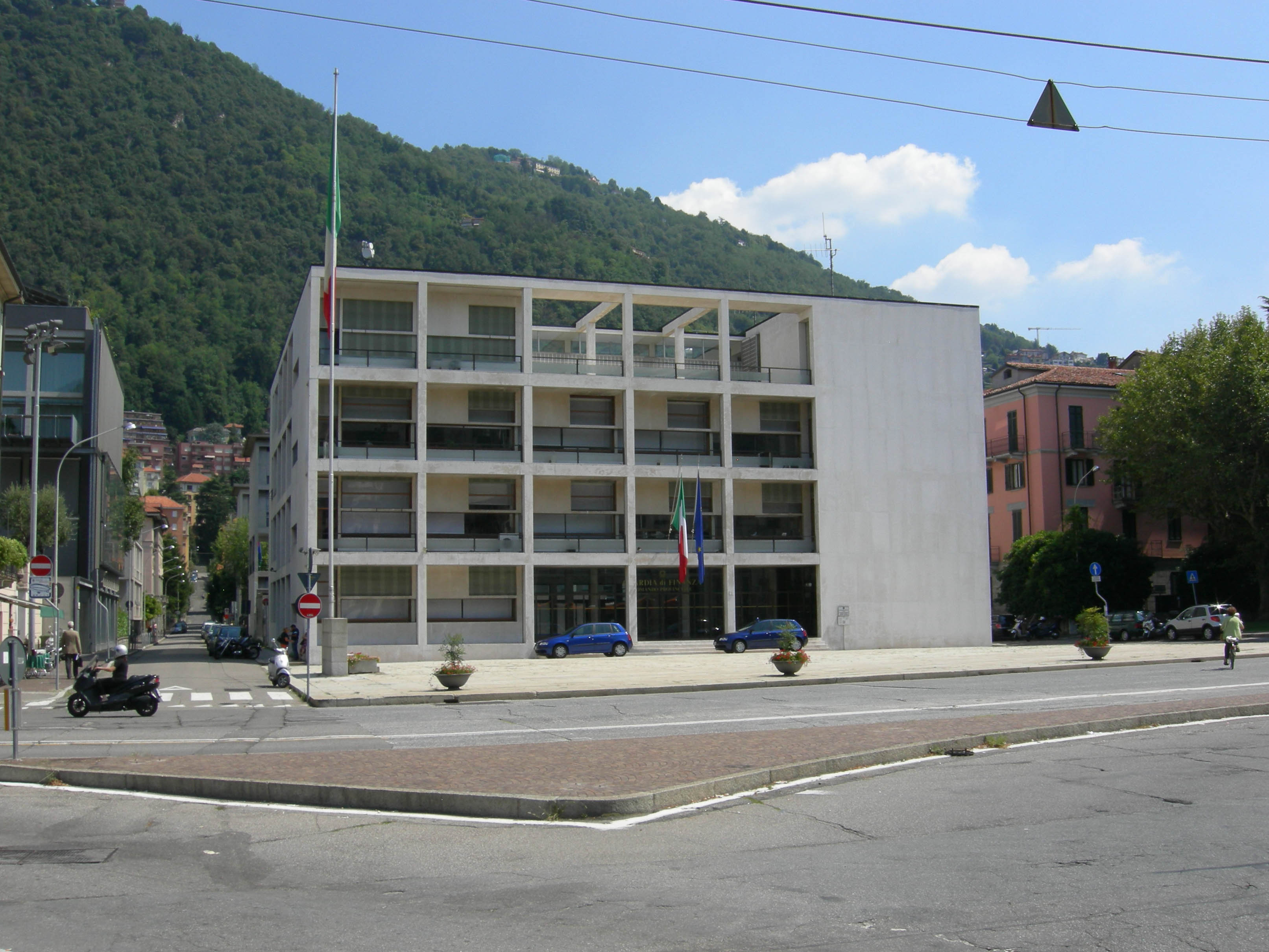
No city holds more of the story per square kilometre than Como, Terragni’s home town. It begins on a quiet residential avenue with the Novocomum, the apartment block he completed in 1929 while still in his twenties. He submitted a tame neoclassical drawing to the planning office and built something else entirely; when the scaffolding came down to reveal glazed cylindrical corners, the scandal made him famous. A few hundred metres away stands the building that made him canonical, the Casa del Fascio of 1936 — a perfect half-cube of white marble whose glass-walled interior Terragni described as an architecture of total transparency. Stripped now of its original politics, it survives as a lesson in proportion and daylight.
Milan and Turin: the modern apartment
In Milan, Terragni worked with Pietro Lingeri on a run of apartment houses that brought Rationalism into the speculative market. The finest is Casa Rustici on Corso Sempione, finished in 1935, where two parallel blocks are tied together at every floor by slender suspended walkways across an open courtyard. Turin had begun even earlier: the Casa Gualino, designed by Giuseppe Pagano and Gino Levi-Montalcini around 1928, is usually called the first rationalist house in the city, and Pagano went on to become the movement’s most influential editor and critic.
Rome: the regime builds big
Rome is where the argument turned monumental. At the Foro Italico sports complex, Enrico Del Debbio ringed his Stadio dei Marmi with sixty marble athletes, a frankly classical idea executed with modern restraint. Closer to pure Rationalism is Adalberto Libera and Mario De Renzi’s Palazzo delle Poste in the Ostiense district, a 1933 post office whose long glazed front and floating canopy still read as effortlessly contemporary. Both belong to the same decade and the same city, and they could hardly be more different.
The new towns: a country drawn from zero
The boldest experiment was demographic. To settle the newly drained Pontine Marshes south of Rome, the regime founded a string of brand-new towns in the mid-1930s, designed whole. Sabaudia, laid out in 1934 by Cancellotti, Montuori, Piccinato and Scalpelli, is the masterpiece — a calm grid of white volumes and a slender civic tower, modern enough that the artists and writers of postwar Italy adopted it as a retreat. Nearby Latina kept a more theatrical edge, summed up by Oriolo Frezzotti’s Palazzo M, whose plan spells a single monumental letter.
North-east: the coast and the Lido
The movement reached the Adriatic too. On the Venetian Lido, the Palazzo del Casinò of 1938 gave the world’s oldest film festival a Rationalist front of horizontal stone and glass. Inland at Bologna, the great elliptical Stadio Renato Dall’Ara, opened in 1927 with its tall brick Marathon Tower, shows how quickly the new architecture was absorbed into civic life across the north.
How to read these buildings now
Eighty years on, the politics that paid for much of this architecture has collapsed, and the buildings have outlived it. That is exactly what makes them worth visiting with open eyes. Look past the dedications and the dates and you find a coherent body of work — honest structure, generous light, proportions you can read at a glance — that earned Italy a permanent place in the history of modern architecture. Start in Como, follow the coast or the new towns, and the whole argument unfolds in stone, marble and glass.
On video
Sources
- S1 — Ciucci, Giorgio. Gli architetti e il fascismo: architettura e città 1922-1944. Einaudi, 2002. ISBN 978-88-06-16310-5.
- S2 — Nicoloso, Paolo. Architetture per un'identità italiana. Einaudi, 2012. ISBN 978-88-06-19086-6.
Spotted an error? Write to editorial@culturalheritageonline.com and we correct it the same day.