

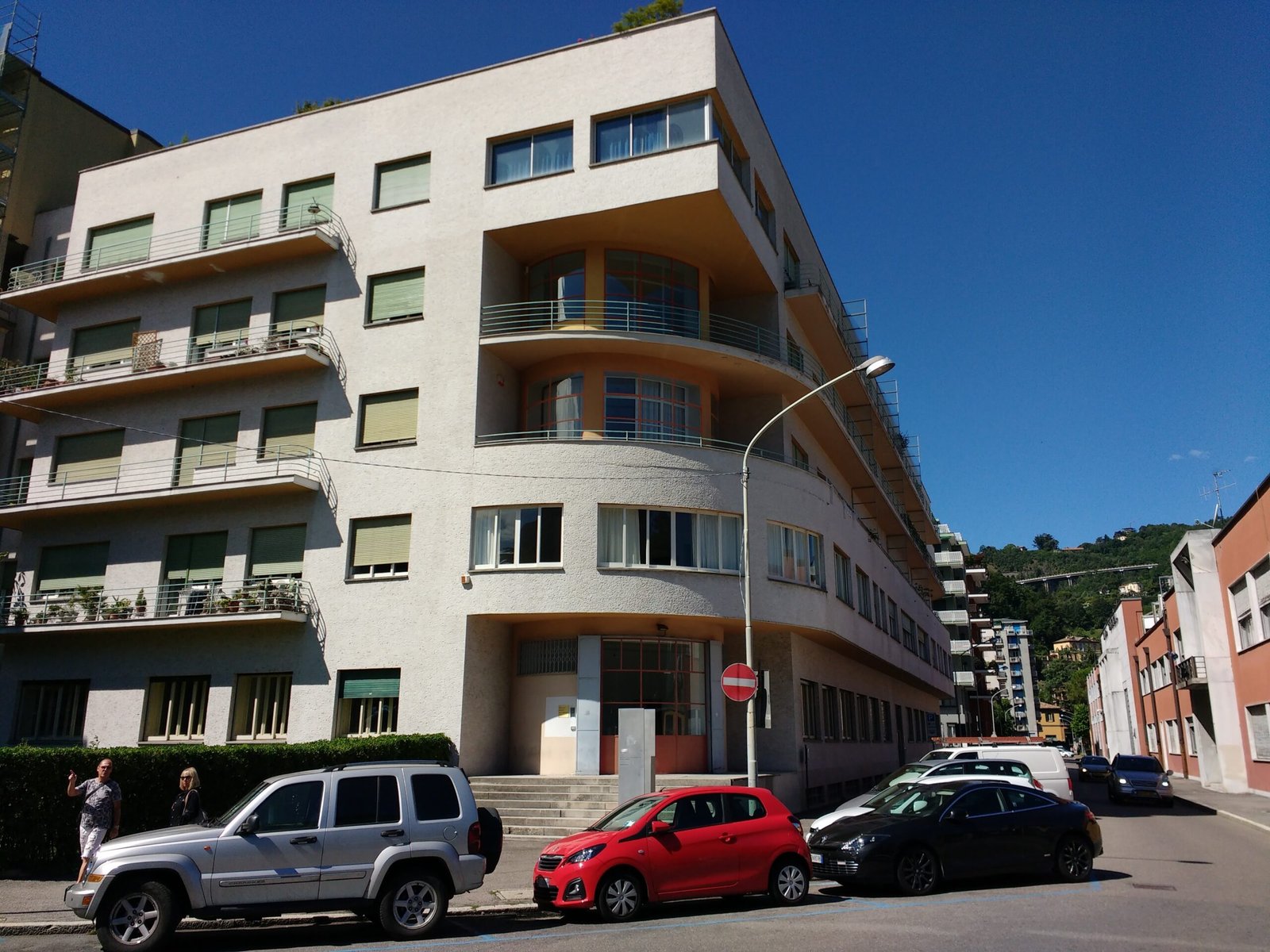
The Novocomum is the building that announced Giuseppe Terragni. Completed in 1929, when the architect was just twenty-five, this apartment block on the edge of Como’s lake hid a radical modern design behind a neoclassical drawing — and when the scaffolding came down, the city found itself looking at the first openly Rationalist building in Italy, its corners dissolved into glazed cylinders.
- Address
- Viale Giuseppe Sinigaglia, 22100 Como CO
- Period
- Designed and built 1928–1929
- Architect
- Giuseppe Terragni (1904–1943)
- Client
- Società Novocomum, a property company from Olgiate Comasco
- Style
- Italian Rationalism (Razionalismo italiano)
- Layout
- Five above-ground floors, with eight apartments on each of the upper levels
- Status
- Still in residential use
- Coordinates
- 45.8131° N, 9.0732° E
Visit on the map
Viale Sinigaglia, Como · 45.8131° N, 9.0732° E
Download for your navigator
A single waypoint, ready for GPS apps, navigators, and contacts.
In 1927 the Società Novocomum, a property company from Olgiate Comasco, commissioned a young and almost unknown architect to design a speculative apartment block on Viale Sinigaglia, between the city centre and Como’s lakefront stadium. Giuseppe Terragni was twenty-three. The drawings he submitted to the building authority showed a sober, vaguely neoclassical facade of the kind the commission expected, and on that basis the permit was granted. What rose behind the scaffolding over the next two years was something else entirely.
When the hoardings came down in 1929, Como saw a five-storey block whose corners had been carved away and replaced with cylindrical bodies entirely in glass, the wall seeming to peel back to reveal a drum of light at each angle. The horizontal banding, the ribbon windows and the floating corners owed an open debt to the European avant-garde — and to nothing in the local tradition. Scandal followed at once: Terragni had effectively built one design while approving another, and the municipality summoned an expert commission, chaired by the Milanese architect Piero Portaluppi, to decide whether the building damaged the decorum of the city.
The commission ruled that it did not, and the Novocomum stood. The verdict mattered well beyond Como. In 1930 the critic and architect Giuseppe Pagano reviewed the building enthusiastically in La Casa Bella, and the Novocomum became a manifesto in built form — proof that an Italian modern architecture was not only possible but already standing. Terragni would go on to the Casa del Fascio a few hundred metres away, but it was here, on a quiet residential avenue, that Razionalismo first declared itself in Italy. The building remains private apartments, lived in much as it was designed.
Resources & References
Editorial picks across Wikipedia, photo archives, and architectural databases.
Hero photograph by Giankywiki via Wikimedia Commons, CC BY-SA 4.0. Editorial text Cultural Heritage Online, OASIS Tech LLC USA.
Find it on the map
See this place and what’s around it →Record researched and written by Stefano Vigolo for Cultural Heritage Online, 2026.


Events here — now on & upcoming
📷 Become a Cultural Heritage Online photographer
Share your photos of places: they stay published under your name as the author. The more they're seen, the more you get noticed — and soon a contest will reward the most appreciated photos.
Log in or sign up free to add a photoIs this page about you?
This page is read by travellers and heritage enthusiasts who find it on Google. Tell us how you are connected to this place and we will take it from there.