

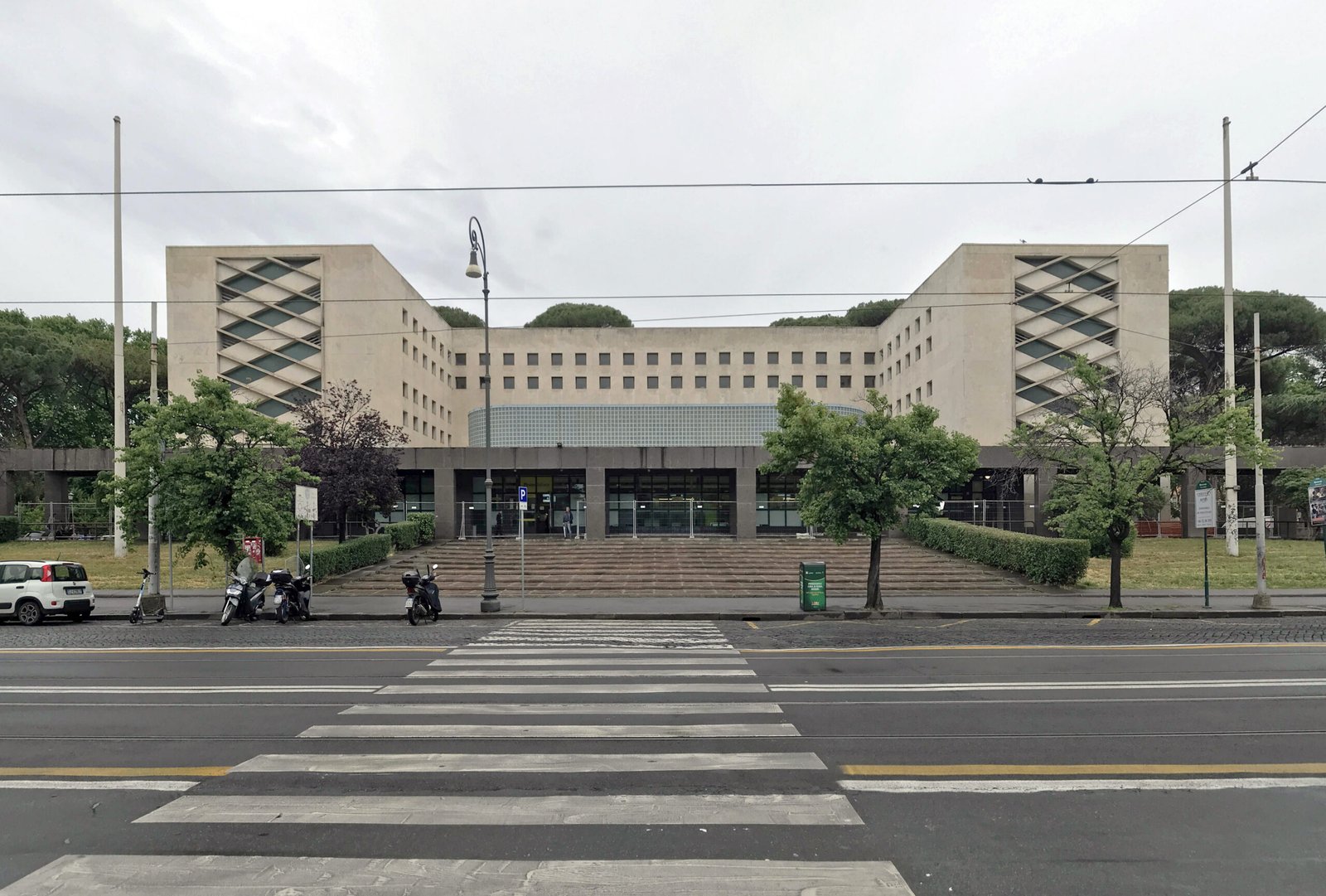
Adalberto Libera and Mario De Renzi built the Ostiense post office between 1933 and 1935 as a long, low travertine slab on the slope between Aventino and San Saba. Inaugurated on 28 October 1935, the building is one of the cleanest statements of Italian rationalism in the capital and is still operated by Poste Italiane as a working post office.
At a glance
The Palazzo delle Poste Ostiense stretches along Via Marmorata, the wide street that connects the Tiber to the slope of the Aventine. Libera and De Renzi designed it as a single horizontal block faced in travertine, with a long colonnade marking the entrance and a stripped-down classicism reduced to proportion, material and rhythm. Commissioned by the Ministry of Posts and Telegraphs during the rapid expansion of public services under the Fascist regime, the building opened to the public on 28 October 1935 and has served the southern districts of Rome continuously since. Today it is owned by Poste Italiane and remains a fully operational post office, a rare case of a 1930s public building still used for its original function.
Key facts
- Architects: Adalberto Libera (1903–1963) and Mario De Renzi (1897–1967).
- Built: 1933–1935.
- Opened: 28 October 1935.
- Style: Italian rationalism.
- Commissioned by: Ministry of Posts and Telegraphs (Ministero delle Poste e dei Telegrafi).
- Owner / operator: Poste Italiane, working post office.
- Address: Via Marmorata, San Saba / Aventino, Roma Capitale, Lazio, Italy.
- Coordinates: 41.8779° N, 12.4804° E (Google Maps).
History
The commission belongs to a campaign launched in 1933 to build new post offices for the rapidly growing peripheral districts of Rome. Libera, born in Villa Lagarina in 1903 and trained between Parma and the Roman scene of the late 1920s, had already become one of the most visible voices of Italian rationalism through the Movimento Italiano per l’Architettura Razionale (MIAR) and through the temporary facade he had designed with De Renzi the previous year for the Mostra della Rivoluzione Fascista at the Palazzo delle Esposizioni. De Renzi, six years older and Roman by training, brought an established practice in housing and public buildings, including work at the Garbatella borgata-giardino and the Palazzi Federici on viale XXI Aprile.
The two architects worked on the Ostiense project between 1933 and 1935 and delivered a building that became, alongside Libera’s later Casa Malaparte and his pavilions for the E.42 quarter, one of the canonical works of his career. The official opening on 28 October 1935 placed the new post office at the heart of a district then under heavy transformation, between the gasometer of Ostiense, the slaughterhouse at Testaccio and the new residential blocks climbing toward San Saba. The building has continued to serve as a public post office through the post-war decades and the privatisation of the Italian postal service, never converted to other uses.
The Ostiense palazzo also belongs to the wider story of Libera and De Renzi as a working pair: the same year they signed the Italian pavilion for the Chicago World’s Fair, and in 1934 they would compete together, with Giuseppe Vaccaro, for the unbuilt Palazzo del Littorio on Via dell’Impero. The Ostiense post office is the most fully realised public commission of that partnership in Rome.
What you see
The building reads from Via Marmorata as a long horizontal volume, low to the street and faced entirely in travertine. The entrance front is dominated by a deep colonnade of slim travertine pillars set under a flat overhang, an austere portico that filters daylight into the public hall behind and gives the facade its only strong shadow line. There is almost no ornament: no cornices, no orders, no symbolic apparatus. The architectural language is reduced to the relation between the wall, the columns and the long horizontal cut of the entablature, in keeping with the principles of Italian rationalism as Libera had been formulating them since the late 1920s.
The interior, organised around the banking hall, develops the same logic on a smaller scale, with clean wall surfaces, exposed structural rhythm and natural light pulled through tall openings. The proportion of the colonnade and the bare travertine cladding remain the dominant images of the building, and the reason it is still photographed and studied as one of the clearest built statements of the rationalist generation in Rome.
Practical information
- Function: active public post office, open during Poste Italiane counter hours.
- Visit: the exterior and the entrance colonnade are freely accessible from Via Marmorata; the public hall can be entered during postal opening hours.
- Time needed: 15–25 minutes for the facade, the colonnade and the entrance hall.
- Best light: late morning, when the sun rakes along the travertine and the colonnade casts its deepest shadow.
Getting there
The building stands on Via Marmorata between the Aventine and the San Saba district, a short walk from Piramide / Ostiense station, served by Rome Metro line B and by the Roma–Lido suburban line. Trastevere station, on regional and FL1/FL3 lines, is about a kilometre to the west across the Tiber. From the historic centre, the post office can be reached on foot in about twenty minutes from the Bocca della Verità, walking south along Via di Santa Maria in Cosmedin and then west along Via Marmorata.
Nearby
- Aventine Hill: the early-medieval church of Santa Sabina, the Giardino degli Aranci and the Orange Garden viewpoint over the Tiber, a few hundred metres uphill.
- Testaccio: the former slaughterhouse, the Protestant Cemetery and the Pyramid of Cestius, west along Via Marmorata.
- Ostiense gasometer: the great industrial-era gas holder visible from the river, south along Via Ostiense.
Sources
- Adalberto Libera, Italian Wikipedia, biographical entry listing the Palazzo delle Poste di via Marmorata (1933–35) with Mario De Renzi.
- Mario De Renzi, Italian Wikipedia, biographical entry confirming the Ostiense commission and its rationalist character.
- Wikidata Q28322881 — Palazzo delle Poste Roma Ostiense: architects, opening date 28 October 1935, owner Poste Italiane, style rationalism, coordinates.
- Sergio Poretti, Progetti e costruzione dei Palazzi delle Poste a Roma 1933–1935, Edilstampa, Roma 1990.
- Luca Rivalta, Adalberto Libera, Mario De Renzi. Il Palazzo delle Poste a Roma, Alinea Editore, 2000.
Find it on the map
See this place and what’s around it →Record researched and written by Stefano Vigolo for Cultural Heritage Online, 2026.


Historical events at this place (1)
📷 Become a Cultural Heritage Online photographer
Share your photos of places: they stay published under your name as the author. The more they're seen, the more you get noticed — and soon a contest will reward the most appreciated photos.
Log in or sign up free to add a photoIs this page about you?
This page is read by travellers and heritage enthusiasts who find it on Google. Tell us how you are connected to this place and we will take it from there.