
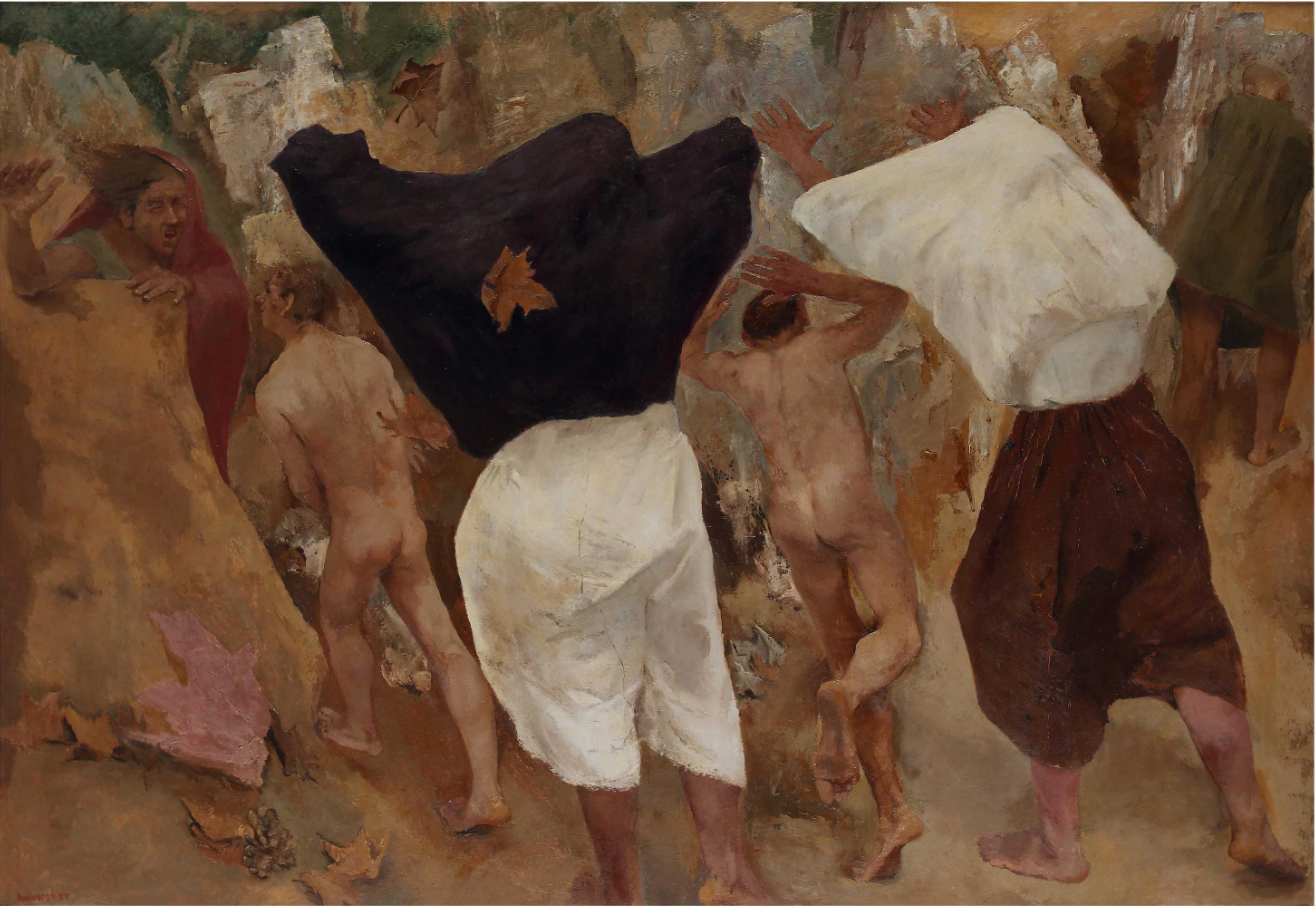
La tempesta is a painting created by Fausto Pirandello in 1938. The work belongs to the visual language of the Scuola romana, the Roman School movement to which Pirandello dedicated much of his artistic practice.
Pirandello’s approach to painting synthesised quotidian realism with a distinctive psychological depth. His pictorial method employed dense, thorny matter to convey both the unpleasant and pitiless aspects of life, translating brutal naturalist observation into a form of magic realism marked by archaic and metaphysical qualities. This vision reflected an intellectualist sensibility—a trait inherited, perhaps, from his father, the writer Luigi Pirandello, whose analytical and psychological spirit Pirandello sought to interpret through painting.
By 1938, Pirandello had moved through cubism and tonalism toward realist-expressionist forms. His participation in the literary magazine Corrente di Vita anchored his work within broader modernist currents of Italian culture during this period.
About Fausto Pirandello
Fausto Calogero Pirandello (1899–1975) was an Italian painter of the Scuola romana. After early experience in Paris between 1920 and 1930, where he encountered major artistic figures of the time, he committed himself to original and solitary exploration within the Roman School movement. His work stands as testimony to a painter who channelled his father’s literary sensibility into visual form.
Details
- Creator: Fausto Pirandello
- Year: 1938
- Movement: Scuola romana (Roman School), realist-expressionism
- Artistic approach: Magic realism with archaic and metaphysical qualities
On video
Frequently asked questions
Who was Fausto Pirandello?
Fausto Pirandello (1899–1975) was an Italian painter and member of the Scuola romana. He was the son of Nobel laureate Luigi Pirandello and developed a distinctive style blending realism with psychological intensity and metaphysical elements.
What artistic movements influenced this work?
By 1938, Pirandello’s style had evolved through cubism and tonalism toward realist-expressionist forms. His work synthesised quotidian realism with magic realism, marked by archaic and metaphysical qualities.
What does the painting’s style reveal?
The work exemplifies Pirandello’s approach to translating brutal naturalist observation into a form of intellectual, psychologically charged expression, employing dense pictorial matter to convey both visible reality and inner complexity.
Sources
- S1 — Pontiggia, Elena. Il Novecento Italiano. Abscondita, 2003. ISBN 978-88-8416-048-5.
- S2 — Bossaglia, Rossana. Il Novecento italiano. Electa, 1995. ISBN 978-88-435-6178-0.
Spotted an error? Write to editorial@culturalheritageonline.com and we correct it the same day.


