
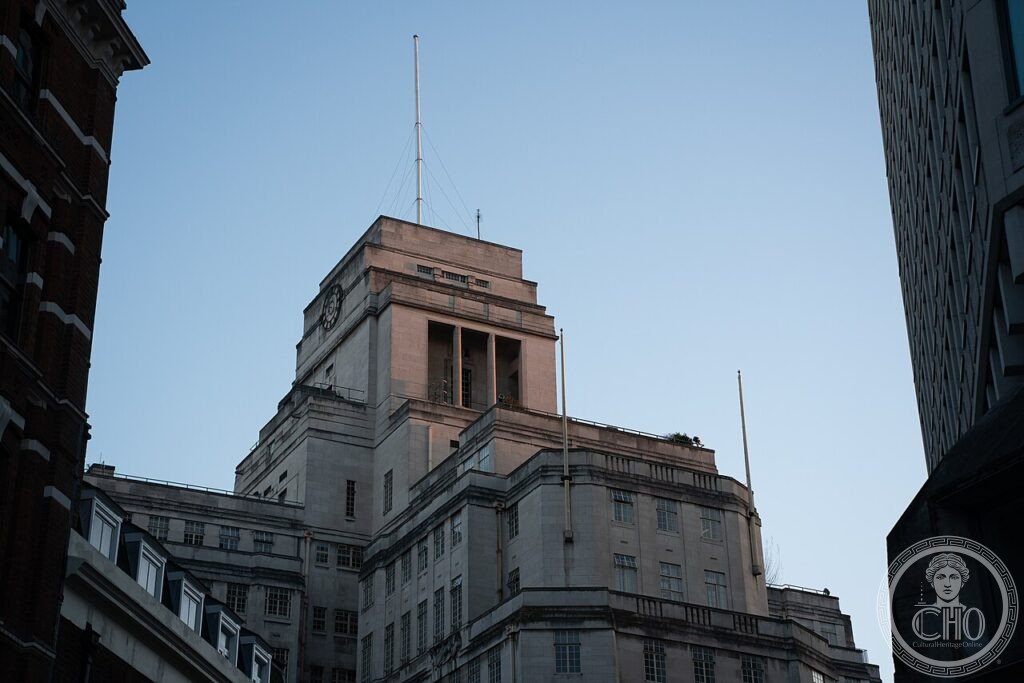

London’s first office skyscraper rose over a tube station: Holden’s cruciform tower for the Underground, carrying sculpture by Epstein, Gill and a 30-year-old Henry Moore. It is listed at Grade I.
At a glance
Built in 1927–1929 above St James’s Park station, 55 Broadway was the headquarters of the Underground Electric Railways of London — the empire of Lord Ashfield and Frank Pick that became London Transport. Charles Holden (1875–1960) designed it as a cruciform tower of Portland stone stepping up to 53.3 metres, a scale and massing inspired by American office buildings and unprecedented in London. Historic England calls it a milestone of twentieth-century design and arguably Holden’s best building; since 2011 it has stood at Grade I.
Key facts
- Built: 1927–1929
- Architect: Charles Holden of Adams, Holden & Pearson
- Client: Underground Electric Railways of London, under Lord Ashfield and Frank Pick
- Height: 175 ft (53.3 m) tower; the wings stop at exactly 80 ft, the limit of the 1894 Building Act
- Plan: Cruciform, set over St James’s Park station — massive girders carry the building above the District line
- Sculpture: Epstein’s Day and Night; eight Winds reliefs by Eric Gill, Henry Moore, Allan Wyon, Samuel Rabinovitch, Eric Aumonier and Alfred Gerrard
- Listing: Grade I, National Heritage List 1219790 (listed 1970, upgraded 2011)
- GPS: 51.499444, −0.133611 — View on Google Maps
History
Frank Pick, the Underground’s managing genius, wanted a headquarters that embodied the modern, unified transport system he was building — and gave Holden the corner of Broadway with a brief to be bold. The architect answered with a plan borrowed from his hospital work: a cross of office wings maximising daylight, braced by diagonal arches, rising to a central clock tower. The Truscon reinforced-concrete system came from Detroit, and so did the massing — Holden’s partner Pearson had photographed the General Motors Building on an American tour.
The sculpture programme made the building famous before it opened. Epstein’s Day and Night, primitive and unbeautified, provoked a press campaign in 1929; the row nearly cost Pick his position, and Epstein agreed to cut back the boy’s figure in Day. Above the sixth floor, six sculptors carved the eight Winds — among them the young Henry Moore, whose West Wind was his first public commission. London Transport and its successors worked here for ninety years; Transport for London moved out in the 2020s, but the exterior, and every sculpture, still belongs to the street.
What you see
Stand back on Broadway and read the stepped Portland-stone mass rising to the clock tower, then come close: the ground floor runs on blue-grey Norwegian granite columns with block capitals of black Belgian marble, and the rainwater hoppers carry ‘U 1929 D’ worked into the Underground roundel. Epstein’s Day faces the southeast entrance, Night the northeast; the eight Winds stretch horizontally on the pediments above the sixth floor, one per face of the cross — Gill’s medieval calm, Aumonier’s geometric South Wind, Moore’s fuller, freer West Wind on the north side of the east wing. Travertine-clad public arcades traverse the ground floor to the station.
Practical information
- The building is not generally open to visitors — but the entire sculpture programme is legible from the pavement; bring binoculars for the Winds
- The arcades to St James’s Park station normally remain open in station hours
- Free to view; 20–30 minutes for the full circuit of all eight facades
Getting there
The tower stands directly above St James’s Park station (District and Circle lines), one stop from Victoria and Westminster. St James’s Park itself is two minutes north; Westminster Abbey is a ten-minute walk east.
Nearby
- Senate House — Holden’s other Portland-stone tower of the 1930s, for the University of London
- BBC Broadcasting House — the other great institutional Deco headquarters of 1932
- Daily Express Building — Fleet Street’s black-glass Streamline answer
- St James’s Park — the royal park at the building’s doorstep
Sources
- Historic England, National Heritage List entry 1219790 — dates, architect, materials, plan, sculpture programme, listing history
- Historic England reasons for designation — “London’s first office skyscraper”, Ashfield and Pick context
- London Transport Museum — Epstein controversy of 1929
- Wikidata Q3286924 — coordinates
Find it on the map
See this place and what’s around it →Record researched and written by Luigi De Marchi for Cultural Heritage Online, 2026.
📷 Become a Cultural Heritage Online photographer
Share your photos of places: they stay published under your name as the author. The more they're seen, the more you get noticed — and soon a contest will reward the most appreciated photos.
Log in or sign up free to add a photoIs this page about you?
This page is read by travellers and heritage enthusiasts who find it on Google. Tell us how you are connected to this place and we will take it from there.