
William Morris looked at Victorian England’s machine-made interiors and concluded that beauty requires craft. His response — the firm of Morris & Co., the Kelmscott Press, the Red House — launched a revolution in applied arts that reached from Bexleyheath to Tokyo within twenty years.
At a glance
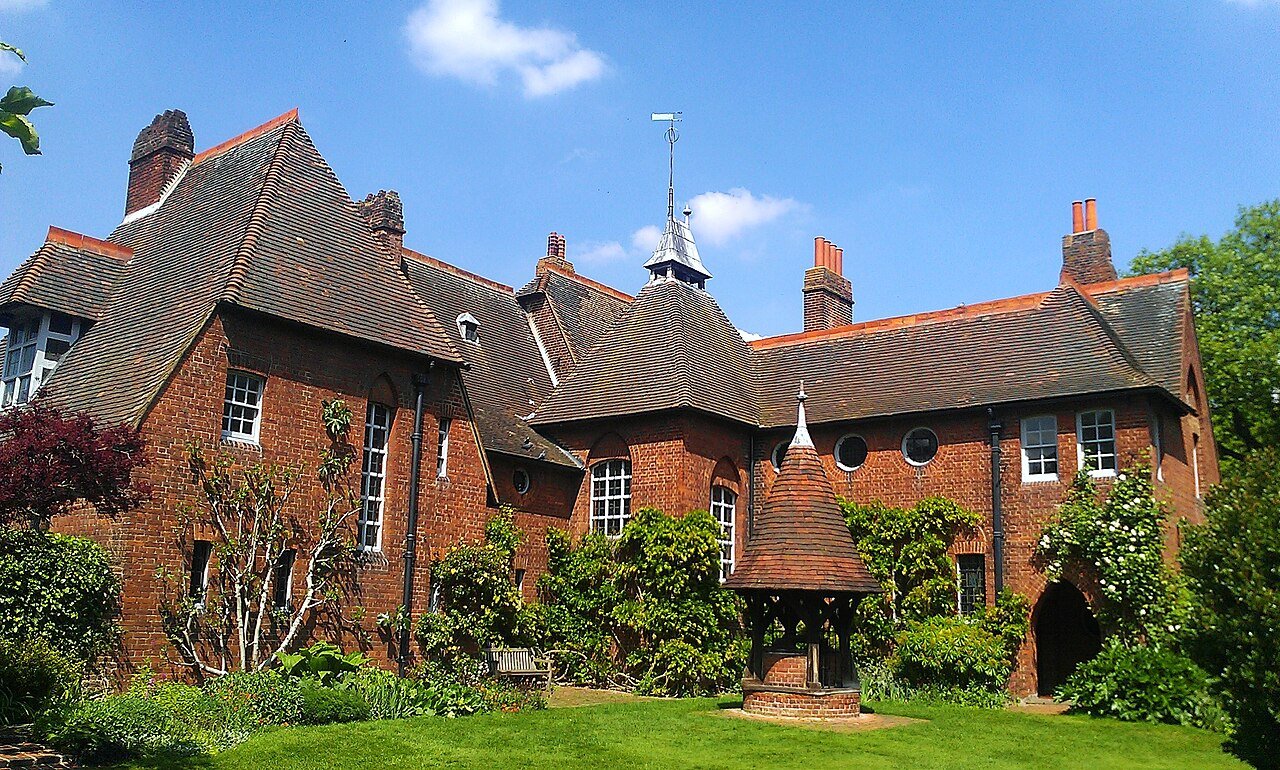
The Arts and Crafts movement emerged in London in the late 1850s as a direct reaction to the alienating products of industrial manufacture. William Morris — poet, designer, socialist, ecologist avant la lettre — provided its ideological programme: honest materials, visible craft processes, designs derived from natural forms observed at firsthand. Morris & Co. (founded 1861) brought that programme into the domestic market with wallpapers, textiles, stained glass and furniture that remain in production to this day. The Red House in Bexleyheath, designed by Philip Webb for Morris in 1860, is the physical foundation of the movement: a red-brick vernacular house built without Gothic ornament, where Morris and his circle — Burne-Jones, Rossetti, Faulkner — spent their weekends designing the interiors.
Key facts
- Country: England, United Kingdom
- Key period: 1860–1900 (Arts & Crafts movement)
- Key figure: William Morris (1834–1896) — designer, poet, political writer, founder of Morris & Co.
- Also notable: Philip Webb (architect, Red House), Edward Burne-Jones (stained glass), John Ruskin (intellectual precursor)
- Essential sites: Red House (Bexleyheath), William Morris Gallery (Walthamstow), V&A Museum (Morris, Gamble and Poynter Rooms), Holy Trinity Sloane Street, Kelmscott House (Hammersmith)
- Annual anniversaries: Morris nascita 24 marzo, Morris morte 3 ottobre
History
William Morris was born in Walthamstow, then a village east of London, on 24 March 1834, into a prosperous middle-class family. He studied at Oxford, where friendship with Edward Burne-Jones led him to John Ruskin’s writings and the Pre-Raphaelite circle. Morris intended originally to enter the Church, then considered painting, before arriving at architecture in the office of G. E. Street — where he met Philip Webb. Webb’s Red House (1860) was the first major commission he gave to a friend: a house built on the principle that beauty requires no applied ornament beyond the honest expression of structure and material.
Morris, Marshall, Faulkner & Co. (later Morris & Co.) was founded in 1861 to produce the decorative arts at the standards Morris demanded. The firm’s first major contract — the Green Dining Room at the Victoria and Albert Museum (1866–1868) — survives intact and is the most important publicly accessible Arts and Crafts interior in London. Morris’s wallpaper designs (Trellis, 1862; Willow Bough, 1887; Strawberry Thief, 1883) and his Jacquard-woven textiles remained in production through the twentieth century and are still available through Morris & Co. today.
In the 1880s Morris turned increasingly to political writing and to typography. He founded the Kelmscott Press in 1890, producing handcrafted books on handmade paper in typefaces he designed himself; the Kelmscott Chaucer (1896), with illustrations by Burne-Jones, is considered the most beautiful printed book of the nineteenth century. Morris died in Hammersmith on 3 October 1896; his doctor attributed the cause to “simply being William Morris, and having done more work than most ten men.”
What you see
The Red House (Red House Lane, Bexleyheath, DA6 8JF) is now in the care of the National Trust and open for guided tours. The high pointed arches, the red tile roof, the well in the garden and the painted settle in the entrance hall express the Arts and Crafts conviction that architecture and its furnishings should form a coherent whole. The painted ceiling of the drawing room — decorated by Morris and Burne-Jones — survives in fragmentary form. To reach it, take the Southeastern train to Bexleyheath from London Bridge (35 minutes) and walk 15 minutes from the station.
The William Morris Gallery (Lloyd Park, Walthamstow, E17) is the most comprehensive collection in the world: wallpapers, textiles, stained glass, ceramics, metalwork and books from all periods of his work, displayed in the Georgian house where Morris’s family lived in his childhood. It is free to enter and served by Walthamstow Central station (Victoria Line, 20 min from Oxford Circus). The V&A Museum’s Morris Rooms (Cromwell Road, SW7) are the most central option: three original public rooms from 1868 that Morris’s firm designed as the museum’s first public refreshment rooms — they have been in continuous use, in one form or another, since.
Practical information
- Red House: National Trust; Wed–Sun, timed guided tours; book at nationaltrust.org.uk
- William Morris Gallery: free entry, Wed–Sun 10:00–17:00; walthamforest.gov.uk/wmg
- V&A Museum: free entry; Morris Rooms on level 2 (refreshments available)
- Holy Trinity Sloane Street: free; open for Sunday services and by appointment
- Time needed: half-day for WMG or V&A; full day adding Red House day trip
Getting there
Heathrow Airport (LHR) connects to central London via the Elizabeth Line (Paddington, 28 min) or Heathrow Express (Paddington, 15 min). For the V&A, take the Piccadilly line to South Kensington (1 stop from Knightsbridge). For the William Morris Gallery, take the Victoria line to Walthamstow Central. For the Red House, take Southeastern trains from London Bridge to Bexleyheath (35 min).
Related in CHO
- Anniversario nascita: William Morris — 24 marzo 1834
- Anniversario morte: William Morris — 3 ottobre 1896
- Glasgow — Mackintosh and the Glasgow Style
- Brussels — Victor Horta and Art Nouveau Architecture
Sources
Find it on the map
See this place and what’s around it →Events here — now on & upcoming
- Birth Anniversary: William Morris — March 24, 183424 Mar 2027See the event →
- Death Anniversary: William Morris — October 3, 189603 Oct 2027See the event →
📷 Become a Cultural Heritage Online photographer
Share your photos of places: they stay published under your name as the author. The more they're seen, the more you get noticed — and soon a contest will reward the most appreciated photos.
Log in or sign up free to add a photo