
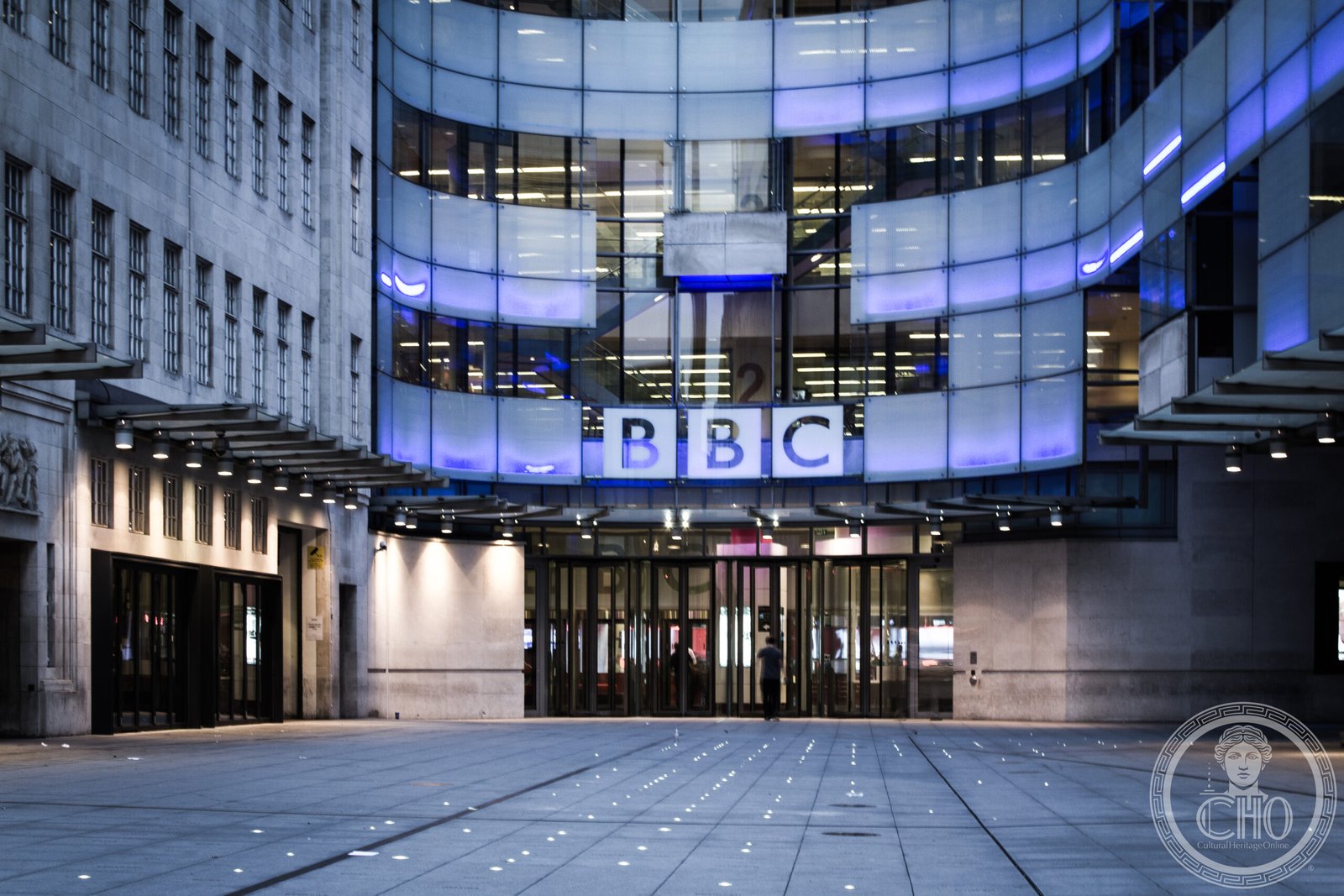
Rising at the curve of Portland Place and Langham Place in Westminster, BBC Broadcasting House has been the nerve centre of British public broadcasting since its first broadcast in 1932. Designed by architect George Val Myer with interiors by Raymond McGrath, the building is an exercise in restrained Art Deco authority: its Portland stone facade, curved prow, and Eric Gill sculptures of Prospero and Ariel project the gravity of a civic institution while gesturing toward the sleek modernism of the interwar era. Inside, nine floors above and three below ground house a labyrinth of studios engineered to achieve near-perfect acoustic isolation — an architectural problem never before solved at such scale. Today it remains the headquarters of the BBC, broadcasting Radio 1, 2, 3, 4, the World Service, and BBC News to audiences across the globe: a living monument to the ambition of public media in the twentieth century.
At a glance
- Type
- Broadcasting headquarters
- Period
- 1928–1932
- Style
- Art Deco
- Location
- Portland Place & Langham Place, Westminster, London
- Coordinates
- 51.5186° N, 0.1438° W
- Architect(s)
- George Val Myer; Raymond McGrath (interiors); Marmaduke T. Tudsbery (civil engineer)
Overview
Broadcasting House is the flagship building of the BBC and one of London’s most recognisable Art Deco landmarks. Construction began on 21 November 1928 and the first broadcast went out on 15 March 1932. Faced in Portland stone and structured around an inner brick core housing the studios, the design solved the unprecedented challenge of placing acoustically isolated broadcast spaces within a functioning urban office building. A Grade II* listed structure since 1981, it was joined by the John Peel Wing in 2005 — expanded and renamed in 2012 — integrating modern production facilities while preserving the historic fabric.
History
The BBC outgrew its first London premises at Savoy Hill and commissioned a purpose-built headquarters fit for the expanding ambitions of public broadcasting. George Val Myer won the commission; structural engineer Marmaduke Tudsbery devised the dual-construction system separating the acoustic core from the office envelope. The first musical programme was led by bandleader Henry Hall; the first news bulletin was read by Stuart Hibberd on 18 March 1932. The building was damaged by bombing during the Second World War yet continued broadcasting throughout. MI5 maintained a vetting office here from 1937. The official opening ceremony took place on 15 May 1932, cementing Broadcasting House as a symbol of the BBC’s public mandate.
Architecture & Design
The building presents two distinct structural identities. The inner core is a windowless brick structure engineered for acoustic isolation, housing studios stacked vertically. The outer envelope is a steel-framed, Portland stone-clad structure following the curve of the street junction, its rounded prow evoking a ship’s bow. Eric Gill’s sculptures of Prospero and Ariel — characters from Shakespeare’s The Tempest symbolising the transmission of knowledge — adorn the facade. Raymond McGrath’s interiors combined modernist materials with warm detailing. The BBC Radio Theatre, originally a concert hall, remains one of London’s intimate performance venues. A 2005–2012 extension by Sir Richard MacCormac integrated a glazed atrium linking old and new wings.
Cultural significance
Broadcasting House is inseparable from the BBC’s identity and, by extension, from the idea of public service broadcasting itself. It broadcast through two world wars, shaped the sound of the twentieth century, and launched countless careers in journalism, music, and drama. Eric Gill’s Ariel sculptures remain among the most recognisable public artworks in London. Jaume Plensa’s sculpture “Breathing,” installed in the forecourt, memorialises journalists killed in duty. George Orwell, who worked for the BBC’s Eastern Service during the war and is thought to have drawn inspiration from the building for the Ministry of Truth in Nineteen Eighty-Four, is commemorated by a bronze statue unveiled here in 2017.
Visiting today
Broadcasting House is an active BBC workplace not open to general public tours. The exterior — including the Eric Gill sculptures, the Orwell statue, and Plensa’s “Breathing” memorial — can be viewed freely from the pavement. The BBC Radio Theatre hosts ticketed recordings of radio programmes open to studio audiences; tickets are available via BBC Studio Audiences. The nearby BBC Experience at MediaCityUK in Salford offers an immersive behind-the-scenes visit for those wishing to explore the corporation’s history in depth.
Getting there
Broadcasting House sits at the junction of Portland Place and Langham Place in Westminster. The nearest Underground station is Oxford Circus (Bakerloo, Central, and Victoria lines), approximately five minutes north along Regent Street. Great Portland Street (Circle, Hammersmith & City, and Metropolitan lines) is also close. Numerous bus routes serve Regent Street and Oxford Street. Santander Cycles docking stations nearby make cycling a practical option.
Sources & resources
Find it on the map
See this place and what’s around it →Record researched and written by Luigi De Marchi for Cultural Heritage Online, 2026.
📷 Become a Cultural Heritage Online photographer
Share your photos of places: they stay published under your name as the author. The more they're seen, the more you get noticed — and soon a contest will reward the most appreciated photos.
Log in or sign up free to add a photoIs this page about you?
This page is read by travellers and heritage enthusiasts who find it on Google. Tell us how you are connected to this place and we will take it from there.