
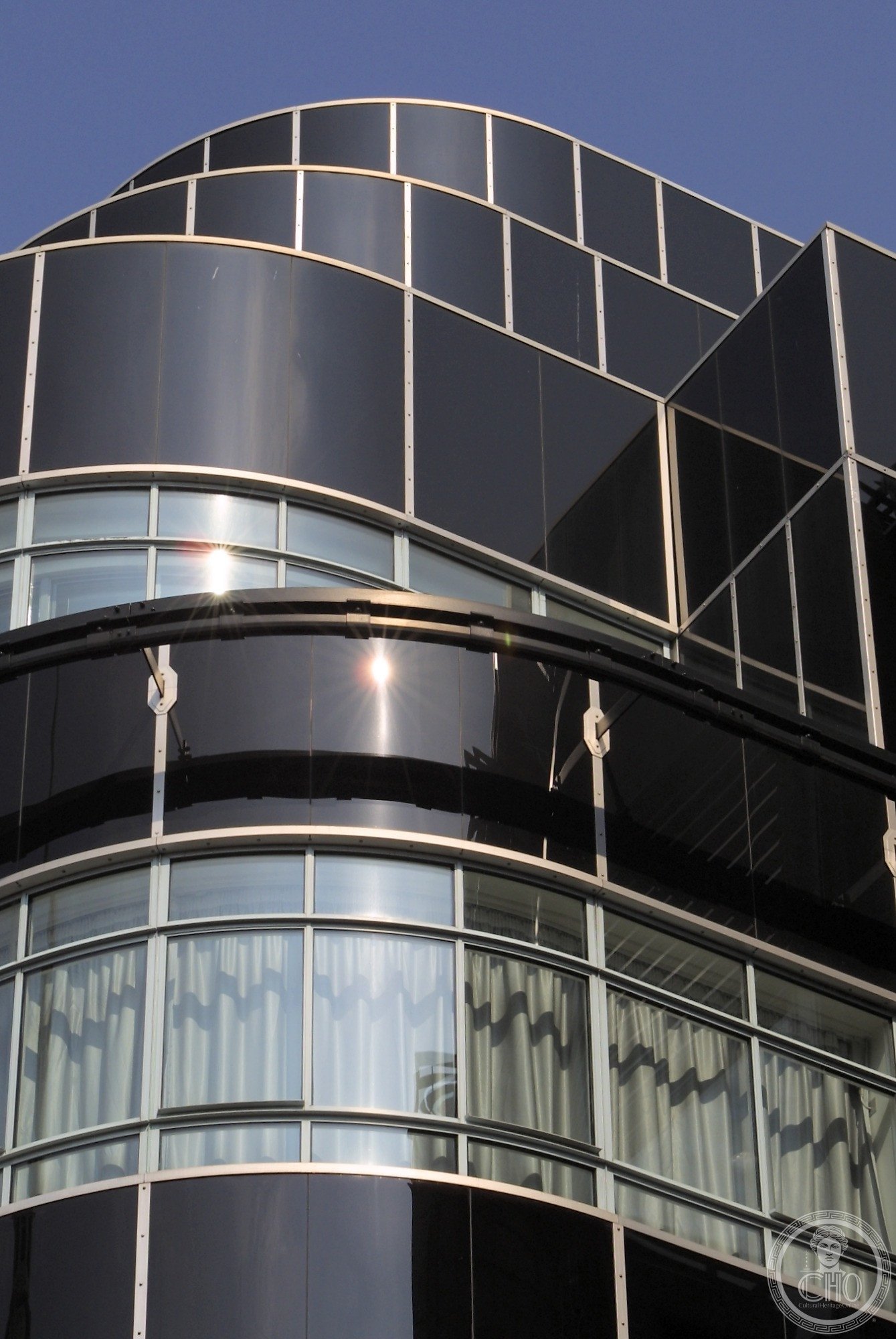
At 120 Fleet Street, the former headquarters of the Daily Express newspaper is among the most thrilling pieces of commercial architecture in London. Built in 1932 to designs by Ellis and Clark — with the lobby created by Robert Atkinson and the structural frame engineered by Sir Owen Williams — the building wraps its reinforced concrete skeleton in a curtain of black vitrolite glass and chromium strips, its corners rounded in the manner of Streamline Moderne at its most self-assured. The interior lobby is a spectacular chamber of silver, gilt, and plaster relief, featuring Eric Aumonier’s decorative panels titled “Britain” and “Empire” and a silvered pendant lamp of extraordinary delicacy. Grade II* listed, the building was comprehensively refurbished in 2000 and is now occupied by Goldman Sachs, its exterior unchanged and its lobby meticulously restored. It stands as a monument to Fleet Street’s golden age and to the ambition of British popular journalism between the wars.
At a glance
- Type
- Commercial office building (former newspaper headquarters)
- Period
- 1932
- Style
- Streamlined Art Deco / Streamline Moderne
- Location
- 120 Fleet Street, City of London
- Coordinates
- 51.5144° N, 0.1060° W
- Architect(s)
- Ellis and Clark; Robert Atkinson (lobby); Sir Owen Williams (structural engineer)
Overview
The Daily Express Building is a landmark of interwar commercial architecture and one of Fleet Street’s most glamorous survivors. Completed in 1932, it was purpose-built as the London headquarters of Lord Beaverbrook’s Daily Express, then one of the most widely read newspapers in the world. Its black vitrolite facade with chromium detailing represented a radical departure from the stone-faced neoclassicism that dominated Fleet Street, projecting modernity and mass-media confidence. Grade II* listed, it underwent full refurbishment in 2000 by John Robertson Architects, with the lobby interior recreated from historical photographs to restore its original silvered splendour.
History
Lord Beaverbrook commissioned a new London home for the Daily Express in the late 1920s as circulation climbed toward the two million mark. Ellis and Clark produced a design that broke decisively with Fleet Street convention. Sir Owen Williams — engineer of Wembley Stadium and the Boots D10 factory — devised a stacked portal frame in reinforced concrete, enabling the black glass curtain wall to be hung without traditional masonry support. The building opened in 1932 and served as the Express headquarters until the newspaper’s gradual departure from Fleet Street in the 1980s. After years of partial occupation, Goldman Sachs undertook a comprehensive refurbishment in 2000, preserving the facade and commissioning a recreation of the Atkinson lobby from archival evidence.
Architecture & Design
The exterior is clad in black vitrolite — an opaque glass panel — with horizontal chromium strips and areas of clear glazing, the composition sweeping around curved corner bays that give the building its streamlined dynamism. Owen Williams’s cantilevered reinforced concrete frame allowed the curtain wall to be non-load-bearing, a technique still unusual in Britain in 1932. Robert Atkinson’s lobby is a masterpiece of Deco interior design: plaster reliefs by Eric Aumonier depict allegorical scenes of “Britain” and “Empire”; the ceiling is silvered; a magnificent oval staircase rises through the space; a silvered pendant lamp hangs at the centre. Most original furniture was designed by Betty Joel. The 2000 refurbishment by John Robertson Architects preserved the lobby’s character while upgrading services throughout.
Cultural significance
The Daily Express Building embodies Fleet Street’s early twentieth-century dominance as the global capital of the English-language press. Its bold black facade announced a new era of mass-media confidence and modernity, and became an architectural touchstone for the idea that commerce could be as ambitious as high culture. Together with the Daily Telegraph Building and Reuters building nearby, it forms a remarkable concentration of interwar newspaper architecture. The lobby — with its imperial allegories rendered in the most modern of materials — encapsulates the particular tension of British modernity in the 1930s: simultaneously forward-looking and empire-minded.
Visiting today
The building is an active office occupied by Goldman Sachs and is not open to the general public. The exterior — one of the most striking black glass facades in London — can be appreciated freely from Fleet Street at any time. The lobby is occasionally accessible during Open House London, the annual heritage open weekend each September, when the restored Atkinson interior can be viewed. Architecture enthusiasts should also note the nearby Grade II* listed Daily Telegraph Building at 135 Fleet Street.
Getting there
120 Fleet Street lies in the City of London. The nearest Underground stations are Blackfriars (Circle and District lines) and City Thameslink rail, both a short walk west along Fleet Street. Temple station (Circle and District lines) is a similar distance to the east. Numerous bus routes serve Fleet Street and the Strand. Santander Cycles docking stations make cycling straightforward along the Embankment.
Sources & resources
Find it on the map
See this place and what’s around it →Record researched and written by Luigi De Marchi for Cultural Heritage Online, 2026.
📷 Become a Cultural Heritage Online photographer
Share your photos of places: they stay published under your name as the author. The more they're seen, the more you get noticed — and soon a contest will reward the most appreciated photos.
Log in or sign up free to add a photoIs this page about you?
This page is read by travellers and heritage enthusiasts who find it on Google. Tell us how you are connected to this place and we will take it from there.