
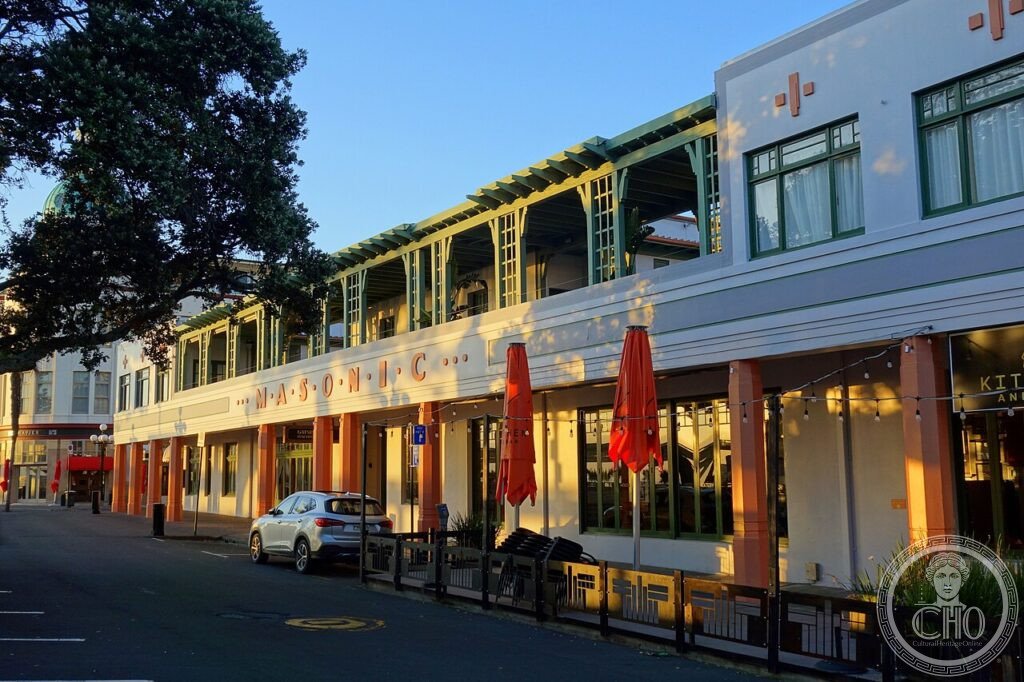

Burned in 1896, flattened and burned again in 1931, reborn in Deco in 1932: the Masonic holds the corner of Napier’s seafront with a wooden pergola on its roof and its name spelt in red glass.
At a glance
A Masonic Hotel has stood at the corner of Tennyson Street and Marine Parade since 1861, when Joseph Gill opened the first; fire took it in 1896, a second hotel of 1897 followed, and the Hawke’s Bay earthquake of 3 February 1931 — and above all the fires that followed it — destroyed that in turn. The present building went up in 1932 to a design from the Wellington practice of Prouse & Wilson — with Norman Wilson credited for much of the design: a low, symmetrical Art Deco block whose one flourish is an elaborate first-floor timber pergola facing the ocean. It remains a working hotel, and the social anchor of the world’s most concentrated Art Deco townscape.
Key facts
- First hotel on the site: 1861, opened by Joseph Gill; destroyed by fire 23 May 1896
- Second hotel: 1897, by C. Fleming McDonald; destroyed in the 1931 earthquake and fires
- Present building: 1932, by the Wellington practice of Prouse & Wilson; Norman Wilson is credited with much of the design
- Signature features: First-floor wooden pergola over Marine Parade; MASONIC in red leadlight Deco capitals in the entrance canopy
- Interim: A corrugated-iron temporary hotel served guests while the rebuild rose
- Today: Art Deco Masonic Hotel, refurbished 2012
- GPS: −39.489634, 176.918773 — View on Google Maps
History
The Masonic’s story is Napier’s in miniature: a Victorian seafront institution repeatedly erased and rebuilt, each time in the style of its decade. The 1896 fire consumed the first hotel — the fire bell, the hotel’s own history records, rang only fifteen minutes after the blaze began. The earthquake of 1931 killed 256 people across Hawke’s Bay and levelled central Napier; what the shaking spared at the Masonic, the firestorm finished. While the town rebuilt itself in two frantic years of concrete, the hotel traded from a corrugated-iron shed.
The 1932 building chose calm over spectacle — a simple symmetrical front, enlivened by the timber pergola running along the first floor towards the sea, an outdoor room a decade ahead of its time. Refurbished in 2012, the Masonic now trades on precisely the era that made it: guests sleep inside the emblem of the rebuilt town, and February’s Art Deco Festival fills its balconies first.
What you see
From Marine Parade the hotel reads as a long two-storey band of cream and terracotta, its parapet stepped in shallow Deco increments, the green-painted pergola riding the roofline like a ship’s deck rail. The entrance canopy on the corner carries the hotel’s best detail: MASONIC spelt out in red leadlight capitals, glowing when the lamps come on behind. Around the ground floor, slim columns frame café and bar openings that spill onto the pavement — the building was designed to live at street level, and it still does. Fine geometric ironwork encloses the terraces.
Practical information
- Operating hotel — the bars, café and lounges are open to non-guests; be considerate in residential corridors
- The pergola and leadlight lettering are best seen from the Marine Parade side in late-afternoon light
- Book far ahead for February’s Art Deco Festival weekend
Getting there
The hotel stands at the corner of Tennyson Street and Marine Parade, at the exact centre of Napier’s seafront and a few steps from the Art Deco quarter’s main streets. Napier is a five-hour drive or a one-hour flight from Wellington; everything in the centre is walkable.
Nearby
- Napier — The Art Déco Town Rebuilt After the Earthquake — the CHO city guide
- National Tobacco Company Building — Louis Hay’s rose-wreathed masterpiece in Ahuriri
- Napier Municipal Theatre — the town’s Deco stage of 1938
- Daily Telegraph Building — the newspaper front of the rebuilt town
Sources
- Art Deco Masonic Hotel official history (masonic.co.nz) — 1861 origins, fires, 1932 rebuild, Prouse, leadlight canopy
- Te Ara — Encyclopedia of New Zealand and Global Art Deco — Prouse & Wilson attribution (Norman Wilson design credit), rebuilding context
- NZ History (nzhistory.govt.nz) — 1931 Hawke’s Bay earthquake, 256 victims
- OpenStreetMap / Nominatim — coordinates, 2 Tennyson Street
Find it on the map
See this place and what’s around it →Record researched and written by Luigi De Marchi for Cultural Heritage Online, 2026.
📷 Become a Cultural Heritage Online photographer
Share your photos of places: they stay published under your name as the author. The more they're seen, the more you get noticed — and soon a contest will reward the most appreciated photos.
Log in or sign up free to add a photoIs this page about you?
This page is read by travellers and heritage enthusiasts who find it on Google. Tell us how you are connected to this place and we will take it from there.