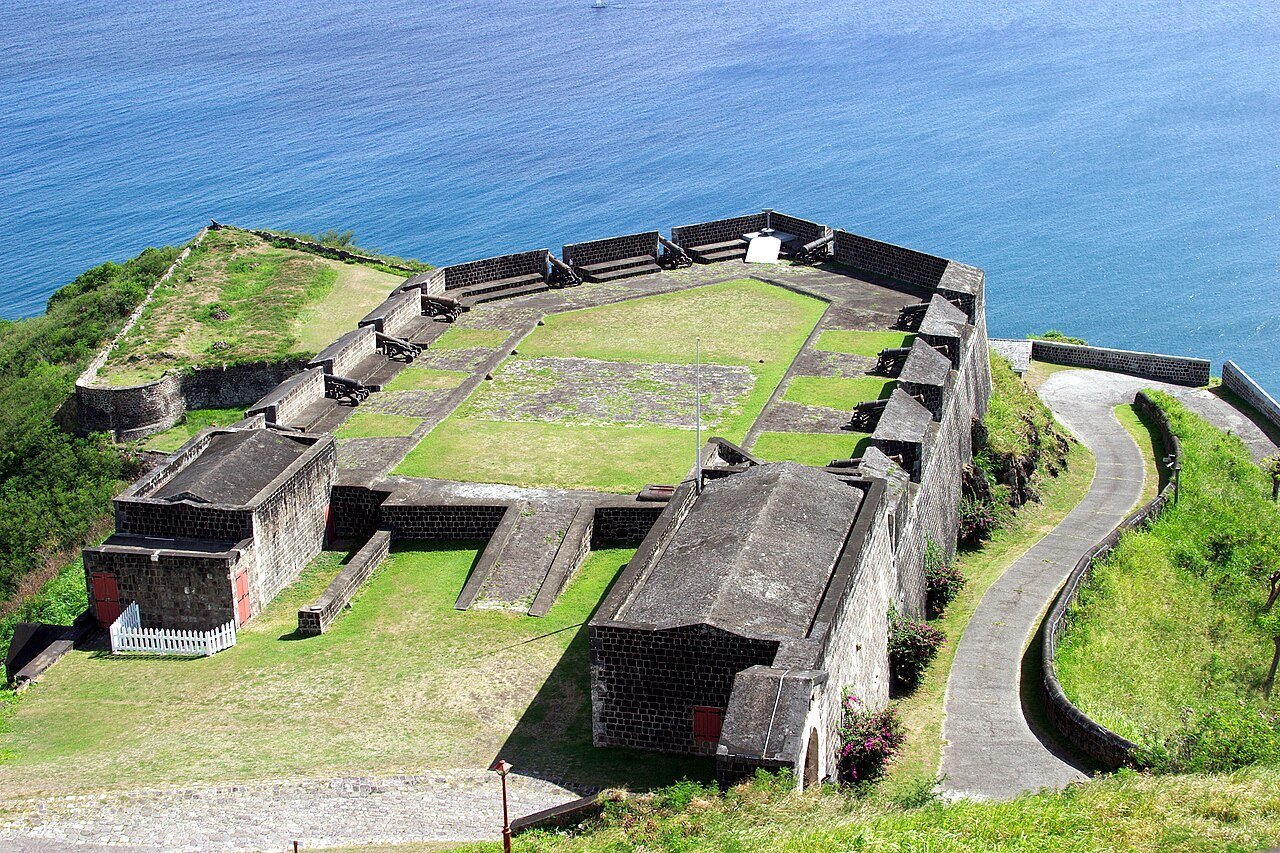
Saint Kitts and Nevis has one UNESCO World Heritage Site: a fortress perched on volcanic basalt above the Caribbean Sea that encodes three centuries of colonial ambition, enslaved labour, and military engineering. That single inscription carries an outsized historical weight for an island nation barely 261 square kilometres in area. From Cultural Heritage Online.
Why Saint Kitts and Nevis’s list looks the way it does
Saint Kitts and Nevis is a small-island developing state with a heritage landscape shaped almost entirely by the colonial plantation economy and the defensive rivalries of European powers. The UNESCO tally reflects that concentration: one extraordinary site of military and social history rather than a distributed network of inscriptions. The country’s tentative list, compiled in 1998, nominates the historic zone of Basseterre and the town of Charlestown on Nevis — both awaiting the institutional and technical groundwork required to advance a nomination file.
The relative brevity of the list is not a measure of cultural thinness. It reflects the resource constraints that small island states face when preparing the documentation, management plans, and conservation assessments that UNESCO requires. What Saint Kitts and Nevis does have on the list, it has in impressive form.
The first inscription
Saint Kitts and Nevis joined the World Heritage Convention late relative to the Caribbean region, but its first nomination was accepted without equivocation. In 1999, UNESCO inscribed:
- Brimstone Hill Fortress National Park (1999) — cultural site, inscribed under criteria (iv): an outstanding example of 17th- and 18th-century European military architecture adapted to a tropical Caribbean setting.
This remains the country’s only inscription to date. The fortress sits on a volcanic plug rising approximately 240 metres above sea level on the western coast of Saint Kitts. It was designed by British military engineers and constructed largely by enslaved African labourers over nearly a century, from the 1690s onward. UNESCO’s evaluation singled out its state of preservation and its value as physical evidence of colonial expansion, the transatlantic slave trade, and the formation of Caribbean society.
The most visited — and the alternatives
Brimstone Hill Fortress National Park is the single draw on the World Heritage list, and it rewards close attention. The complex includes the Citadel, barracks, a hospital, ordnance store, and a magazine — all constructed from the same dark volcanic stone that makes the site visually striking from a distance. At its peak garrison, it was known as the “Gibraltar of the West Indies,” though that label understates its distinctly Caribbean character: the enslaved workers who built it left their own material traces in the construction techniques and spatial organisation of the site.
For visitors wanting depth beyond the fortress itself, the tentative-list sites offer a complementary itinerary. The historic core of Basseterre, Saint Kitts’s capital, contains Georgian commercial streetscapes centred on The Circus, a small roundabout modelled loosely on Piccadilly Circus in London. Charlestown on Nevis preserves a compact colonial town grid with the Museum of Nevis History — housed in the birthplace of Alexander Hamilton — alongside intact 18th-century stone buildings lining its main street.
Natural and shared sites
Saint Kitts and Nevis currently has no inscribed natural or mixed UNESCO World Heritage Sites. The country’s ecosystems — including the rainforest of the central mountain range on Saint Kitts and the volcanic slopes of Nevis Peak — have not advanced to formal nomination. Neither island participates in any transnational or serial World Heritage inscription.
The absence of a natural inscription should not be read as a signal about ecological significance. The Centre Hills forest on Nevis, for example, supports endemic bird species and has been subject to conservation attention, but has not entered the UNESCO pipeline. Should the country expand its tentative list in a future cycle, natural or mixed nominations remain a plausible direction.
How to find them
Brimstone Hill Fortress National Park is located on the northwestern coast of Saint Kitts, approximately 14 kilometres from the capital Basseterre, and is accessible by road. The site is managed as a national park with a visitor centre, guided tours, and conservation infrastructure. Opening arrangements and admission are managed by the Brimstone Hill Fortress National Park Society.
Saint Kitts and Nevis’s World Heritage sites sit alongside thousands of other places on CHO’s interactive map, with GPS and sourced editorial history for each. See also our guides to Italy’s and France’s UNESCO sites, and our piece on cultural travel beyond mass tourism.
Frequently Asked Questions
How many UNESCO World Heritage Sites does Saint Kitts and Nevis have?
Saint Kitts and Nevis has one UNESCO World Heritage Site: Brimstone Hill Fortress National Park, inscribed in 1999. The country also maintains two properties on its tentative list — the historic zone of Basseterre and the town of Charlestown on Nevis — both submitted in 1998 and not yet formally nominated.
What was Saint Kitts and Nevis’s first UNESCO World Heritage Site?
Brimstone Hill Fortress National Park was inscribed in 1999 and remains the country’s only World Heritage Site. UNESCO recognised it as an outstanding, well-preserved example of 17th- and 18th-century European military architecture in a Caribbean context, built by enslaved African labourers under British direction.
Is Brimstone Hill Fortress a cultural or natural UNESCO site?
Brimstone Hill Fortress National Park is a cultural World Heritage Site, inscribed under criterion (iv) for its exceptional illustration of military architecture and its documentation of colonial history and the transatlantic slave trade. Saint Kitts and Nevis currently has no inscribed natural or mixed sites.
What sites in Saint Kitts and Nevis could become UNESCO World Heritage Sites in the future?
Two properties have been on the tentative list since 1998: the historic zone of Basseterre, the capital of Saint Kitts, and the town of Charlestown on Nevis. Both are proposed as cultural sites, though neither has yet advanced to a formal nomination dossier submitted to the World Heritage Committee.
Sources used in this article
- UNESCO — State Party Saint Kitts and Nevis — World Heritage list.
- UNESCO — Saint Kitts and Nevis: World Heritage Sites.
- CHO magazine — What is a World Heritage Site?
- CHO — Interactive map of heritage sites.
Sources
- S1 — Dyde, Brian. Out of the Crowded Vagueness: A History of the Islands of St Kitts, Nevis and Anguilla. Macmillan Caribbean, 2005. ISBN 978-0-333-73162-8.
- S2 — Watts, David. The West Indies: Patterns of Development, Culture and Environmental Change. Cambridge University Press, 1987. ISBN 978-0-521-24555-5.
Spotted an error? Write to editorial@culturalheritageonline.com and we correct it the same day.