Mumbai is home to two UNESCO World Heritage Sites within the city itself — a Victorian railway terminus still handling millions of passengers, and a corridor of Gothic public buildings facing off against Art Deco apartment blocks across an open cricket ground — plus a third inscription on an island one hour by ferry offshore. From Cultural Heritage Online.
Chhatrapati Shivaji Maharaj Terminus City centre — on the Central Railway main line
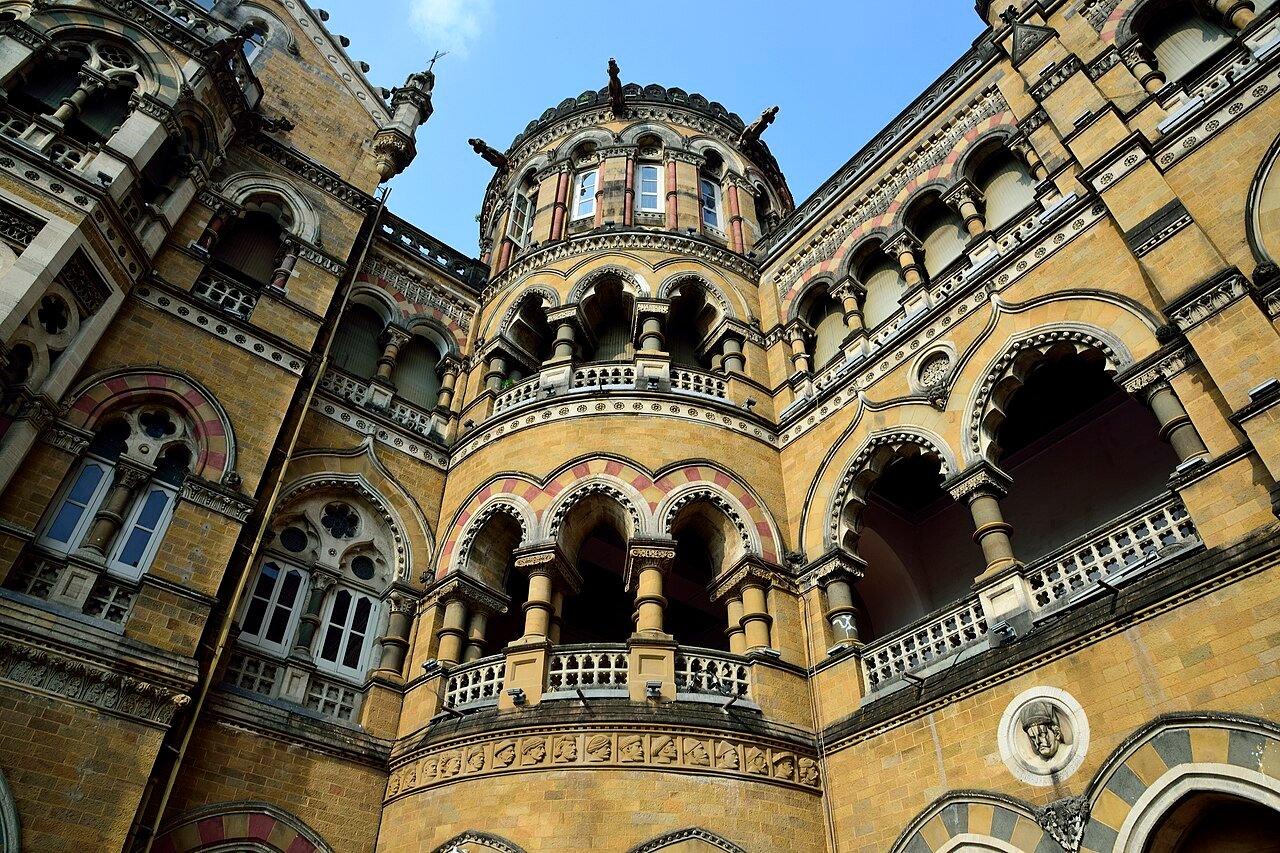
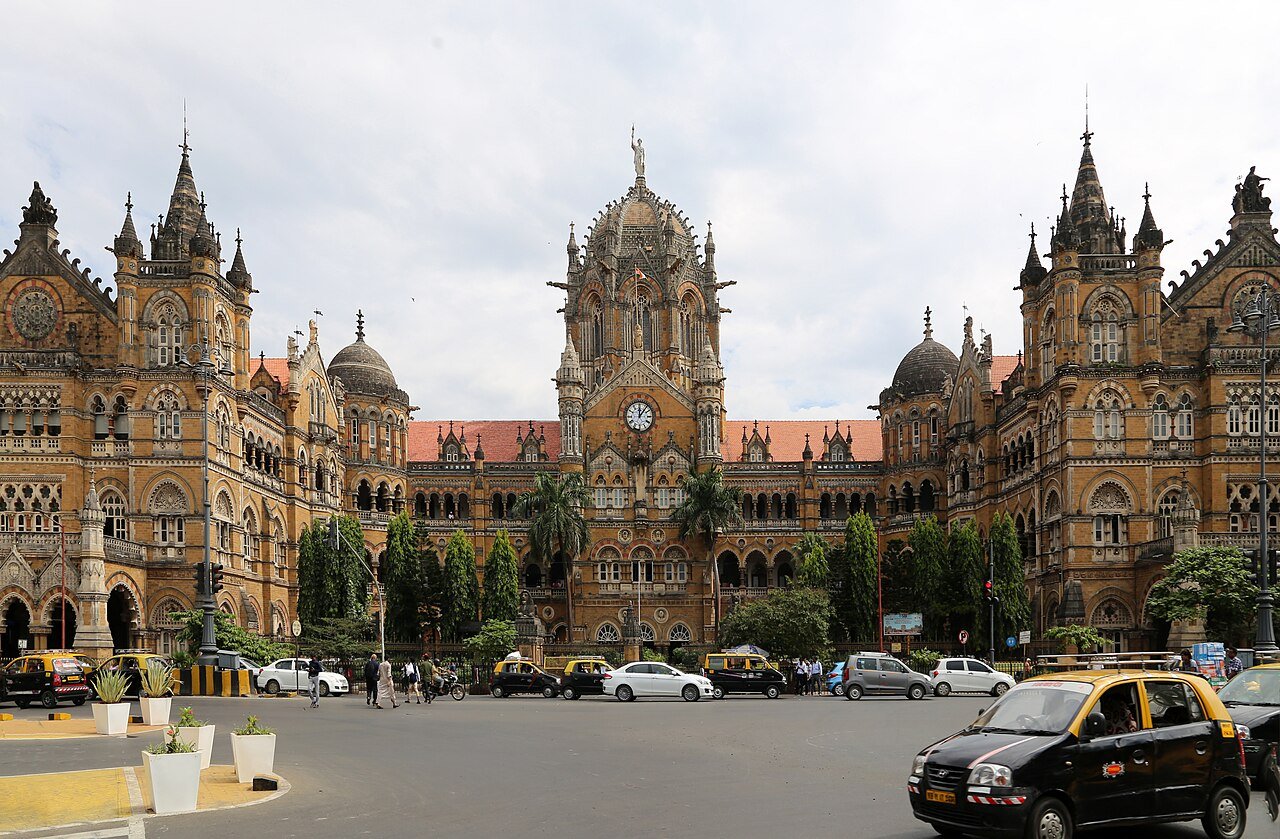
Inscribed on the UNESCO World Heritage List in 2004, Chhatrapati Shivaji Maharaj Terminus — still abbreviated CSMT, and widely called VT after its original name Victoria Terminus — stands as the most elaborate railway station built during the British colonial period in Asia. Frederick William Stevens designed the building between 1878 and 1888, drawing on Victorian Gothic Revival conventions and blending them with Indo-Saracenic detailing: pointed arches, a ribbed octagonal central dome crowned by an allegorical figure of Progress, turrets at each corner, and a facade dense with bas-reliefs, friezes, and gargoyles that would not look out of place on a Loire cathedral. The station operates 18 platforms and remains the busiest rail terminus in India, which means the experience is sensory overload in the best possible way — pigeons wheel through the vaulted concourse, trains announce themselves with a low metallic thunder, and the carved stone overhead could occupy an architect for an afternoon without running out of new detail. The exterior is best seen from across the junction in the late afternoon, when the stone facade shifts from warm ochre to deep amber.
Getting there: The terminus is its own destination — served by Central Railway suburban lines from across Mumbai; the building itself is the working station. Allow: 30–60 minutes for the exterior and main concourse. Best for: Travellers who want to understand how Victorian ambition and Indian craft tradition met on a single building site.
Victorian Gothic and Art Deco Ensembles of Mumbai Oval Maidan (Marine Lines Metro) — 1 km walkable route
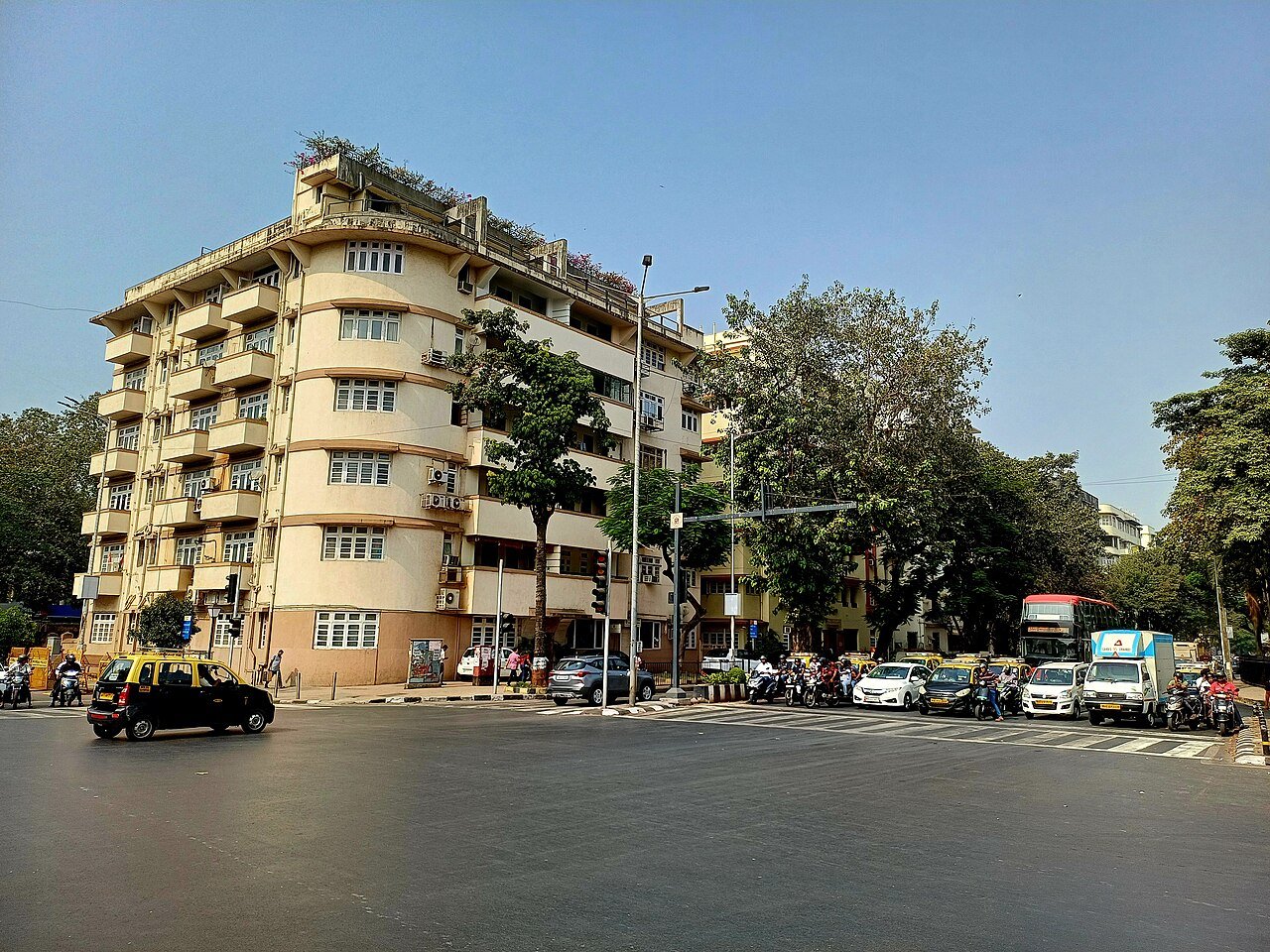
This inscription — awarded in 2018 at the 42nd session of the World Heritage Committee — covers 94 buildings spread across 66 hectares in Mumbai’s Fort precinct, making it the second-largest surviving collection of Art Deco architecture in the world after Miami’s South Beach. The ensemble is organised around a geographic fact: Oval Maidan, a cricket ground that has remained open since the colonial period, separates the two distinct eras of construction. On the eastern side stand the Victorian Gothic public institutions — the Bombay High Court, the University of Mumbai’s Fort Campus, and the Rajabai Clock Tower, completed in 1878 by architect William Burges and modelled loosely on Big Ben. On the western side, a continuous terrace of 1930s Art Deco apartment buildings faces the maidan, their cream and off-white facades decorated with geometric friezes, porthole windows, and cantilevered sun-breakers adapted for the Mumbai climate. The contrast is unusually legible from the centre of the cricket ground: two centuries of architecture facing each other across an expanse of grass and red-clay pitch. The standard walking route links the Bombay High Court at the southern end to Flora Fountain, roughly one kilometre north, taking in the High Court, the University library, and the Eros Cinema — one of the best-preserved Art Deco picture houses in Asia.
Getting there: Alight at Marine Lines Metro station and walk south to Oval Maidan; the route to Flora Fountain is fully walkable at about 1 km. Allow: 2–3 hours for a thorough walking tour. Best for: Visitors with an interest in urban planning, colonial architecture, or the social history of a city whose built fabric spans a complete century of European architectural movements.
Elephanta Caves 1 hr by ferry from Gateway of India — avoid June–September monsoon
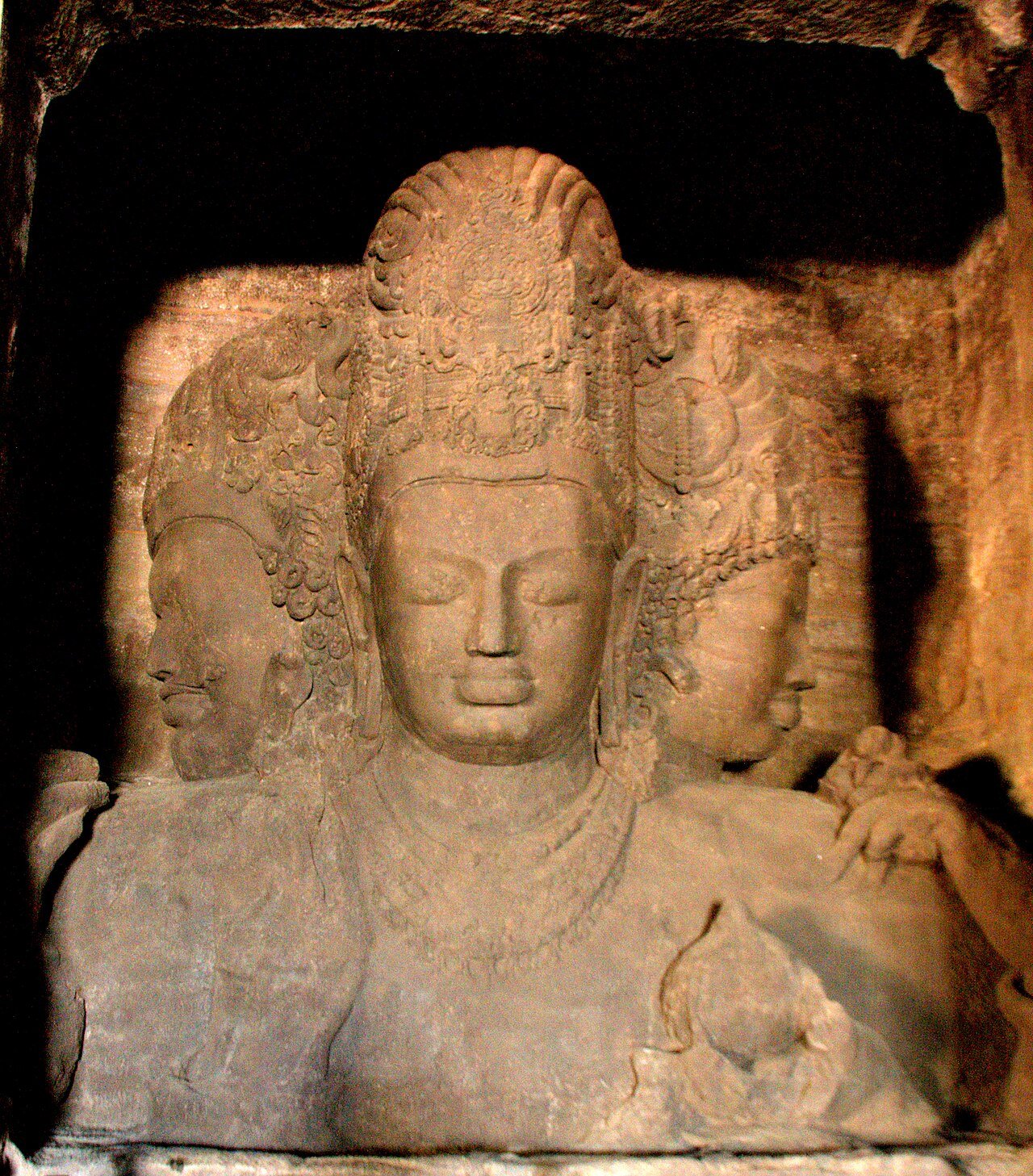
Gharapuri — known to visitors as Elephanta Island — sits in Mumbai Harbour, close enough to see the city skyline from the jetty but far enough that the ferry crossing registers as a genuine departure. The island’s seven rock-cut cave temples were inscribed as a UNESCO World Heritage Site in 1987, becoming one of the earliest Indian sites on the List. Scholars attribute the main complex to the Kalachuri dynasty, with the Hindu caves completed by approximately 550 CE. The centrepiece is the Trimurti — a three-headed portrait of Shiva in his creator, preserver, and destroyer aspects — carved in high relief to a height of 7 metres (23 feet) from the back wall of the main cave. The cave itself measures roughly 40 metres square, its interior divided by rows of stone columns whose capitals are carved with seated figures of guardians and celestial beings. Light enters from the north through carved doorways, striking the Trimurti at an angle that makes the expression of each face shift depending on where the visitor stands. Five Hindu caves occupy the western hill; two Buddhist caves with water tanks survive on the eastern hill. Ferries run daily except Monday from Gateway of India, departing between 09:00 and 14:30, with a journey time of approximately one hour each way.
Getting there: Ferries depart from Gateway of India daily (except Monday), 09:00–14:30; journey time approximately 1 hour. Avoid the monsoon season (June–September) when seas are rough and the caves can be partially inaccessible. Allow: 2–3 hours on the island, plus travel time. Best for: Anyone drawn to early medieval Indian sculpture; the Trimurti is among the greatest works of rock-cut art on the subcontinent.
Frequently Asked Questions
How many UNESCO World Heritage Sites are near Mumbai?
Mumbai has three UNESCO World Heritage Sites within easy reach. Two are located in the city itself — Chhatrapati Shivaji Maharaj Terminus (inscribed 2004) and the Victorian Gothic and Art Deco Ensembles of Mumbai (inscribed 2018). The third, Elephanta Caves (inscribed 1987), is on an island in Mumbai Harbour reached by a one-hour ferry from Gateway of India.
What is the closest UNESCO World Heritage Site to Mumbai?
Both CSMT and the Victorian Gothic and Art Deco Ensembles sit in Mumbai’s Fort district, which means they are effectively at the centre of the city. CSMT is a working railway terminus, so visitors arrive at the site itself. The two ensembles share the same southern Mumbai precinct and can be visited on the same half-day walking tour.
What is the best time of year to visit Elephanta Caves?
October through February is the most comfortable season for the ferry crossing and the island itself — temperatures are moderate and seas calm. The caves remain open during summer months (March–May), but the heat on the island is intense. The monsoon season (June–September) brings rough seas and the ferry service can be suspended; the Archaeological Survey of India sometimes restricts access to the caves during heavy rains.
Do visitors need to book tickets in advance for any of these sites?
Chhatrapati Shivaji Maharaj Terminus is a working public station and requires no ticket for exterior visits or concourse access. Elephanta Caves is administered by the Archaeological Survey of India (ASI), which charges a standard entry fee; tickets can be purchased at the island jetty and advance booking is not required, though it is advisable to check the ASI website for current pricing before travel. The Victorian Gothic and Art Deco Ensembles are public urban streetscapes and can be walked freely, though guided tours offered by local heritage organisations provide significantly richer context.
Sources
- S1 — Dwivedi, Sharada, and Rahul Mehrotra. Bombay: The Cities Within. India Book House, 1995. ISBN 978-81-85028-80-4.
- S2 — Michell, George. The Elephanta Caves. India Book House, 2002. ISBN 978-81-7508-348-6.
Spotted an error? Write to editorial@culturalheritageonline.com and we correct it the same day.