Cape Verde has 1 UNESCO World Heritage Site: the historic centre of Ribeira Grande on the island of Santiago, a colonial settlement that changed the course of Atlantic history. Small in number but outsized in significance, that single inscription anchors an archipelago whose tentative list points toward a far richer story still to be told. From Cultural Heritage Online.
Why Cape Verde’s list looks the way it does
Cape Verde ratified the UNESCO World Heritage Convention on 29 April 1988, but a first inscription did not follow until 2009. The delay reflects both the logistical demands of preparing nomination dossiers for a small island nation and the concentrated character of the country’s built heritage: most of what survives from the colonial era is gathered on a single island, Santiago, rather than spread across the archipelago’s ten islands. UNESCO inscriptions require rigorous documentation of Outstanding Universal Value, and for a state with limited resources that process takes time.
The tentative list, updated in 2016, now holds nine candidates covering cultural, natural, and mixed categories. That breadth — from volcanic calderas to colonial-era penal institutions — signals that Cape Verde is building the evidence base for future nominations. Until those dossiers are submitted and reviewed, Cidade Velha remains the country’s sole inscribed site and its most legible point of contact with the global heritage canon.
The first inscription
In 2009, UNESCO inscribed Cape Verde’s first and, to date, only World Heritage Site:
- Cidade Velha, Historic Centre of Ribeira Grande (2009) — cultural site, criteria ii, iii, and iv.
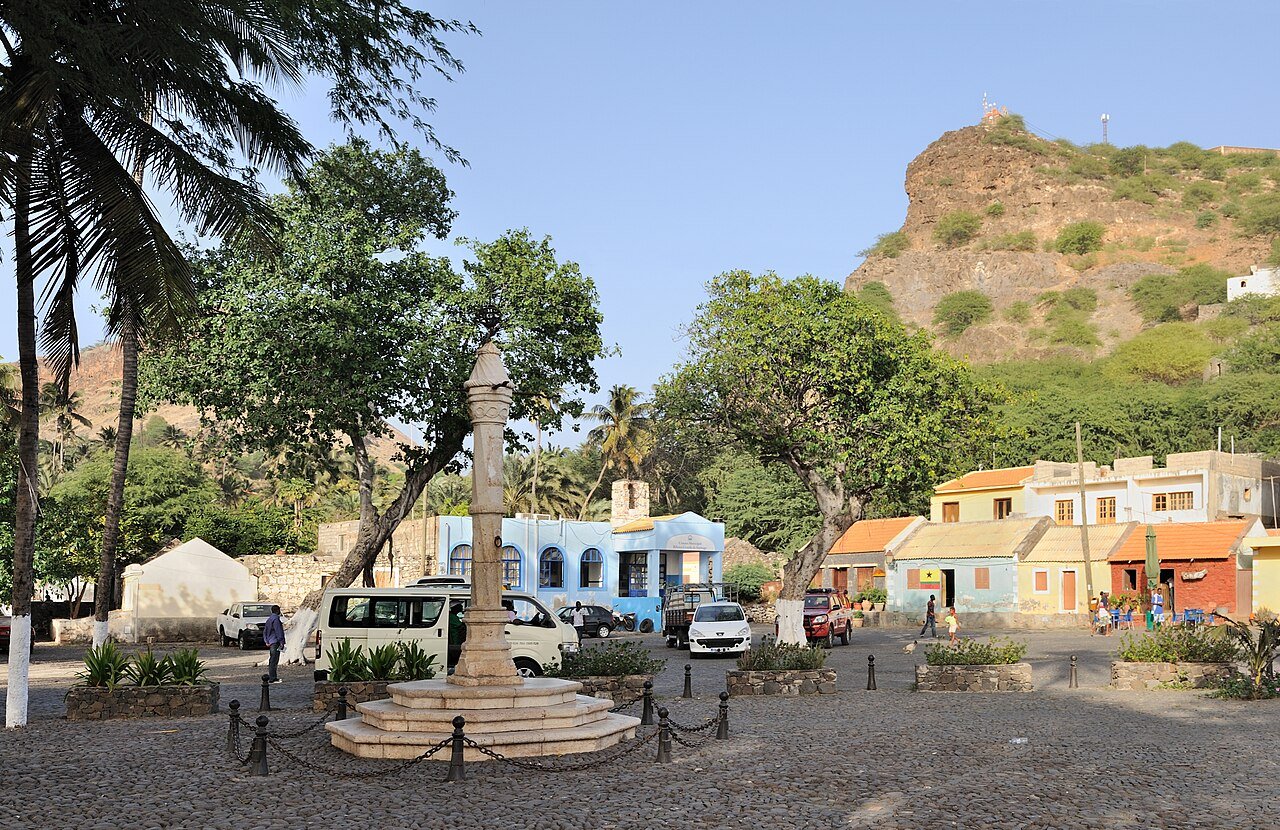
Founded in the 1460s, Ribeira Grande was the first European colonial settlement in the tropics and for more than a century served as the principal staging post for the Atlantic slave trade. Its surviving fabric — a coherent original street layout, the ruins of two churches, the Royal Fortress of São Filipe, and the Pillory Square where enslaved people were publicly subjected to colonial authority — encodes that global history in stone and cobblestone. The site meets criterion ii for the cultural exchange it facilitated between Europe, Africa, and the Americas, criterion iii as exceptional testimony to a now-vanished civilisation, and criterion iv as an outstanding example of a colonial settlement type.
The most visited — and the alternatives
Cidade Velha draws the overwhelming share of heritage visitors to Cape Verde. The old town sits a short drive west of the modern capital Praia, and its compact layout means the main monuments can be covered on foot in half a day. The Pillory, dating from around 1512, is one of the oldest surviving examples of Portuguese colonial punishment architecture anywhere in the world; the Cathedral of Santa Maria, though largely ruined, preserves enough masonry to convey the ambition of the original settlement.
For travellers willing to look beyond the inscribed site, Cape Verde’s tentative list offers several compelling alternatives. The Tarrafal concentration camp on Santiago’s northern coast, proposed in 2016, was used by the Portuguese Estado Novo regime to imprison political dissidents from Portugal, Cape Verde, Angola, and Guinea-Bissau — a site of conscience with direct resonance for post-colonial memory across the Lusophone world. The Pedra de Lume salt works on Sal island, also on the tentative list, preserves a volcanic crater lake where industrial salt extraction has operated since the nineteenth century; the hypersaline water gives the landscape an otherworldly pink-orange tint. These sites lack the formal UNESCO stamp for now, but the historical and visual substance is there.
Natural and shared sites
Cape Verde’s tentative list includes two natural and two mixed candidates, among them the Fogo Natural Park-Chã das Caldeiras, a volcanic landscape centred on the active Pico do Fogo stratovolcano. Fogo last erupted in 2014-2015, destroying much of the village of Chã das Caldeiras before the lava flow stopped at its edges. The caldera’s geological dynamism and the cultural resilience of the communities that returned to farm its fertile soils make it a strong candidate under both natural and cultural criteria — which is presumably why it appears in the mixed category on the tentative list.
Cape Verde does not currently participate in any transnational or serial World Heritage inscription, though the Atlantic slave trade sites of West Africa and its offshore islands are a recognised thematic cluster at UNESCO. Future cooperation with Senegal, Guinea-Bissau, and other states in the region around shared Atlantic heritage remains a plausible long-term pathway for the archipelago.
How to find them
Cidade Velha is accessible by taxi or aluguer (shared minibus) from Praia in under thirty minutes. The site is open to visitors year-round; the Royal Fortress of São Filipe on the hill above town offers the most complete views of the historic layout. Tentative-list sites such as Fogo’s caldera and the Tarrafal camp are reachable by inter-island ferry or domestic flight and local transport, though opening hours and on-site interpretation vary.
Cape Verde’s World Heritage sites sit alongside thousands of other places on CHO’s interactive map, with GPS and sourced editorial history for each. See also our guides to Italy’s and France’s UNESCO sites, and our piece on cultural travel beyond mass tourism.
Frequently Asked Questions
How many UNESCO World Heritage Sites does Cape Verde have?
Cape Verde has one inscribed UNESCO World Heritage Site: Cidade Velha, Historic Centre of Ribeira Grande, added to the list in 2009. The country also maintains a tentative list of nine candidate sites spanning cultural, natural, and mixed categories.
What was Cape Verde’s first UNESCO World Heritage Site?
Cidade Velha, Historic Centre of Ribeira Grande, inscribed in 2009, is both Cape Verde’s first and currently only World Heritage Site. Founded in the 1460s, it was the first European colonial settlement established in the tropics and played a central role in early Atlantic trade networks.
What makes Cidade Velha significant beyond its colonial architecture?
Cidade Velha was a pivotal node in the transatlantic slave trade for more than a century, and its surviving urban fabric — street layout, churches, fortress, and Pillory Square — documents that global history with exceptional physical continuity. UNESCO recognised it under three criteria, including its role in facilitating cultural exchange between Europe, Africa, and the Americas.
Does Cape Verde have any natural UNESCO sites?
Cape Verde does not yet have an inscribed natural World Heritage Site, but the Fogo Natural Park-Chã das Caldeiras, centred on an active volcano that last erupted in 2014-2015, is on the tentative list as a mixed (natural and cultural) candidate. Two further natural candidates also appear on the tentative list.
Sources used in this article
- UNESCO — State Party Cape Verde — World Heritage list.
- UNESCO — Cape Verde: World Heritage Sites.
- CHO magazine — What is a World Heritage Site?
- CHO — Interactive map of heritage sites.
Sources
- S1 — Lobban, Richard A. Cape Verde: Crioulo Colony to Independent Nation. Westview Press, 1995. ISBN 978-0-8133-8451-1.
- S2 — Carreira, António. The People of the Cape Verde Islands: Exploitation and Emigration. C. Hurst & Co., 1982. ISBN 978-0-905838-59-5.
Spotted an error? Write to editorial@culturalheritageonline.com and we correct it the same day.