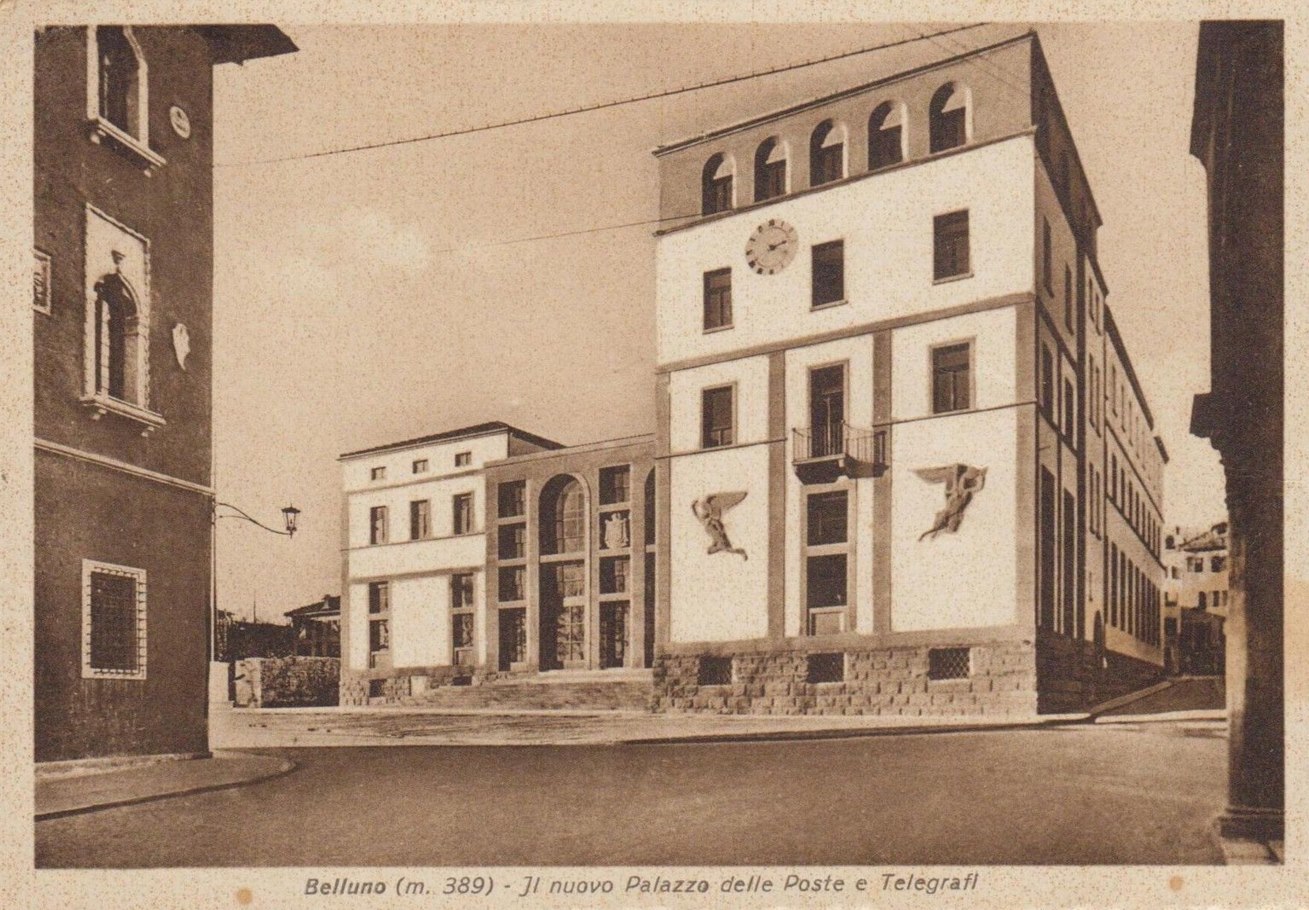
The Palazzo delle Poste e Telegrafi in Belluno is a public building designed by architect Alberto Alpago between 1936 and 1938. The structure represents the institutional architecture of interwar Italy, serving the postal and telegraph services of the Veneto region.
Alpago, educated at the Polytechnic University of Milan and the Brera Academy, established himself as a significant figure in Italian architecture and urban planning in the early twentieth century. After World War I, he collaborated with colleagues on projects across Italy and in colonial territories before concentrating his practice in the Belluno area, where he became deeply engaged with local historical and archaeological scholarship.
About Alberto Alpago
Alberto Alpago-Novello (1889–1985) was an Italian architect and urban planner who distinguished himself in urban design, public architecture, and monumental works. Following his early career in Milan, where he worked on projects internationally, he later directed his attention toward historical research and publication, contributing to journals including Domus and directing the Archivio storico di Feltre, Belluno, Cadore.
Details
- Architect: Alberto Alpago
- Years: 1936–1938
- Location: Belluno, Veneto, Italy
- Function: Postal and telegraph offices
- Photograph credit: Stefano Vigolo
Explore more: 10 heritage places in Belluno
Frequently asked questions
Who designed the palazzo?
The building was designed by Alberto Alpago, an Italian architect and urban planner trained at the Polytechnic University of Milan and the Brera Academy, who worked on significant public and monumental projects throughout Italy.
When was it built?
Construction took place between 1936 and 1938, during Italy’s interwar period.
What was its original purpose?
The palazzo served as a postal and telegraph office, providing essential communication services to the Belluno region.