

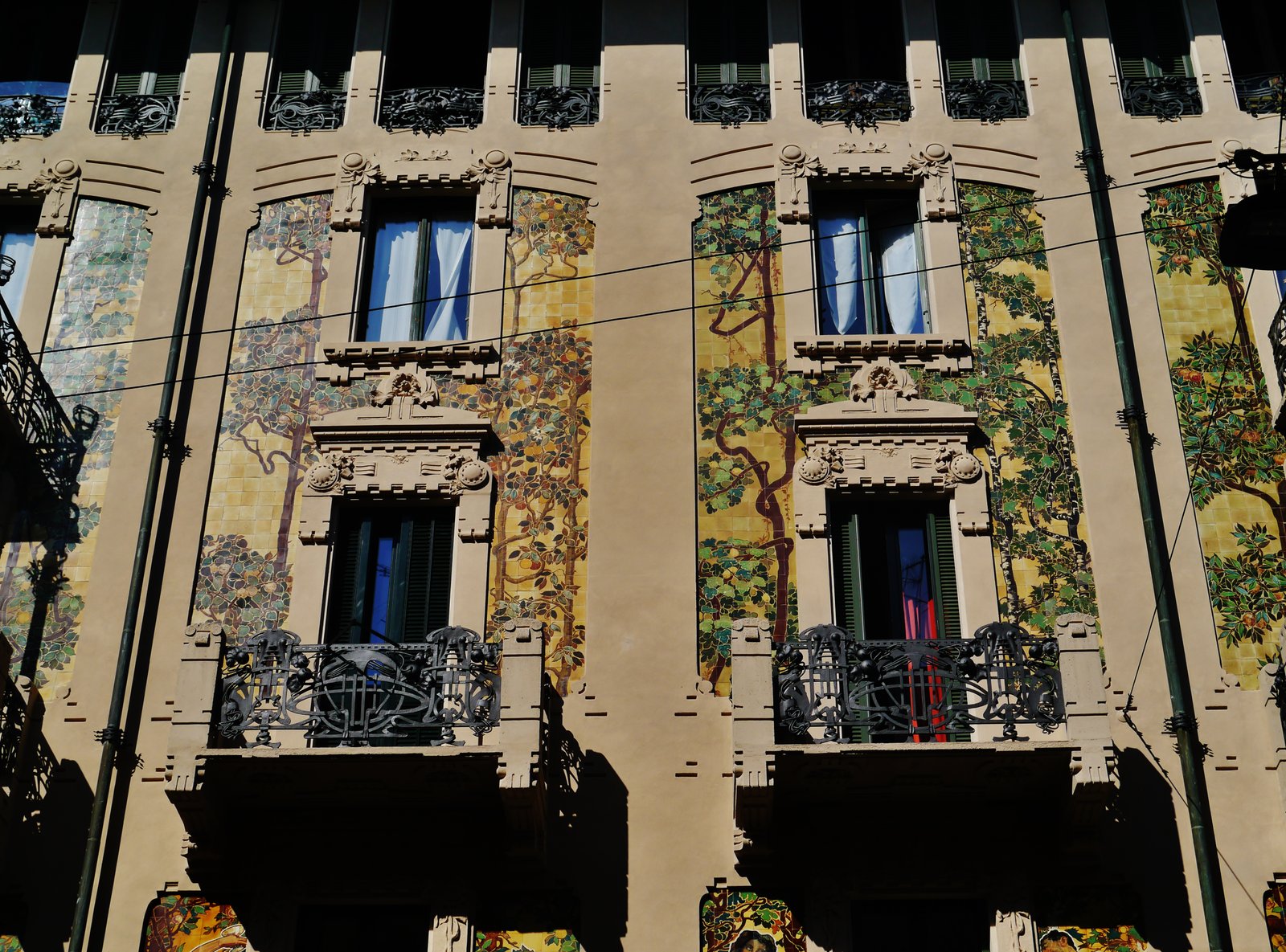
Italian Liberty is Italy’s name for Art Nouveau: an architectural and decorative movement that flourished between roughly 1890 and 1915, marked by floral ornament, polychrome ceramic, curvilinear wrought iron, and sculpted stone. It took its name from a London shop. This is a short, sourced answer, part of CHO’s complete guide to Italian Liberty.
Where the name comes from
Most countries gave Art Nouveau a local name. Germany called it Jugendstil, Vienna Secessionsstil, Catalonia Modernisme. Italy called it Liberty, after Arthur Liberty’s shop on Regent Street in London, whose fabrics and decorative goods had circulated in Italian design circles since the 1870s. The name stuck to the whole movement. You will also see it written as Stile Floreale, the “floral style”, a description of its favourite subject matter rather than its origin.
The borrowed name carries a useful reminder. Italian Liberty was never a closed national school. It absorbed ideas from France, Belgium, Austria, and Britain, then reworked them with materials and historical references particular to the peninsula.
What it looks like
Four materials recur often enough to identify the style from street level. Polychrome ceramic, used as painted majolica panels or inlaid tile. Hammered botanical ironwork, irises and wisteria worked into balconies and gates. Sculpted stone moulding that curves where an academic facade would stay straight. And frescoed or rendered surface, colour applied directly to the wall.
The shared instinct behind all four is ornament as argument. A Liberty building announces the modernity of its owner through decorated surface rather than through scale or expensive stone. The result is a style most at home on apartment houses, villas, and hotels — the private and commercial commissions of a confident middle class — rather than on town halls and ministries.
When and where it flourished
The movement found its public platform in 1902, at the Esposizione Internazionale d’Arte Decorativa Moderna in Turin, the first international exhibition devoted entirely to modern decorative art. From there it spread through the cities that already had money and ambition: Milan, Palermo, Turin, with concentrated chapters in Florence, Trieste, and the Venetian Lido.
Milan’s Porta Venezia quarter holds the densest surviving fabric. Palermo produced the movement’s grandest individual buildings under Ernesto Basile. Turin kept the most intact Liberty streets around Casa Fenoglio-Lafleur. Rome closed the story late, with Gino Coppèdè’s Coppedè District, built between 1915 and 1927.
How it differs from French Art Nouveau
Italian Liberty arrived about a decade after the French and Belgian wave, and it behaved differently once it did. It prioritised residential over civic work. It made far greater use of polychrome ceramic and painted surface. And it lasted longer: where the French line had largely closed by 1910, Italian examples stretch into the late 1920s. French and Belgian Art Nouveau prized the unbroken curvilinear line; Italian Liberty more readily mixed its ornamental grammar with local historical references — Norman-Gothic in Palermo, medieval and mannerist quotation in Rome.
That willingness to quote the past is why Italian Liberty has no clean end date. It did not stop so much as turn into something else, shading into the eclecticism of the 1920s and, eventually, into Art Déco and Rationalism.
See the style on the map
CHO documents the principal Liberty buildings with sourced editorial cards — architecture, history, GPS, and photography — and plots them on an interactive map. The fastest way to grasp the style is to read the complete guide, then open the map and let the city clusters reveal where to walk.
Open the interactive Art Nouveau map →
Frequently Asked Questions
What is Italian Liberty style?
Italian Liberty is Italy’s version of Art Nouveau, an architectural and decorative movement of roughly 1890 to 1915. It is recognised by floral ornament, polychrome ceramic panels, curvilinear wrought-iron balconies, and sculpted stone moulding, used mostly on apartment houses, villas, and hotels.
Why is it called “Liberty” and not “Art Nouveau”?
The name comes from Arthur Liberty’s shop on Regent Street in London, whose fabrics and decorative goods circulated in Italian design circles from the 1870s. Other countries used their own names: Jugendstil in Germany, Secessionsstil in Vienna, Modernisme in Catalonia.
What are the main features of Italian Liberty architecture?
Polychrome ceramic and majolica, hammered botanical ironwork in balconies and gates, curvilinear sculpted stone, and frescoed or rendered colour applied directly to the facade. The style favours decorated surface over monumental scale.
How does Italian Liberty differ from French Art Nouveau?
Italian Liberty arrived about a decade later, favoured residential over civic commissions, made greater use of polychrome ceramic and painted surface, and lasted longer — some examples reach the late 1920s. It also mixed its ornament with local historical references more freely than the French curvilinear line.
Sources used in this article
- CHO magazine Italian Liberty: the complete guide — pillar article, with per-building sources.
- CHO place_card Casa Galimberti — Giovan Battista Bossi, 1904–1905, painted majolica facade, Milan.
- CHO place_card Casa Fenoglio-Lafleur — Pietro Fenoglio, 1902, Turin.
- CHO place_card Coppedè District — Gino Coppèdè, 1915–1927, Rome.
Sources
- S1 — Bossaglia, Rossana. Il Liberty in Italia. Charta, 1997. ISBN 978-88-8158-144-3.
- S2 — Bairati, Eleonora, and Daniele Riva. Guide all'architettura in Italia: Il Liberty in Italia. Laterza, 1985. ISBN 978-88-420-2541-2.
Spotted an error? Write to editorial@culturalheritageonline.com and we correct it the same day.


