Emilia-Romagna holds the strangest chapter of the Rationalist story. This was Mussolini’s home ground — he was born here, in a hillside village above Forlì — and the regime spent the 1930s rewriting three of its towns in white plaster and travertine, turning provincial Romagna into an open-air laboratory of Italian modernism. The buildings have outlived the politics, and they are still standing, in varying states, for anyone willing to read them.
Forlì: the city of the Duce
Forlì called itself the città del Duce, and it built like it. The regime carved a monumental axis — Piazzale della Vittoria and the long Viale della Libertà — to link the railway station to the historic core, and lined it with the institutions of the new state. The grandest is the Collegio Aeronautico, a boarding academy for Air Force cadets designed by the Roman architect Cesare Valle between 1935 and 1939. Valle fronted Piazzale della Vittoria with a long colonnade of square stone pillars — a stripped, modernised portico — and organised the school around a deep symmetrical courtyard. It now houses the Liceo Morgagni, one of the city’s main high schools, and remains in daily use.
Valle was also the author, a few years earlier, of the nearby Casa del Balilla of 1933–1935, the youth centre of the regime, while the Palazzo delle Poste by Cesare Bazzani brought the same monumental clarity to the everyday business of the mail. Together they form the most coherent open-air ensemble of 1930s Italian modernism in Emilia-Romagna — a complete Rationalist cityscape you can still cross on foot.
Predappio: a town built around a birthplace
Twenty kilometres south, in the hills, lies the most loaded site of all. Predappio is where Benito Mussolini was born in 1883, and from 1925 the regime reshaped it as a model settlement, laying out a new district — Predappio Nuova — below the original village under a master plan coordinated by Florestano Di Fausto. Its symbolic anchor was the Casa del Fascio, built between 1934 and 1937 at the crossing of the two main streets: a heavy brick volume clad in Roman travertine, crowned by a tall littorio tower, and the largest party headquarters ever raised in any small Italian town. It stands abandoned today, at the centre of a long and unresolved debate over its conversion into a documentation centre on twentieth-century totalitarianism, a project the municipality announced in 2014. The town’s Palazzo delle Poste completes the civic set.
Predappio is uncomfortable ground, and honestly so. The buildings were instruments of a cult, and the town still draws a stream of nostalgic visitors that the comune has spent decades trying to reframe. That discomfort is exactly why the architecture deserves clear-eyed attention rather than either celebration or erasure.
Tresigallo: the metaphysical new town
The third site is the purest as architecture. Tresigallo, in the flat lower plain near Ferrara, was rebuilt almost in its entirety between 1933 and 1939 by Edmondo Rossoni — born in the village in 1884, risen to direct the fascist labour confederation and serve as Minister of Agriculture. From his Rome office Rossoni treated his home town as a personal project, replacing a farming hamlet of a few hundred souls with a working city sized for thousands. It remains the most intact città di fondazione of the period, and the only fascist-era foundation town to also carry the official designation of città d’arte.
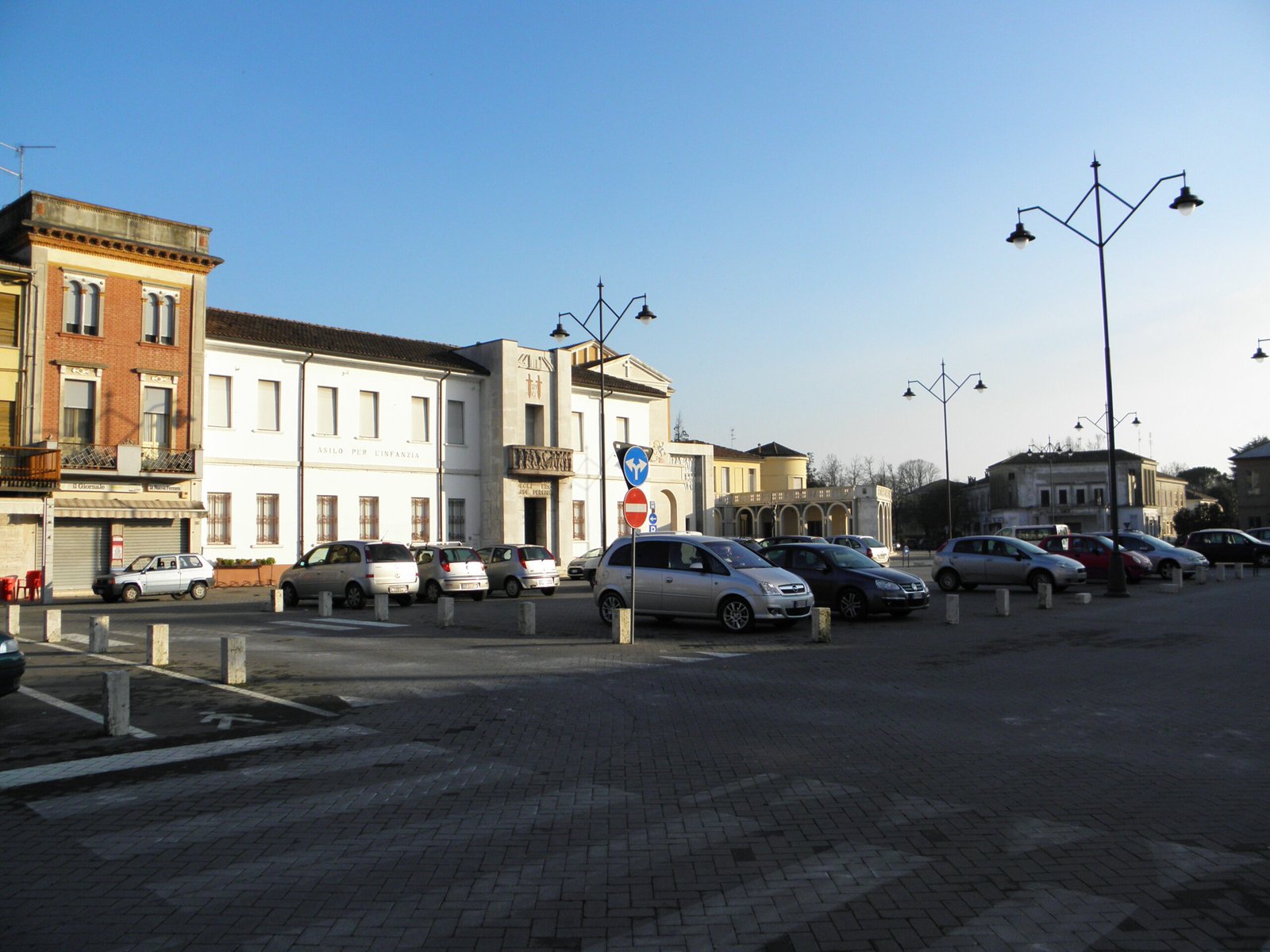
The plan is its masterpiece. Tresigallo is organised around two perpendicular axes — one linking the parish church to the youth centre, the other running from the civic centre straight to the cemetery, a deliberately metaphysical line connecting public life to memory. White and pale-ochre plaster, long horizontal porticoes, rhythmic pilasters and regular grids of windows give the whole town the controlled, slightly unreal calm of a de Chirico painting. Piazza Italia is the hinge of the composition, framed by the municipal building, the Casa della Cultura and the parish nursery.
Reading Romagna today
These three towns belong to the same decade and the same political will, yet they ask to be read differently — Forlì as a civic showcase still in daily use, Predappio as a ruin loaded with unfinished argument, Tresigallo as an almost intact work of urban art. Together they form a Rationalist itinerary unlike any other in Italy, where the architecture cannot be separated from the history that paid for it. For the visitor, that is not a reason to look away. It is the reason to look closely.
Sources
- S1 — Ciucci, Giorgio. Gli architetti e il fascismo. Einaudi, 1989. ISBN 978-88-06-11422-0.
- S2 — Ghirardo, Diane. Building New Communities: New Deal America and Fascist Italy. Princeton University Press, 1989. ISBN 978-0-691-04064-6.
Spotted an error? Write to editorial@culturalheritageonline.com and we correct it the same day.