Giuseppe Terragni lived for thirty-nine years and worked for barely fifteen of them. Almost everything that matters in his career happened in a single lakeside city — Como, where he was raised, trained his eye, and built the handful of structures that turned Italian Rationalism from a magazine argument into architecture you could walk into. To understand the movement, you go to Como. To understand Como, you follow Terragni.
A provincial city, an international idea
Terragni was born in Meda in 1904 and grew up in Como, a prosperous textile town at the foot of the Alps. He studied at the Politecnico di Milano and, while still a student, joined the circle that in 1926 and 1927 announced itself as Gruppo 7 — seven young architects who declared, in a series of published articles, that Italy needed a modern architecture: rational, clear, true to its materials, and free of the historical costume the establishment still favoured. Most manifestos stay on paper. Terragni went home to Como and started building.
Novocomum: the scandal that started everything
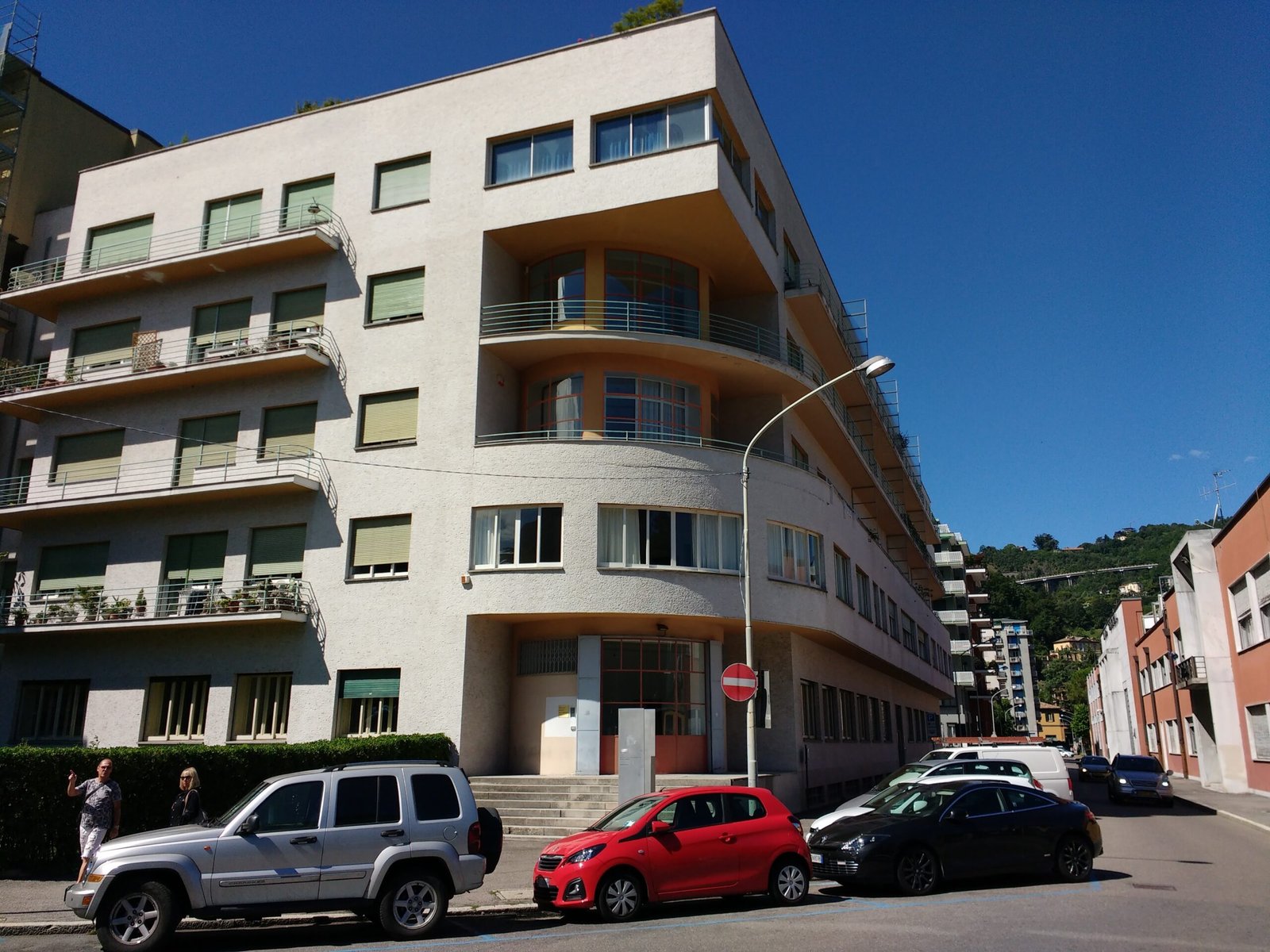
His first major work was an apartment block. The Novocomum, commissioned by a local property company and finished in 1929, sits on Viale Sinigaglia between the city and its lakefront. Terragni was twenty-three when he won the job, and the drawings he filed with the planning office were reassuringly conventional. What rose behind the scaffolding was anything but: a five-storey block whose corners dissolved into cylinders of glass, the wall peeling back to reveal drums of light. When the hoardings came down the city was scandalised, and a special commission chaired by the Milanese architect Piero Portaluppi was convened to judge whether the building harmed the decorum of Como. It ruled that it did not. The Novocomum stood, and Italian modernism had its first built statement.
Casa del Fascio: the half-cube
Seven years later came the building that made Terragni canonical. The Casa del Fascio, built between 1932 and 1936 facing Piazza del Popolo, is the most analysed structure of the entire movement. Its plan is a square of 33.20 metres a side; its height is exactly half that, 16.60 metres — a perfect half-cube faced in pale Botticino marble. At its heart Terragni placed a double-height assembly hall lit from above through a roof of glass blocks, and lined the main facade with a loggia whose glazed doors could all be thrown open at once. He spoke of the building as an architecture of total transparency. Stripped today of the politics that paid for it — it now houses the Guardia di Finanza — it survives as a pure demonstration of proportion, daylight and honest material, and was listed as cultural heritage of major importance in 1986.
Beyond Como: the Milan apartments
Terragni rarely worked alone on his larger commissions. With the architect Pietro Lingeri he carried Rationalism out of Como and into the Milanese property market, designing a series of apartment houses for private clients. The best known is Casa Rustici on Corso Sempione, completed in 1935, where two parallel residential blocks are tied together at every floor by slender walkways suspended across an open courtyard. It is a building that takes a routine speculative brief and turns it into a clear structural idea — exactly the discipline Terragni had rehearsed at home.
Elsewhere in the city, Casa Toninello of the same years applies the same Terragni–Lingeri partnership to a smaller apartment block.
The Como concentration
What makes Como exceptional is density. Most cities are lucky to hold one canonical modern building; Como holds a cluster, almost all by the same hand and almost all within walking distance. Beyond the Novocomum and the Casa del Fascio, Terragni left the city his Asilo Sant’Elia, a nursery school of 1936–1937 whose low, light-filled classrooms open onto a sheltered garden — Rationalism turned toward the smallest and least monumental of clients, children. The school applies the same convictions as the famous half-cube down the road: clarity of plan, generosity of daylight, no ornament that does not earn its place. Seen together, these buildings turn a single provincial town into a complete museum of the movement, one you tour on foot rather than through a catalogue.
The work cut short
That concentration is also a record of how little time he had. The career ended abruptly: called up for military service, Terragni served on the Eastern Front, and the experience broke him. He returned ill and died in Como in 1943, at thirty-nine, two years before the regime he had built for collapsed. What he left behind is small in quantity and enormous in influence — proof that a provincial lakeside town could, for one extraordinary decade, set the terms of European modern architecture. To walk Como today, from the lakefront cylinders of the Novocomum to the marble calm of the Casa del Fascio, is to follow the entire arc of a movement compressed into the work of one short life.
Follow the route
These buildings are collected in the curated itinerary Terragni Rationalism RoadBook: an interactive map from Novocomum and the Casa del Fascio in Como to the partnership’s Milan apartment houses, with a play-through tour and GPX and KML files for your own navigator.
Sources
- Wikipedia, Giuseppe Terragni, Novocomum, Casa del Fascio (Como), Casa Rustici — biography, dates and attributions.
- Lombardia Beni Culturali — twentieth-century architecture of Como and Milan.