
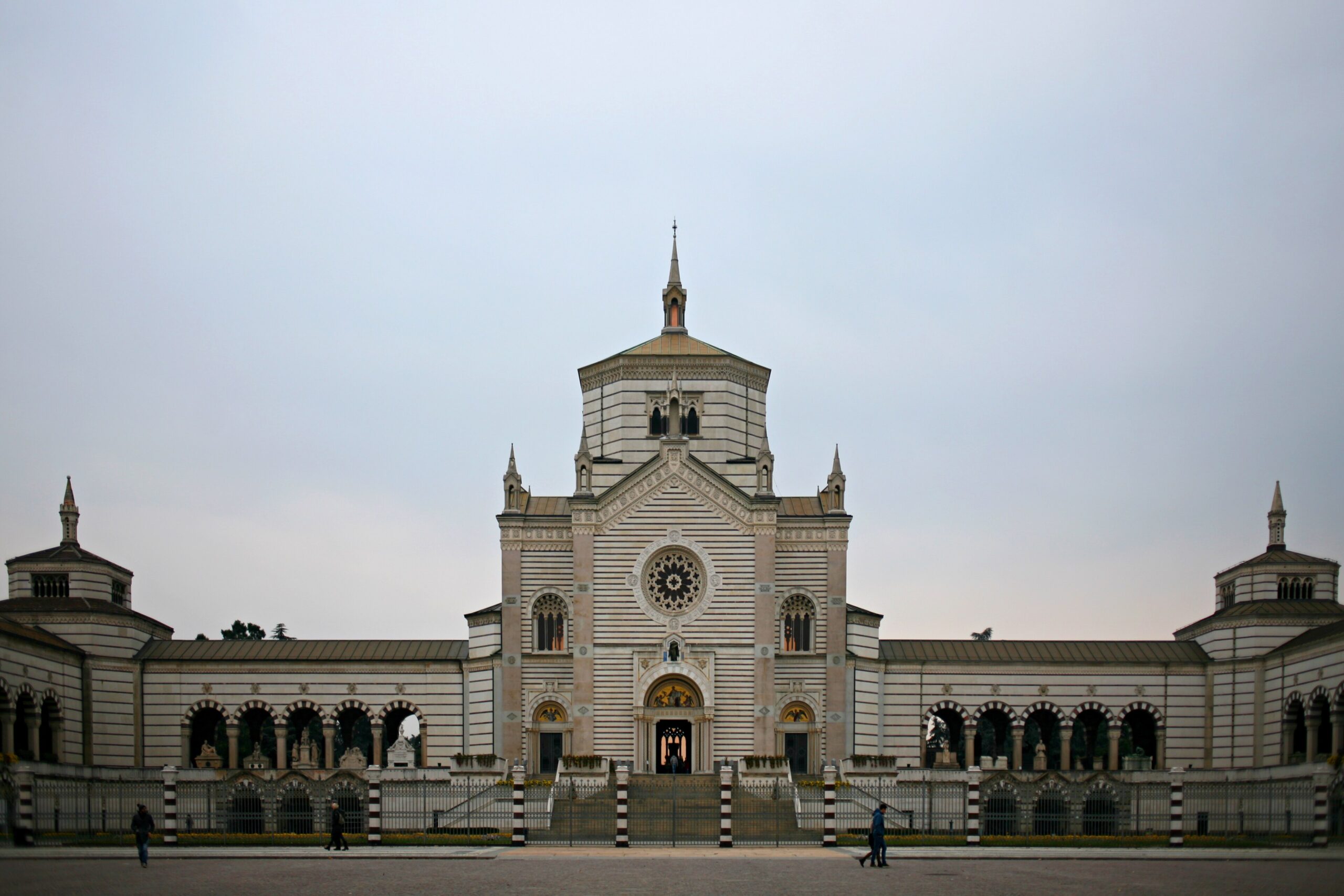
The Porcile Family edicola is a funerary chapel designed by architect Enrico Agostino Griffini and completed in 1934 within Milan’s Cimitero Monumentale.
This small chapel exemplifies Griffini’s commitment to Rationalism, the architectural movement he embraced after a 1927 study visit to the Weißenhofsiedlung in Stuttgart. The edicola stands among the diverse array of artistic tombs and monuments that characterize the Cimitero Monumentale, which opened officially in 1866 and has since accumulated works by leading Italian sculptors and architects. Griffini’s design reflects the modernist principles of the Italian Rationalist movement, of which he was a pioneer and an adherent of the MIAR (Movimento italiano per l’architettura razionale).
About Enrico Agostino Griffini
Griffini (1887–1952) was a Venetian-born architect and engineer who established his principal practice in Milan after earning his degree in electrical engineering from what is now the Politecnico di Milano in 1910. Beyond his funerary work, he contributed significantly to twentieth-century Italian architecture, including the reconstruction of the upper church of Santa Maria alla Fontana (1922) and the Istituto per la fanciullezza abbandonata in Lodi (1933). He himself rests in a tomb at the Cimitero Monumentale.
Details
- Architect: Enrico Agostino Griffini
- Year: 1934
- Location: Cimitero Monumentale di Milano, Milan
- Movement: Italian Rationalism
- Type: Funerary chapel (edicola)
Frequently asked questions
Who designed the Porcile edicola?
Enrico Agostino Griffini, a Venetian architect and pioneer of Italian Rationalism, designed the chapel in 1934.
Where is it located?
The edicola stands within the Cimitero Monumentale di Milano, one of Milan’s two largest cemeteries, which officially opened in 1866 and is renowned for its artistic tombs and monuments.
What architectural movement influenced this work?
Griffini embraced Rationalism after visiting Stuttgart’s Weißenhofsiedlung in 1927 and became an adherent of the MIAR, the Italian Rationalist movement, whose principles shaped the design of this funerary chapel.
Sources
- S1 — Danesi, Silvia, and Luciano Patetta, eds. Il razionalismo e l'architettura in Italia durante il fascismo. Electa, 1976. ISBN 978-88-435-0394-0.
- S2 — Ciucci, Giorgio. Gli architetti e il fascismo: architettura e città 1922-1944. Einaudi, 1989. ISBN 978-88-06-11656-9.
Spotted an error? Write to editorial@culturalheritageonline.com and we correct it the same day.


