

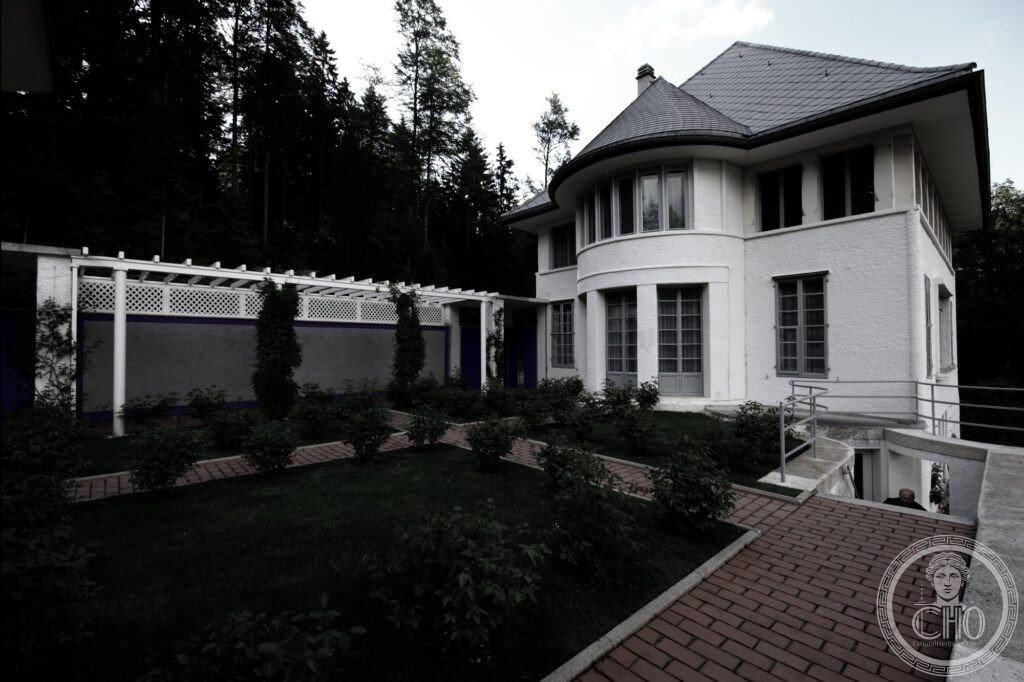

White walls where pine-motif plasterwork used to be: at the top of the same lane as the Pouillerel trilogy, the twenty-five-year-old Jeanneret built his parents a house that showed exactly how far he had already gone.
At a glance
Maison Blanche — the White House — stands at Chemin de Pouillerel 12, a short walk above the three Style Sapin villas that Jeanneret had completed between 1906 and 1909. Built in 1912 for his parents, Marie-Charlotte-Amélie and Georges Jeanneret-Perret, it is his first independent project: not a collaboration with Chapallaz, not a school exercise, but one of the first buildings entirely designed and coordinated by the twenty-five-year-old architect alone. Its white rendered walls, horizontal emphasis, and near-absence of applied ornament represent a decisive break with the Style Sapin. Jeanneret had spent 1908 in Paris with Auguste Perret and 1910 in Berlin with Peter Behrens; the influences of both are legible here. The building is open to visitors and is in a UNESCO World Heritage city (La Chaux-de-Fonds, watchmaking town planning, 2009).
Key facts
- Architect: Charles-Édouard Jeanneret (later Le Corbusier), first independent project
- Style: Proto-modern, departing from Style Sapin; influenced by Perret (Paris) and Behrens (Berlin)
- Year: 1912
- Clients: his parents, Marie-Charlotte-Amélie and Georges Jeanneret-Perret
- Address: 12 Chemin de Pouillerel, 2300 La Chaux-de-Fonds
- GPS: 47.1061° N, 6.8158° E — Google Maps
- Visiting: open to the public (Association Maison Blanche; restored 2004–2005, opened 2005)
- Heritage: Swiss Federal Inventory of Heritage Sites; La Chaux-de-Fonds is a UNESCO WH city (watchmaking town planning, 2009)
History
Jeanneret completed the Maison Blanche while still living in La Chaux-de-Fonds, before his final move to Paris in 1917. He had spent formative periods away — Paris with Perret on reinforced concrete in 1908, Germany with Behrens and the Deutscher Werkbund in 1910 — and each had sharpened his dissatisfaction with the Style Sapin he had practised under L’Eplattenier. The Maison Blanche was the first place he could give that dissatisfaction built form: for his own parents, on the same lane as his earliest work, he made the contrast with those earlier buildings explicit.
Jeanneret occupied and worked in the house from 1912 until 1915, when his parents moved in permanently. After their deaths the building was sold in 1919, and it passed through private hands for decades, suffering alterations and neglect. In 2000 the Association Maison Blanche acquired the property and undertook a careful restoration (active works 2004–2005), reopening it as a visitor centre in 2005. The Swiss government included it in its proposal to UNESCO for the Le Corbusier transnational inscription, which was granted in 2016.
What you see
The house is a compact white volume under a shallow pitched roof, set into the hillside so that the entrance is at a mid-level. The most distinctive quality is what is absent: there is almost no ornament. Where the Pouillerel villas carry incised plasterwork, ironwork balconies, and pine-motif friezes, Maison Blanche relies on the geometry of the openings — horizontal windows organised in a clear compositional rhythm — and on the whiteness of the rendered walls. It reads as a manifesto of subtraction, made more pointed by the forest of Style Sapin it rises above.
Inside, the spatial arrangement shows the influence of Perret’s rationalism: rooms are planned around a clear structural logic, without the ornamental interior programmes of the earlier villas. The current visitor-centre configuration preserves much of the original disposition, complemented by displays tracing Jeanneret’s transition from the Jura manner to what would become, a decade later, the five points of modern architecture.
Practical information
- Maison Blanche is open to visitors; check current opening hours at the Association Maison Blanche website or at the La Chaux-de-Fonds tourist office.
- Entry is ticketed; guided tours available (advance booking recommended for groups).
- The visit includes the ground floor and garden; exhibition material on Jeanneret’s early career is installed throughout.
- Allow at least 45 minutes for the house visit, plus time for the Pouillerel walk.
Getting there
Chemin de Pouillerel 12 is at the upper end of the lane, above the three Style Sapin villas. From La Chaux-de-Fonds central station, a twenty-minute walk or a short bus ride brings you to the Pouillerel area; the Maison Blanche is the highest building on the lane. It sits within a ten-minute walk of Villa Fallet (no.1), Villa Stotzer (no.6), and Villa Jacquemet (no.8).
Nearby
- Villa Fallet (1906) — Chemin de Pouillerel 1, the beginning of the same story.
- Villa Stotzer (1908–09) — no.6.
- Villa Jacquemet (1907) — no.8.
- Villa Schwob (Villa Turque) (1916–17) — Rue du Doubs 167, Jeanneret’s most accomplished La Chaux-de-Fonds commission.
Sources
- Wikipedia EN, “Villa Jeanneret-Perret” (architect, year, clients, address, restoration history, UNESCO).
- Wikipedia EN, “Le Corbusier” (1908 Paris stay, 1910 Berlin stay, first independent project context).
- Wikidata Q3277871 (GPS confirmed: 47.10611, 6.81583; P84 architect Q4724 Le Corbusier; P571 inception 1912).
- Association Maison Blanche (restoration 2000–2005, opening 2005; cited in Wikipedia).
- Fondation Le Corbusier (primary source: design 1911–1912, restoration 2004–2005). La Chaux-de-Fonds is a UNESCO WH city (watchmaking, 2009).
Find it on the map
See this place and what’s around it →📷 Become a Cultural Heritage Online photographer
Share your photos of places: they stay published under your name as the author. The more they're seen, the more you get noticed — and soon a contest will reward the most appreciated photos.
Log in or sign up free to add a photo