

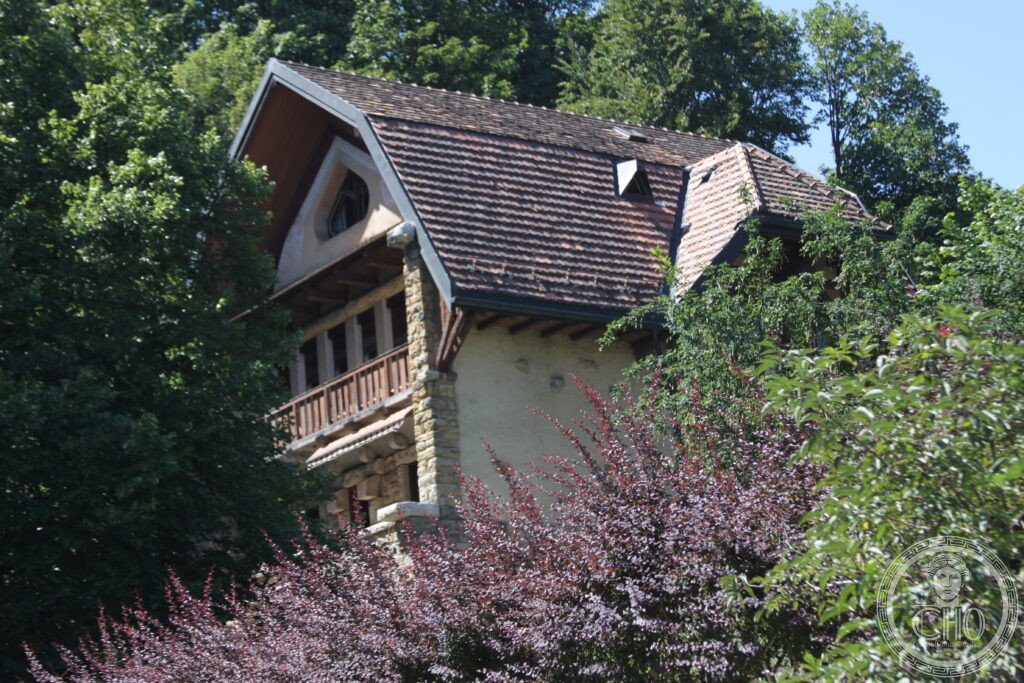

The final villa of the Pouillerel trilogy: Jeanneret’s ornamental grammar had reached its most refined point, and within three years he would abandon it entirely for white walls and flat roofs.
At a glance
Villa Stotzer at Chemin de Pouillerel 6 completes the “Pouillerel trilogy” of three Style Sapin houses designed by Charles-Édouard Jeanneret and René Chapallaz on the same wooded hillside lane. Built between 1908 and 1909, it shows the ornamental programme of the Style Sapin — pine-tree motifs, geometric Jura-forest patterns, rendered façade surfaces — in its most fully realised form. Within a few years Jeanneret would leave La Chaux-de-Fonds for Paris and begin dismantling everything the Style Sapin had built; Villa Stotzer is the last moment before that break.
Key facts
- Designer: Charles-Édouard Jeanneret (later Le Corbusier) and René Chapallaz
- Style: Style Sapin (Jura Art Nouveau), ornamental direction by Charles L’Eplattenier
- Year: 1907–1908 (Fondation Le Corbusier; completed October 1908; Wikidata Q29522950)
- Address: 6 Chemin de Pouillerel, 2300 La Chaux-de-Fonds
- GPS: 47.1046° N, 6.8151° E — Google Maps
- Heritage: La Chaux-de-Fonds is a UNESCO World Heritage city for watchmaking town planning (2009); the villa is on the Swiss Federal Heritage Inventory
History
By the time Villa Stotzer was commissioned in 1908, Jeanneret had completed two houses on the same lane and was well practised in the Style Sapin idiom. The Atelier des Arts Réunis, under L’Eplattenier, had made the lane into a demonstration project for the movement, and local patrons were responding.
The villa’s construction coincided with a shift in Jeanneret’s thinking. In 1907 he had visited Vienna, Florence, and the Charterhouse of Ema; in 1908 he moved temporarily to Paris to work with Auguste Perret on reinforced concrete. The Stotzer commission was completed during this period of expanding horizons, which makes it the last fully committed Style Sapin building in the trilogy, and in Jeanneret’s output generally.
The villa is listed among the transnational UNESCO World Heritage sites dedicated to Le Corbusier’s architectural work, inscribed in 2016.
What you see
The façade shares the vocabulary established at Villa Fallet — steep pitched roof with deep eaves, rendered walls with incised ornament, ironwork balconies in pine-motif patterns — but the handling is more assured. The geometric abstraction of the natural motifs is pushed slightly further, moving toward a pattern language that anticipates, in a modest way, the kind of abstract surface decoration that would appear in Jugendstil work elsewhere in Europe.
Seen alongside Fallet (no.1) and Jacquemet (no.8), Villa Stotzer (no.6) shows how the Style Sapin evolved through three commissions: the ornament grew more disciplined, the composition more controlled, without losing the essential reference to Jura flora.
Practical information
- Private residence; the façade is visible from the lane.
- Walk the three Pouillerel villas as a sequence (no.1 Fallet, no.6 Stotzer, no.8 Jacquemet) and continue to no.12 Maison Blanche, which is open to visitors.
- Best light is morning, on the south-facing façade.
- Allow 30–45 minutes for the full Pouillerel walk with stops.
Getting there
From La Chaux-de-Fonds central station, take a local bus to the Pouillerel stop or walk twenty minutes south through the grid. The villa is at number 6 on Chemin de Pouillerel, between Fallet (no.1) and Jacquemet (no.8).
Nearby
- Villa Fallet (1906) — no.1, first villa of the trilogy.
- Villa Jacquemet (1907) — no.8, second villa.
- Maison Blanche (Villa Jeanneret-Perret) (1912) — no.12, open to visitors.
Sources
- Wikipedia EN, “Villa Fallet” (the trilogy; Style Sapin programme; Chapallaz role).
- Wikipedia EN, “Le Corbusier” (1908 Paris stay with Perret; Villa Stotzer as part of the early Swiss output).
- Wikidata Q29522950 (inception: 1909; GPS: 47.10455, 6.81514).
- Swiss Federal Inventory of Cultural Heritage Sites; the city of La Chaux-de-Fonds is UNESCO WH (watchmaking town planning, 2009).
Find it on the map
See this place and what’s around it →📷 Become a Cultural Heritage Online photographer
Share your photos of places: they stay published under your name as the author. The more they're seen, the more you get noticed — and soon a contest will reward the most appreciated photos.
Log in or sign up free to add a photo