
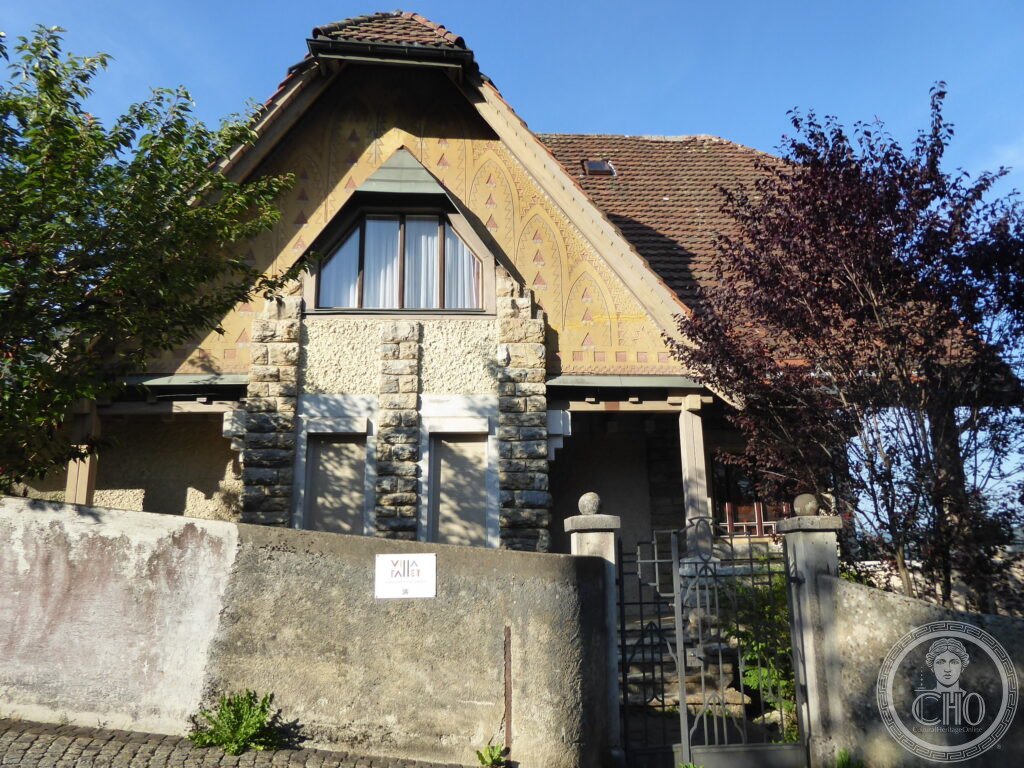

An eighteen-year-old drew the plans; a neighbourhood of pine-cone plasterwork was the result. It was Jeanneret’s first house and the Style Sapin’s most quoted debut.
At a glance
Villa Fallet stands at Chemin de Pouillerel 1 on the wooded slope south of La Chaux-de-Fonds, the first house designed by Charles-Édouard Jeanneret, then a student at the local School of Art. Jeanneret worked the plans under the supervision of his teacher Charles L’Eplattenier and the structural guidance of architect René Chapallaz, who served as project director. Completed in 1906, the villa demonstrates the Style Sapin — a regional variant of Art Nouveau that drew its ornament not from Parisian floral curves but from the Jura forest: pine branches, pine cones, geometric fir patterns. It is now a listed cultural property of national significance in the canton of Neuchâtel.
Key facts
- Designer: Charles-Édouard Jeanneret (later Le Corbusier), project direction René Chapallaz
- Style: Style Sapin (Jura variant of Art Nouveau), ornamental programme under Charles L’Eplattenier
- Year: construction November 1906 – April 1907; design from 1905
- Client: Louis Fallet, an engraver and jeweller and jeweller from La Chaux-de-Fonds
- Address: 1 Chemin de Pouillerel, 2300 La Chaux-de-Fonds
- GPS: 47.1051° N, 6.8167° E — Google Maps
- Heritage: Federal Inventory of Swiss Heritage Sites (canton Neuchâtel); La Chaux-de-Fonds is itself a UNESCO World Heritage site for watchmaking town planning (2009)
History
When Louis Fallet commissioned a villa on the Pouillerel hillside in 1905, he turned to the Atelier des Arts Réunis at the local School of Art, where Charles L’Eplattenier was building a movement he called the Style Sapin. L’Eplattenier believed that the Jura landscape — its fir forests, its granite, its light — should provide the vocabulary of a genuinely regional modern architecture. He assigned the project to Jeanneret, then eighteen, who had only recently completed his decorative-arts training. René Chapallaz, a licensed architect, oversaw execution.
The success of Villa Fallet led immediately to two further commissions on the same lane: Villa Jacquemet (1907) and Villa Stotzer (1908–09), forming what historians call the “Pouillerel trilogy.” All three share the steep local chalet roof, the rendered façade, and the Jura-forest ornament, but Jeanneret’s handling of proportion grew more assured with each house.
Villa Fallet remained private for over a century. In 2022 the municipality of La Chaux-de-Fonds purchased it for 1,150,000 Swiss francs, making it the first of Jeanneret’s early works to enter public ownership. The Swiss Federal Inventory had listed it as a cultural property of national significance well before that, and UNESCO included it in the transnational Le Corbusier sites inscription in 2016.
What you see
The villa reads as a large chalet at first: steep roof to shed Jura snow, rendered walls, strong timber elements at the eaves. But the façade surfaces are not plain. L’Eplattenier and Jeanneret covered them in sgraffite and incised plasterwork: pine trees rendered as flat geometric triangles, pine cones as repeating diamond forms, stylised foliage turning corners and framing windows. The ironwork at balconies and the woodwork at doors carry the same motifs at a smaller scale. The effect is of a building that knows exactly which forest it is standing in.
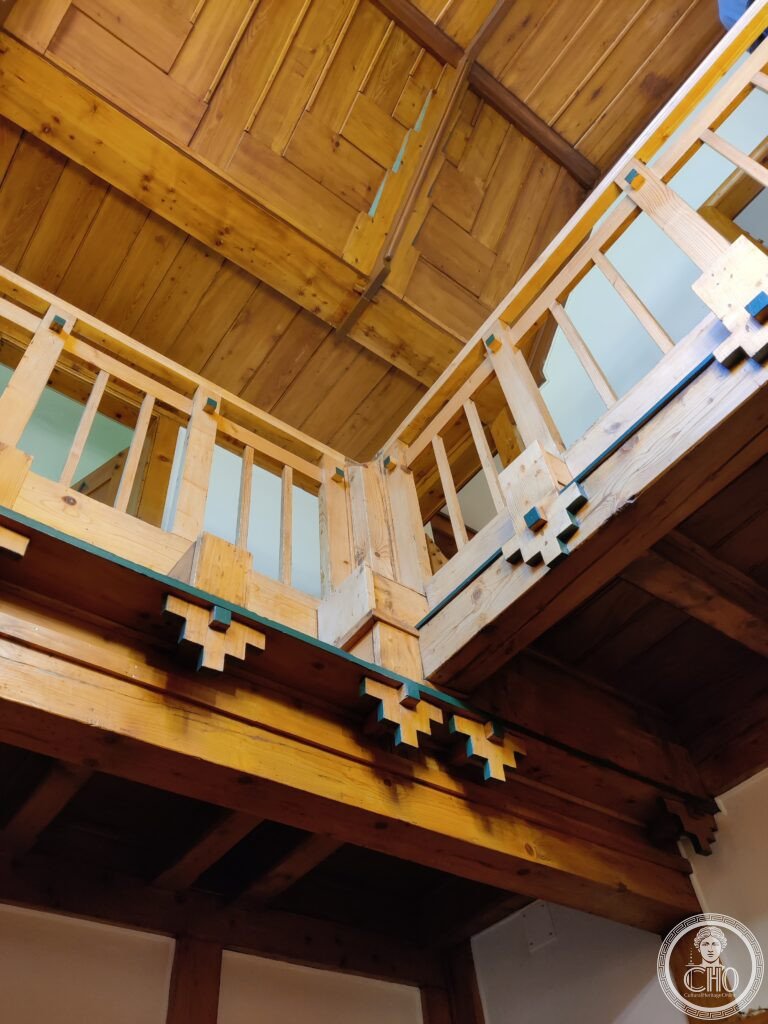
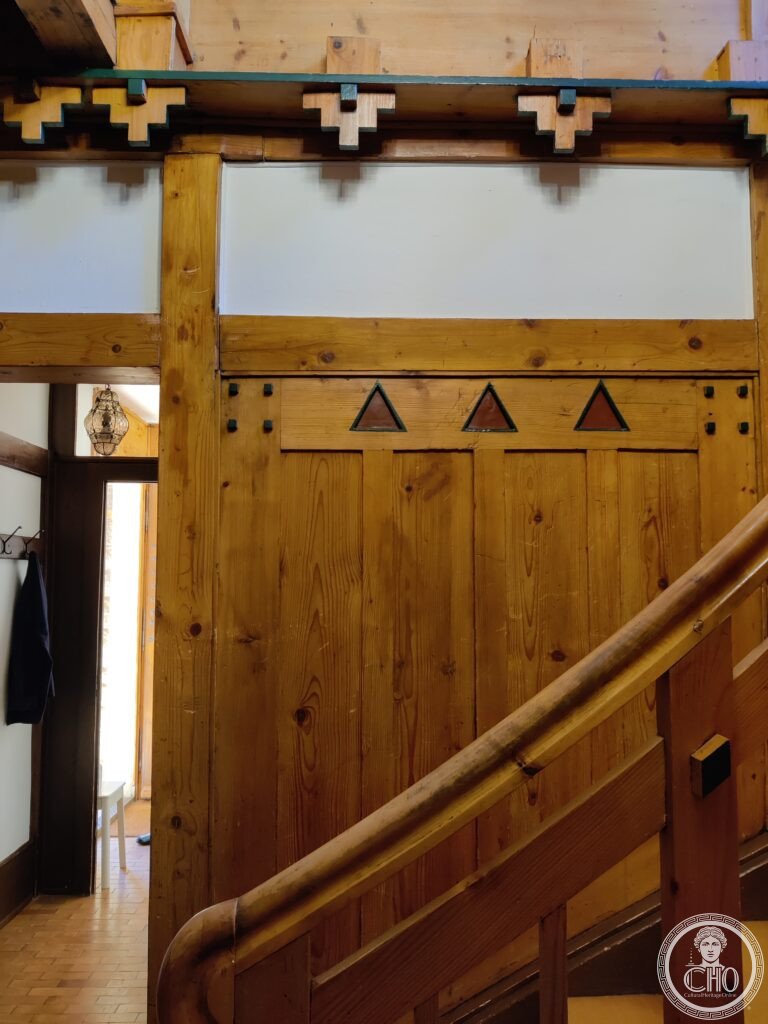
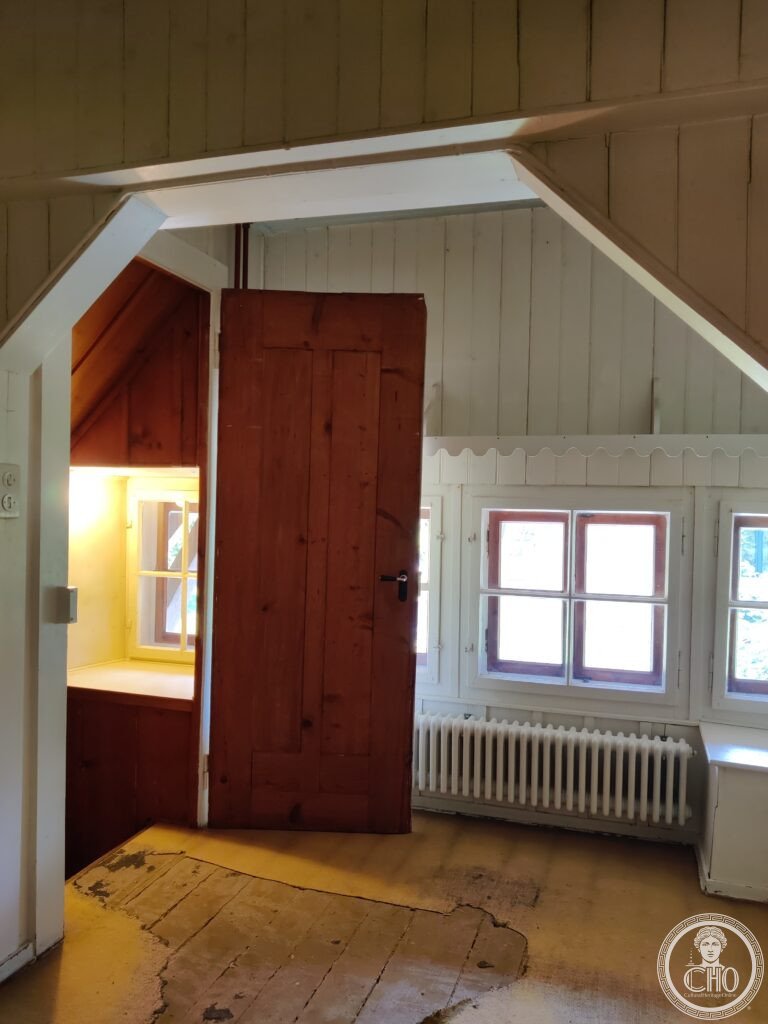
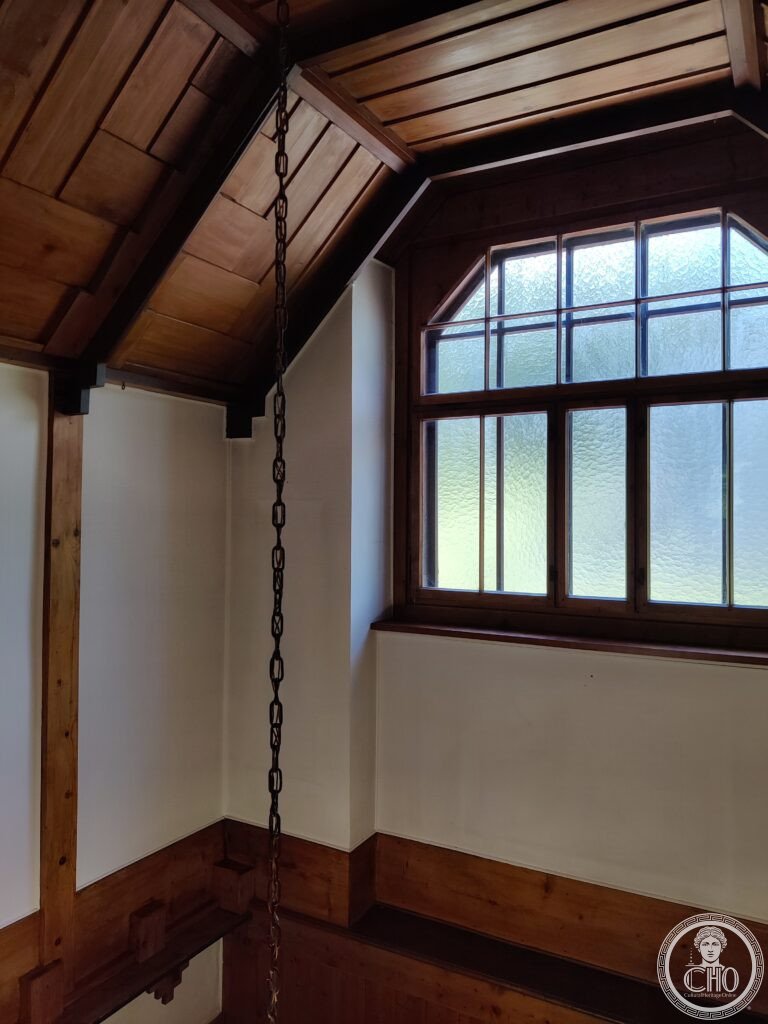
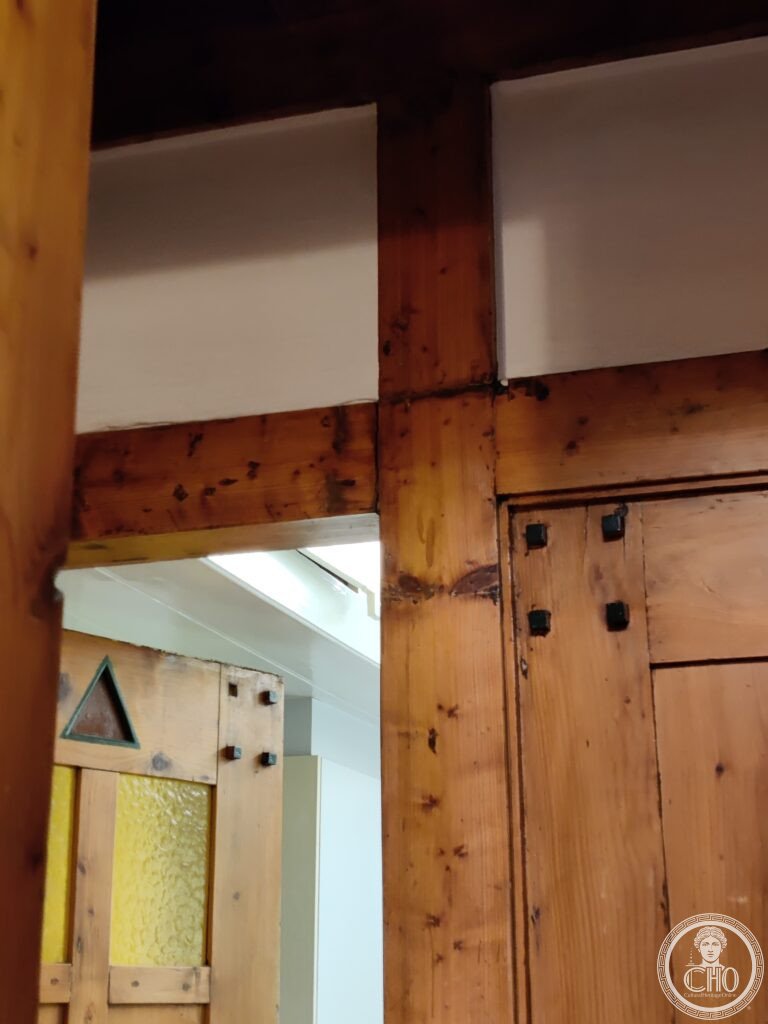
Inside, the hall plasterwork and the stair details sustain the programme begun on the exterior. Photographs from after the 2022 municipal purchase show the original ornamental system substantially intact, a rare survival of early Jeanneret work in its designed state.
Practical information
- The villa is a private residence purchased by the municipality; interior access depends on the current public programme — check with the La Chaux-de-Fonds tourist office before visiting.
- The exterior and the ornamental façade are fully visible from Chemin de Pouillerel.
- Best light is morning, when the south-facing façade is lit directly.
- Villa Jacquemet and Villa Stotzer are within a two-minute walk on the same lane.
- Combine with the Maison Blanche (Chemin de Pouillerel 12) for a full Jeanneret walking circuit.
Getting there
La Chaux-de-Fonds is served by regular trains from Biel/Bienne and Neuchâtel. From the central station, Chemin de Pouillerel is a twenty-minute walk uphill through the residential quarter south of the grid. Bus lines run to the Pouillerel stop, from which the villa is a short walk. The neighbouring villas Jacquemet and Stotzer are on the same street.
Nearby
- Villa Jacquemet (1907) — Chemin de Pouillerel 8, two minutes’ walk.
- Villa Stotzer (1908–09) — Chemin de Pouillerel 6, adjacent.
- Maison Blanche (Villa Jeanneret-Perret) (1912) — Chemin de Pouillerel 12, five minutes’ walk.
- La Chaux-de-Fonds / Le Locle — Watchmaking Town Planning (UNESCO WH site overview).
Photo gallery
Sources
- Wikipedia EN, “Villa Fallet” (architect, client, year, heritage status).
- Wikipedia FR, “Villa Fallet” (construction dates Nov. 1906 – Apr. 1907; Fallet commission 1905; L’Eplattenier’s Atelier des Arts Réunis context).
- Fondation Le Corbusier (cited in Wikipedia as primary source for heritage designation).
- Swiss Federal Inventory of Cultural Heritage Sites, canton Neuchâtel (listed).
- La Chaux-de-Fonds / Le Locle — Watchmaking Town Planning (UNESCO WH, 2009, site 1362)
Find it on the map
See this place and what’s around it →📷 Become a Cultural Heritage Online photographer
Share your photos of places: they stay published under your name as the author. The more they're seen, the more you get noticed — and soon a contest will reward the most appreciated photos.
Log in or sign up free to add a photo