

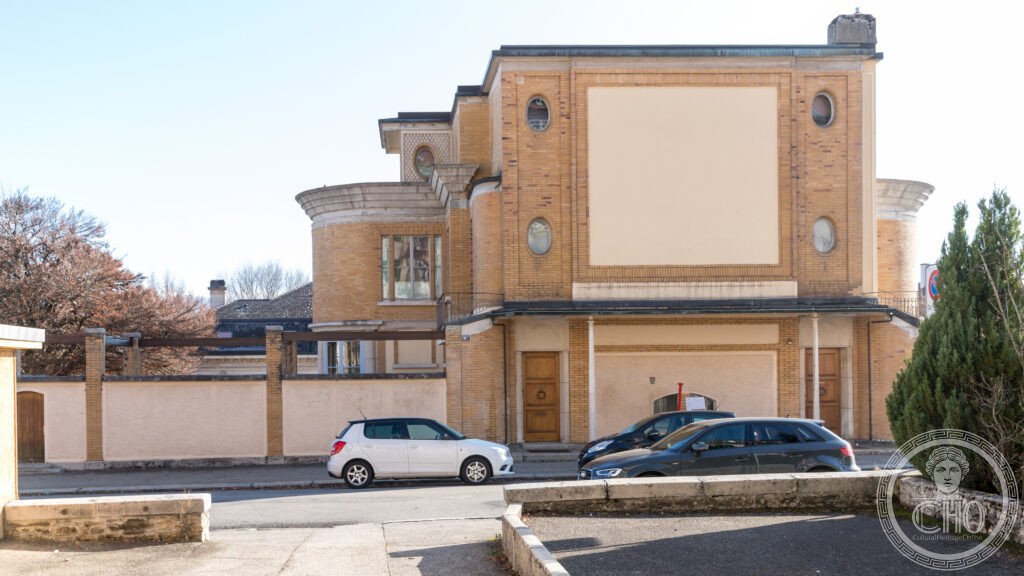

Ochre brick, concrete, and a dome that reads as half-Ottoman from the street: Le Corbusier settled a score with ornament here, and in doing so discovered the regulating lines that would organise his architecture for the next four decades.
At a glance
Villa Schwob at Rue du Doubs 167 is the building Le Corbusier himself described as his most accomplished work before leaving for Paris. Commissioned in 1912 by Anatole Schwob, a watchmaker, and completed in September 1917, it is a large private villa of ochre brick and concrete whose central dome and layered elevation give it an oriental quality — hence its popular name, the Villa Turque. For the architect, it was also a laboratory: the first building in which he consciously applied the principle of “regulating lines,” the geometric proportional system that would become one of the central tools of his mature practice. The Fondation Le Corbusier identifies it as a key work in its own right, not merely a prelude to the Paris years.
Key facts
- Architect: Le Corbusier (Charles-Édouard Jeanneret)
- Style: Proto-Modern; first application of “regulating lines” proportional system
- Commission: July 1916; completed September 1917
- Client: Anatole Schwob, watchmaker
- Popular name: Villa Turque (the Turkish Villa), for its oriental character
- Address: 167 Rue du Doubs, 2300 La Chaux-de-Fonds
- GPS: 47.0996° N, 6.8171° E — Google Maps
- Later ownership: acquired by the Ebel watch group in 1986
History
Anatole Schwob came from a watchmaking dynasty and was among the wealthiest patrons available in La Chaux-de-Fonds in the early twentieth century. When he commissioned a large villa from the thirty-year-old Jeanneret, he was giving the architect the scale and budget he had not yet had. The commission was unusual: Schwob wanted grandeur, the architect wanted a testing ground for ideas he had been developing since his European travels of 1907–1910.
The building took five years to complete, a delay partly attributable to the disruptions of the First World War. When it was finished in 1917, Jeanneret was already preparing his move to Paris, where he would publish his ideas in the journal L’Esprit Nouveau with Amédée Ozenfant. The Villa Schwob was the last substantial work he completed in his hometown. The Fondation Le Corbusier, which holds his archive, considers it the culmination of the Swiss period.
In 1986 the villa was purchased by the Ebel watch group, which described it as “an inexhaustible source of inspiration” aligned with its design values. It remains in private use.
What you see
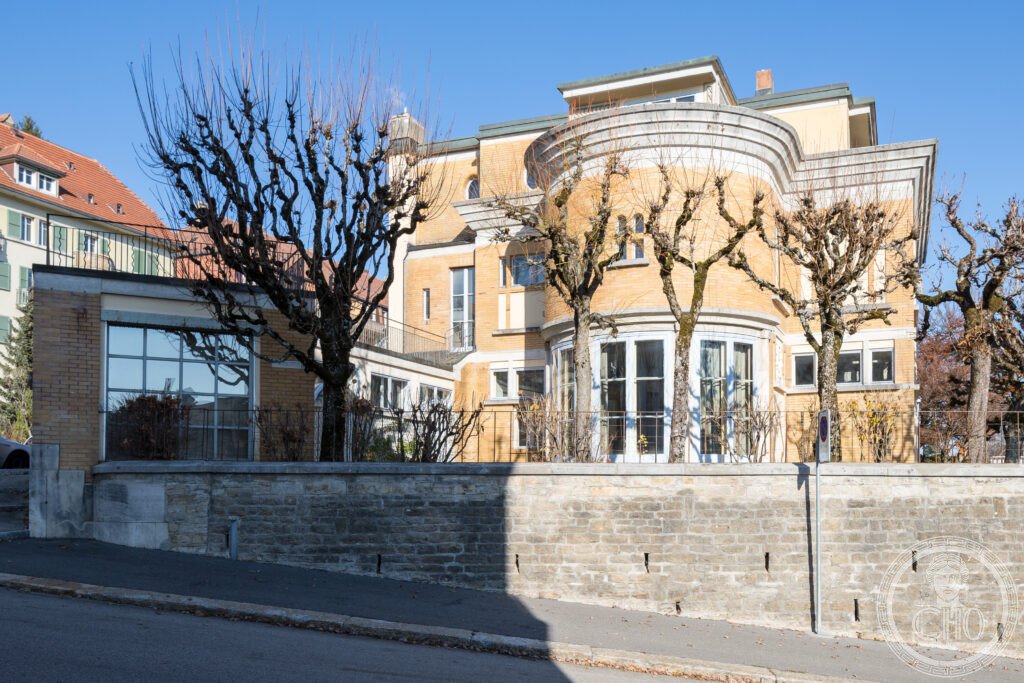
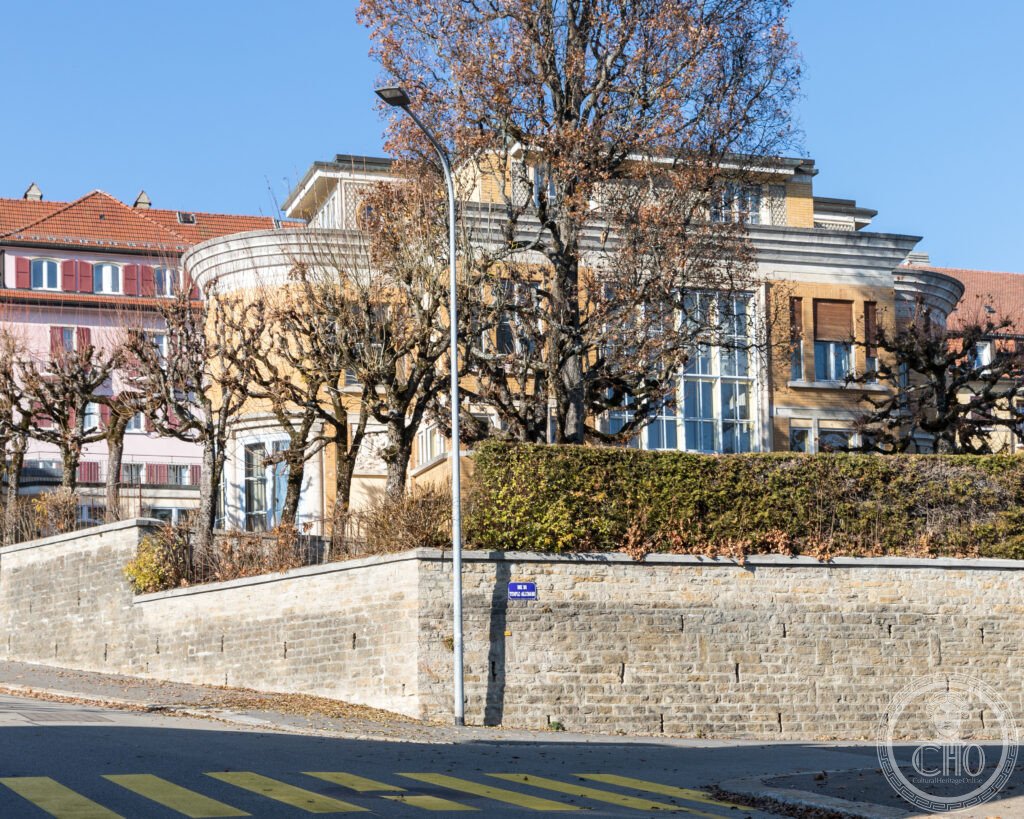
The dominant impression from Rue du Doubs is of mass and calm: a large ochre brick volume with a concrete armature, the central bay rising to a shallow dome that gives the building its Turkish nickname. The ornament is sparse and deliberate — not the flowing pine-motif plasterwork of the Pouillerel villas, but a formal vocabulary of arcading, pilasters, and mouldings that reads as classical in discipline if not in specific detail.
Le Corbusier applied his “regulating lines” to the façade: geometric lines that organise the position of windows, entablature, and dome in a system of proportional relationships invisible to the untrained eye but responsible for the building’s sense of settled authority. It is “rich in symbols, and with elaborate technical and aesthetic aspects,” in the Fondation Le Corbusier’s phrasing.
Practical information
- The villa is in private use; the exterior on Rue du Doubs is freely visible.
- The most informative view is from across the street, where the full symmetry of the façade and the dome can be read.
- Combine with the Maison Blanche (Chemin de Pouillerel 12, ticketed) for a Jeanneret itinerary spanning 1912–1917.
Getting there
Rue du Doubs 167 is in the residential quarter south of the La Chaux-de-Fonds grid, about 25 minutes on foot from the central station. The Maison Blanche (Chemin de Pouillerel) is a 15-minute walk north.
Nearby
- Maison Blanche (Villa Jeanneret-Perret) (1912) — Jeanneret’s proto-modern pivot four years before this villa.
- Villa Fallet (1906) — where the same architect began, in a completely different idiom.
- La Chaux-de-Fonds / Le Locle — Watchmaking Town Planning (UNESCO WH overview).
Photo gallery
Sources
- Wikipedia EN, “Villa Schwob” (architect, client, dates, regulating lines, Villa Turque name, Ebel acquisition).
- Fondation Le Corbusier (cited in Wikipedia as primary source; characterises it as “most accomplished work before leaving for Paris” and “rich in symbols”).
- Wikidata Q7930495 (GPS confirmed: 47.09961, 6.81705; multiple inception dates 1912/1916/1917).
- Wikipedia EN, “Le Corbusier” (the regulating lines principle; Swiss period summary).
Find it on the map
See this place and what’s around it →📷 Become a Cultural Heritage Online photographer
Share your photos of places: they stay published under your name as the author. The more they're seen, the more you get noticed — and soon a contest will reward the most appreciated photos.
Log in or sign up free to add a photo