
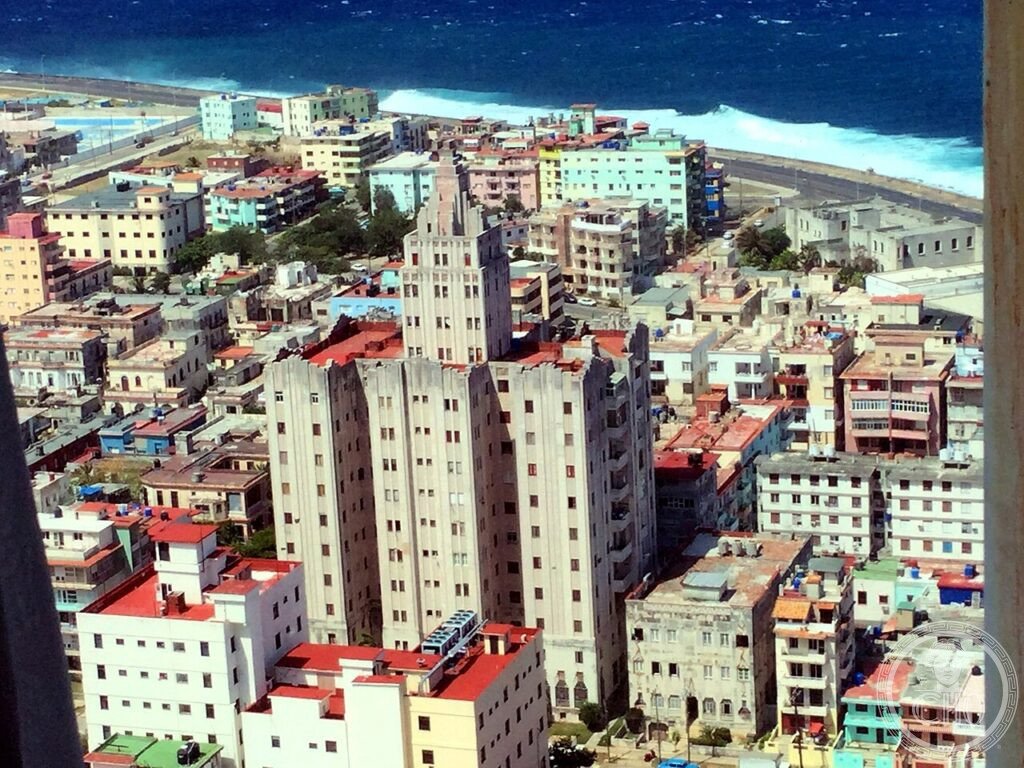

Havana’s little Rockefeller Center: a stepped apartment tower of 1932 that brought Manhattan’s skyline ambitions to Vedado — and stood as the tallest residential building in Cuba for a quarter of a century.
At a glance
The Edificio López Serrano rises at the corner of Calle 13 and Calle L in Vedado, completed in 1932 for José López Serrano of the La Moderna Poesía publishing house. Its architects, Ricardo Mira and Miguel Rosich, composed a stepped apartment tower — ten storeys crowned by a four-level tower block — in the silhouette of the New York skyscraper: the tallest residential building in Cuba until the FOCSA went up in 1956. Zig-zag window recesses, floral friezes and a lobby with a gleaming nickel relief make it the most complete Art Deco statement in the city after the Bacardí.
Key facts
- Completed: 1932
- Architects: Ricardo Mira and Miguel Rosich
- Client: José López Serrano, of the La Moderna Poesía publishing dynasty
- Height: Ten storeys plus a four-level tower — Cuba’s tallest residential building until the FOCSA (1956)
- Lobby: El Tiempo, a nickel-plated relief by graphic artist Enrique García Cabrera, amid ochre marble
- Use: Luxury apartments then, apartments still — a residential building throughout
- Address: Calle 13 esquina L, Vedado
- GPS: 23.144222, −82.387206 — View on Google Maps
History
Havana in the early 1930s had money, ambition and a skyline still low against the sea; the López Serrano changed the third. The publishing heir who commissioned it wanted modern apartments for a modern city — elevators, incinerators, staff quarters, and floor plans stacked with an efficiency Havana had not seen. Mira and Rosich delivered vertical drama on a tight Vedado corner: massing that steps back as it rises, so the tower seems taller than it is.
The building weathered the century better than most of its tenants’ fortunes. After 1959 the apartments passed through Cuba’s changed housing world and the fabric slowly wore — salt air is patient — but the essentials survive: the entrance sequence, the terrazzo, the lettering, and García Cabrera’s El Tiempo still streaking through its nickel sky in the lobby. It remains lived in, loved, and photographed daily by anyone walking Calle L towards the Malecón.
What you see
Stand at the corner of 13 and L and look up: the facade climbs in tight vertical bays, the windows recessed behind zig-zag reveals that throw hard tropical shadow, with cast friezes of stylised flora marking the setbacks. The crown steps like a ziggurat — the New York profile, compressed to Vedado scale. At street level the entrance pulls you into the lobby, where ochre marble walls, cubic light fittings and the nickel-plated El Tiempo relief — a winged figure hurtling through clouds — compose one of the great Deco interiors of the Americas. Ask politely; residents are used to admirers.
Practical information
- Private residential building — the exterior is freely visible; lobby access depends on residents’ goodwill
- Morning light models the east front on Calle L; the full stepped profile reads best from a block south
- Ten minutes on foot from the Malecón and the Hotel Nacional
Getting there
The building stands in eastern Vedado at Calle 13 and L, a short walk from La Rampa (Calle 23) and the university hill. Any taxi or almendón running the Malecón or Linea passes within two blocks.
Nearby
- Edificio Bacardí — the polychrome Deco crown of Old Havana
- Teatro América — the Deco theatre of Galiano, still playing
- Hotel Nacional — the 1930 clifftop grande dame, ten minutes away
- Havana — The Bacardí Building and Tropical Déco — the CHO city guide
Sources
- Aroma de Cuba, “Art Deco Architecture in Havana” — architects, client, 1932, tallest-until-FOCSA, lobby relief
- CubaTech Travel (official tourism portal), “López Serrano Building” — building profile
- Academic figure caption (ResearchGate), “Edificio López Serrano en 13 No 108, esq. L, El Vedado, Arqs. Mira y Rosich” — address and attribution
- Wikidata Q60744127 — coordinates, 1932
Find it on the map
See this place and what’s around it →Record researched and written by Luigi De Marchi for Cultural Heritage Online, 2026.
📷 Become a Cultural Heritage Online photographer
Share your photos of places: they stay published under your name as the author. The more they're seen, the more you get noticed — and soon a contest will reward the most appreciated photos.
Log in or sign up free to add a photoIs this page about you?
This page is read by travellers and heritage enthusiasts who find it on Google. Tell us how you are connected to this place and we will take it from there.