
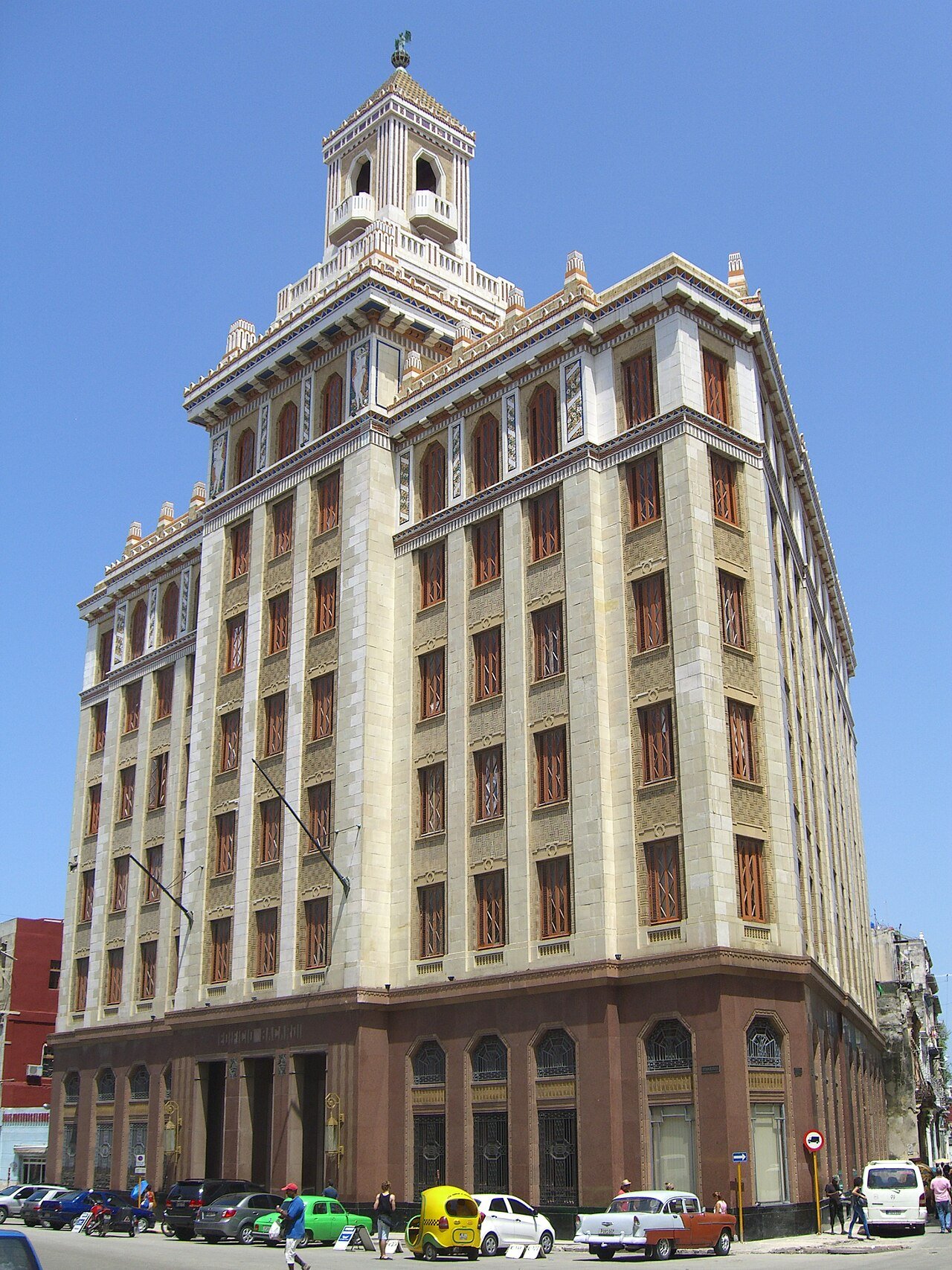
Havana built its first towers in the boom years between the world wars, when a sugar-rich elite reached for marble, granite and the clean geometry of the new century. The result is one of Latin America’s richest concentrations of Art Déco.
At a glance
For travellers who know Havana only as faded colonial arcades and 1950s Buicks, the city’s interwar architecture is a revelation. Within a few blocks of Old Havana and the leafy grid of Vedado stand buildings that belong to the same design moment as Miami Beach and the New York skyline, yet wear their geometry with a Caribbean ease. The Bacardí Building of 1930, a tower of red granite and polychrome detail crowned by a bronze bat, is the emblem of this era; the López Serrano apartment block, finished in 1932, was the island’s first true skyscraper. Around them, eclectic Belle Époque palaces and stepped Déco façades trace the wealth and ambition of a city at its commercial peak.
Key facts
- Country: Cuba
- Key period: 1920s–1930s
- Key building: Edificio Bacardí (1930) — Esteban Rodríguez-Castells and Rafael Fernández Ruenes
- Essential sites: Bacardí Building (Old Havana), Edificio López Serrano (Vedado, 1932), the eclectic and Déco façades of Centro Habana and Vedado
- Style: Art Déco set against Belle Époque eclecticism
History
Havana’s interwar building boom rode on sugar. The high prices that followed the First World War poured money into the Cuban economy, and a confident commercial class wanted architecture to match. The colonial city of arcades and patios was already ringed by the broad avenues of Vedado, laid out in the late nineteenth century, and into this expanding fabric came the styles arriving from Europe and the United States: first the eclecticism and Beaux-Arts grandeur of the Belle Époque, then the streamlined geometry of Art Déco.
The defining gesture came from a rum company. In 1930 the Bacardí family commissioned a new headquarters on the edge of Old Havana, selecting the design of Esteban Rodríguez-Castells and Rafael Fernández Ruenes through an architectural competition. Construction began on 6 January 1930 and was completed within the year, an extraordinary pace for so elaborate a building. For a time it was the tallest structure in the city, and it remains widely regarded as one of the finest Art Déco buildings in Latin America.
Vedado answered with height. The Edificio López Serrano, begun in 1929 and inaugurated in 1932, was designed by Ricardo Mira and Miguel Rosich as a luxury apartment tower — a novelty in 1930s Cuba — and is credited as the island’s first skyscraper. Its stepped silhouette, echoing the setback towers of New York, opened the way for Vedado’s vertical growth in the decades that followed. After the 1959 revolution many of these buildings passed into state hands; the Bacardí Building was nationalised in the early 1960s and later restored, in 2001, by an Italian firm.
What you see
The Bacardí Building rewards a slow look. Its façade combines marble and red granite with bands of glazed terracotta and coloured relief, the polychrome surfaces giving the tower a warmth that pure stone would lack. The vertical massing draws the eye upward to the summit, where a bronze fruit bat — the Bacardí emblem — sits atop the building roughly forty-seven metres above the street. Inside, imported materials announced the company’s wealth: pink granite and green marble line the lower floors, drawn from quarries across Europe.
In Vedado, the López Serrano shows a quieter, more North American Déco. Its body steps back as it rises, and the lobby holds a nickel-silver relief called El Tiempo (Time), cast in 1931 from a design by Enrique García Cabrera. To read the city’s full range, walk the corners of Centro Habana and Vedado: Belle Époque palaces with caryatids and balconies stand a few doors from streamlined apartment blocks and cinema fronts, the two styles together mapping Havana’s confident interwar decades.
Practical information
- The Bacardí Building stands on the edge of Old Havana, near the corner of Calle Monserrate (Avenida de Bélgica) and San Juan de Dios; the ground-floor bar is open to visitors.
- Access to the upper floors and the rooftop is sometimes possible by arrangement and varies — ask on site.
- The López Serrano is in Vedado, on Calle 13 near Calle L; it remains a residential building, so view it from the street.
- Old Havana and Vedado are both walkable; combine a Déco walk with the Malecón seafront.
- Carry cash; card payment is unreliable for visitors in Cuba.
Getting there
Havana is served by José Martí International Airport (HAV), about twenty kilometres south of the centre, with taxis and arranged transfers reaching Old Havana and Vedado in roughly half an hour depending on traffic. From either neighbourhood the main Déco landmarks are best reached on foot or by short taxi hops.
Related in CHO
- Miami — South Beach and Tropical Art Déco
- Buenos Aires — Belle Époque, Art Déco and the Paris of South America
- Mexico City — Bellas Artes and the Déco of La Condesa
Sources

Find it on the map
See this place and what’s around it →Record researched and written by Luigi De Marchi for Cultural Heritage Online, 2026.
📷 Become a Cultural Heritage Online photographer
Share your photos of places: they stay published under your name as the author. The more they're seen, the more you get noticed — and soon a contest will reward the most appreciated photos.
Log in or sign up free to add a photo