

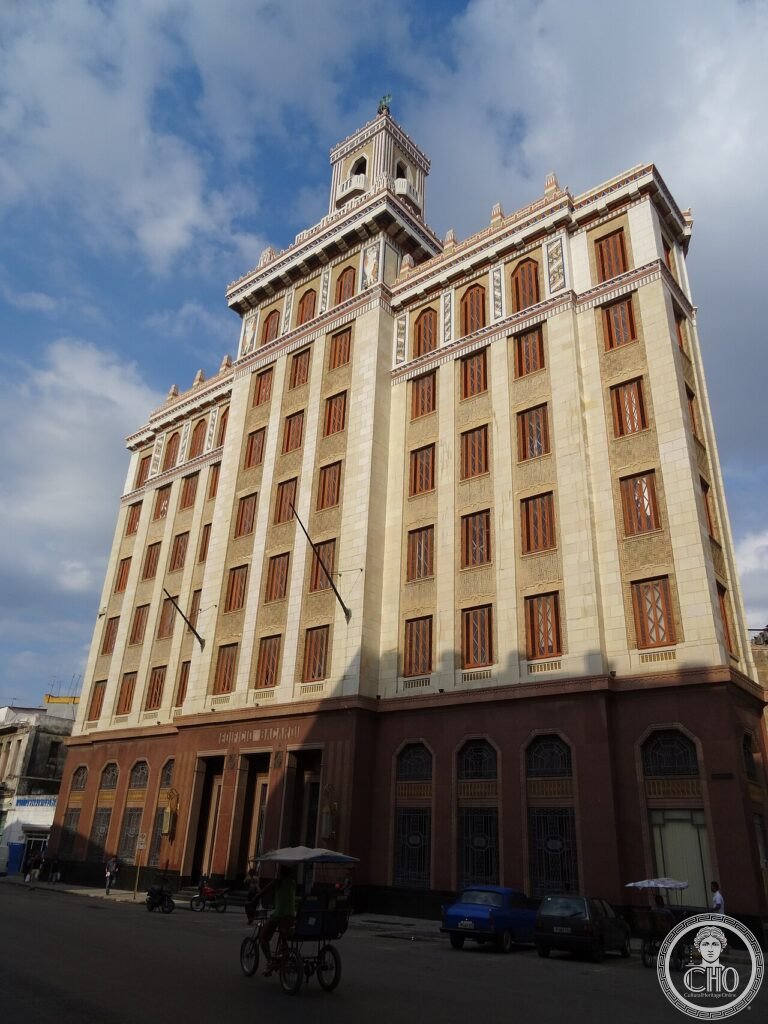

Rum built it, and it looks like celebration: red granite, terracotta in ochre and cobalt, and a stepped tower with a brass bat on top — the Bacardí family’s Havana headquarters remains the happiest Art Deco building in the Americas.
At a glance
Completed in 1930 on Avenida de Bélgica (Monserrate), at the edge of Old Havana, the Edificio Bacardí was the headquarters of the world’s most famous rum house, designed by Esteban Rodríguez-Castells and Rafael Fernández Ruenes. Its polychrome facades combine red granite from Bavaria with marbles, brick and glazed terracotta in colours running from ochre and sienna to white, yellow and cobalt blue — a chromatic exuberance that owes a debt to Catalan modernisme’s love of tile. The stepped tower carries the company’s emblem, the bat, at its summit.
Key facts
- Completed: 1930
- Architects: Esteban Rodríguez-Castells and Rafael Fernández Ruenes
- Client: Bacardí, the Santiago de Cuba rum dynasty
- Materials: Red Bavarian granite, marbles, brick, glazed polychrome terracotta
- Crown: Stepped bell-tower topped by the Bacardí bat emblem
- Address: Avenida de Bélgica (Monserrate), Old Havana
- GPS: 23.1389, −82.3571 — View on Google Maps
- Today: Office building; the ground floor and mezzanine bar are normally accessible
History
By the late 1920s Bacardí was Cuba’s most international company, and its Havana headquarters was conceived as a statement of arrival — taller and brighter than the banks around it, in the newest style on earth. Rodríguez-Castells had won the commission with an eclectic scheme; the design was recast in the Art Deco language fresh from the 1925 Paris exposition, and the building rose swiftly to completion in 1930. Nationalised after the 1959 revolution — the family and the brand went into exile — the building passed through decades of institutional use and gathering shabbiness before a restoration returned its colours. It now houses offices; visitors are generally welcome in the lobby, and the mezzanine bar pours the drink the tower was built on.
What you see
Stand across Monserrate and take in the composition: a symmetrical street block in banded red granite, rising through setbacks to the central tower whose stepped profile ends in a lantern — and on it, the brass bat, the mark Bacardí has stamped on every bottle since the 1860s. The glazed terracotta does the singing: floral and geometric panels in ochre, sienna, cobalt and gold thread across the facade, with nymph reliefs attributed to the era’s decorative sculptors flanking the upper storeys. The lobby continues the display in marble and brass. At golden hour the granite ignites — the building’s photographers’ moment.
Practical information
- Office building — the lobby and mezzanine bar are normally open to visitors during the day; access arrangements can change
- Photography of the facade is free from the street; the tower reads best from a block south on Monserrate
- Combine with the Gran Teatro and Parque Central circuit, five minutes away
Getting there
The building faces Avenida de Bélgica (Monserrate) between Empedrado and San Juan de Dios, on the western edge of Old Havana — five minutes on foot from Parque Central and the Capitolio, at the seam between the colonial city and the republican centre.
Nearby
- Gran Teatro de La Habana — the baroque-revival theatre palace on Parque Central
- El Floridita — Hemingway’s daiquiri bar, two blocks along Monserrate
- Museo de la Revolución — the former Presidential Palace, five minutes north
- Havana — The Bacardí Building and Tropical Déco — the CHO city guide
Sources
- Wikipedia: “Bacardi Building (Havana)” — architects, date
- lahabana.com city guide and cubaplusmagazine — materials, Bavarian granite, terracotta palette, bat emblem
- Building Bacardi (Modern Magazine review) — architectural history of the company’s patronage
- Wikidata Q4838596 — coordinates and 1930 date
Find it on the map
See this place and what’s around it →Record researched and written by Luigi De Marchi for Cultural Heritage Online, 2026.
📷 Become a Cultural Heritage Online photographer
Share your photos of places: they stay published under your name as the author. The more they're seen, the more you get noticed — and soon a contest will reward the most appreciated photos.
Log in or sign up free to add a photoIs this page about you?
This page is read by travellers and heritage enthusiasts who find it on Google. Tell us how you are connected to this place and we will take it from there.