
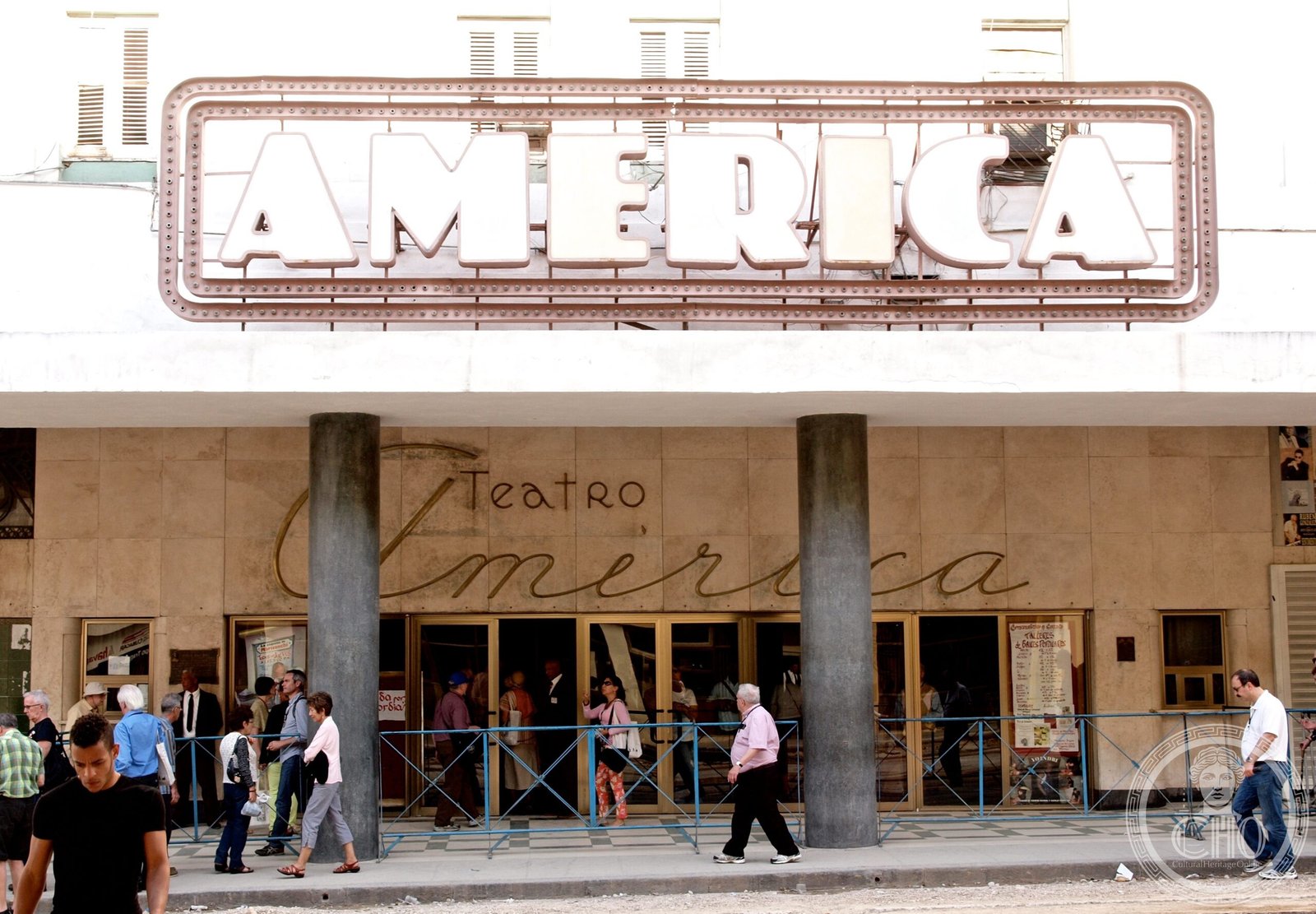
Teatro América is a landmark Art Deco cinema-theater located on Galiano Avenue (Avenida de Italia) in the Centro Habana district of Havana, Cuba. Inaugurated on March 29, 1941, it forms part of the larger Rodríguez Vázquez building — a mixed-use tower combining a theater, restaurant, and residential spaces. Designed by architects Fernando Martínez Campos and Pascual de Rojas, the building is celebrated as one of the finest examples of Art Deco design in the Cuban capital. Its bold vertical lines, ornate marquee, and sumptuously decorated interior — featuring shell-vault ceilings painted with celestial imagery and separate gentlemen and ladies lounges — make it an outstanding monument of mid-century Latin American cultural architecture. Today it functions as Havana City's premier variety theater, seating 1,775 spectators.
At a glance
- Type
- Cinema-theater (variety theater)
- Period
- 1941
- Style
- Art Deco
- Location
- Galiano Avenue (Avenida de Italia), Centro Habana, Havana, Cuba
- Coordinates
- 23.1367° N, 82.3707° W
- Architect(s)
- Fernando Martínez Campos and Pascual de Rojas
Overview
Teatro América stands as one of Havana's most architecturally distinguished entertainment venues. Built in 1941 as part of the multi-story Rodríguez Vázquez commercial block, the theater was conceived as a cinema-theater capable of accommodating 1,775 spectators. Its Galiano Avenue façade commands attention through a dynamic interplay of vertical towers and horizontal marquee bands — a hallmark of American-influenced Art Deco urbanism that flourished in Cuba during the 1930s and 1940s. Today recognized as a heritage building, it continues to stage live variety performances and festivals, preserving its role as a vibrant cultural institution in the heart of the Cuban capital.
History
The theater opened its doors on March 29, 1941, during a golden era of Cuban entertainment when Havana rivaled any Latin American capital in cultural sophistication. Commissioned as part of the broader Rodríguez Vázquez development, it quickly became a magnet for leading Cuban and international performers. Over subsequent decades, the stage welcomed luminaries including singer Benny Moré, actress and singer Rita Montaner, and international star Josephine Baker. As cinema attendance declined across Latin America in the latter twentieth century, the theater transitioned to live variety programming. In 1991, a significant restoration returned the building close to its original Art Deco splendor, ensuring its survival as both a functioning venue and an architectural landmark.
Architecture & Design
Martínez Campos and Rojas drew on the American streamlined Art Deco vocabulary then dominant in cinema architecture across the Americas. The exterior features strong verticality punctuated by stepped cornices and a prominent illuminated marquee. Inside, the auditorium's most striking elements are the shell-vault ceilings adorned with painted celestial motifs, evoking the interior of a jewel box rather than a utilitarian hall. Ornate staircases connect the foyer to upper galleries, while separate lounges for male and female patrons — each decorated with period-appropriate furnishings — reflect the social rituals of 1940s Havana society. The 1,775-seat capacity made it one of the largest purpose-built entertainment venues in republican-era Cuba.
Cultural significance
Teatro América occupies a singular place in Cuban cultural memory as the city's historic variety theater. Its stage hosted a generation of artists who defined Cuban popular music and entertainment in the mid-twentieth century, including Benny Moré, Rita Montaner, and Josephine Baker. The building stands as testimony to the cosmopolitan ambitions of pre-revolutionary Havana, where international architectural fashions merged with local craftsmanship. Following 1959, the theater was preserved under state management and continued to nurture emerging talent through festivals and competitions. It remains a living cultural institution, embodying both the architectural heritage of Art Deco Cuba and the continuity of Havana's performing arts tradition.
Visiting today
Teatro América continues to host live performances, variety shows, and cultural festivals throughout the year. The ornate Art Deco façade on Galiano Avenue is freely visible from the street at any time. Visitors wishing to attend performances should check schedules at the theater box office on Avenida de Italia, or through Havana's cultural event listings. Guided architectural tours of Centro Habana organized by local heritage bodies occasionally include the interior. The theater is a short walk from Parque Central, the Capitolio, and the Gran Teatro de La Habana.
Getting there
Teatro América is situated on Avenida de Italia (Galiano) in Centro Habana. From Old Havana, the theater is approximately 10–15 minutes on foot heading west along Neptuno or San Rafael streets. Local collective taxis (almendrones) run along major corridors nearby. The nearest orientation landmark is the Hotel Inglaterra on Parque Central, from which Galiano Avenue extends northward. The Malecón seafront promenade is a few blocks further north, making the area easy to navigate on foot.
Sources & resources
Find it on the map
See this place and what’s around it →📷 Become a Cultural Heritage Online photographer
Share your photos of places: they stay published under your name as the author. The more they're seen, the more you get noticed — and soon a contest will reward the most appreciated photos.
Log in or sign up free to add a photoDo you manage this place?
This page is read by travellers and heritage enthusiasts who find it on Google. Keep it accurate — and make it work for you. Free for non-profit heritage institutions.