

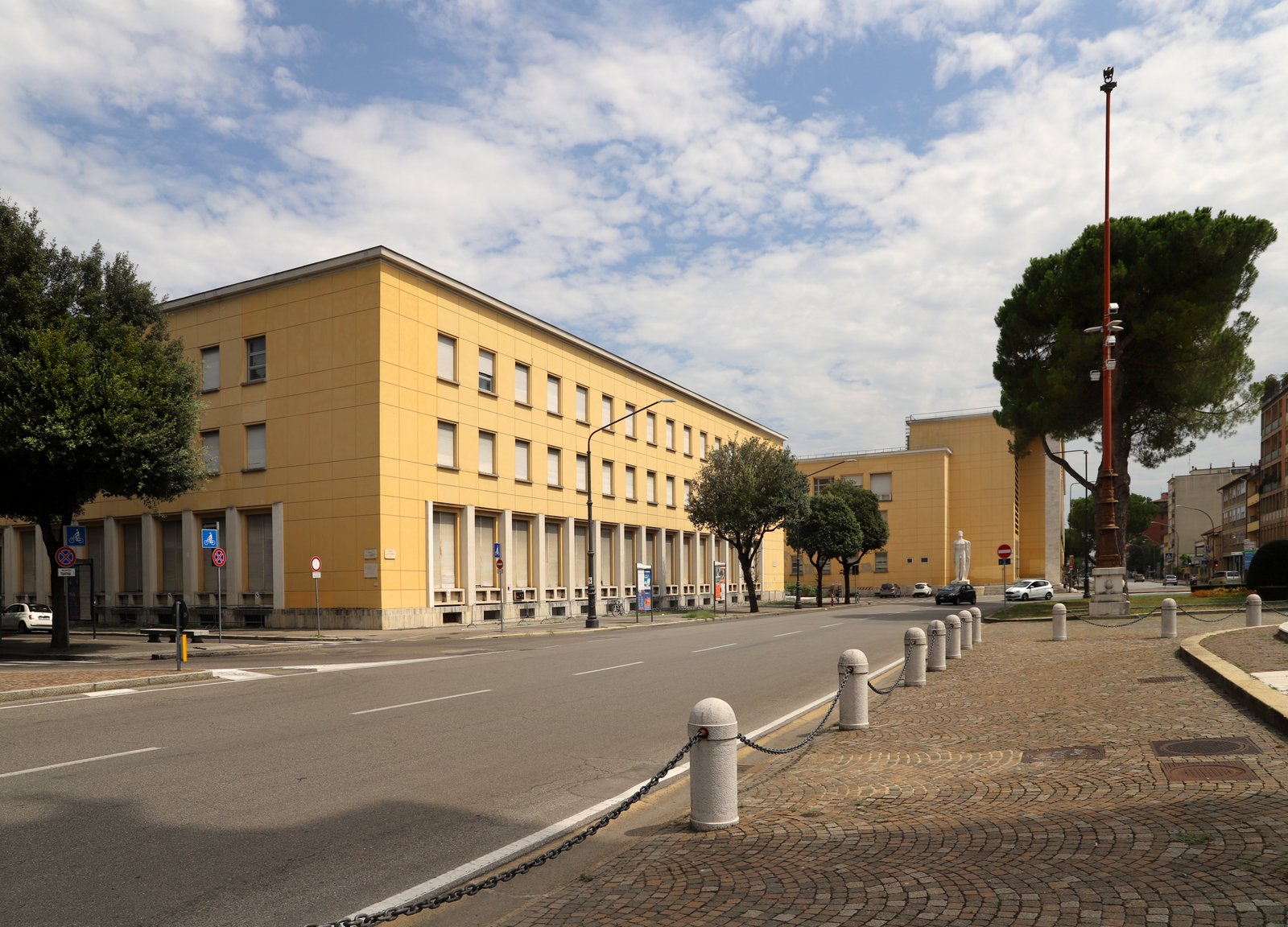
Cesare Valle’s Collegio Aeronautico opened in 1939 as a boarding school for Italian Air Force cadets, set on the eastern edge of Forli’s monumental civic axis. The complex frames Piazzale della Vittoria with a long colonnaded propylaeum and a vast interior courtyard, and is among the most ambitious works of Italian Rationalism built outside the major capitals. After the war the buildings were repurposed for state education, and today they house the Liceo Scientifico Statale “Giovanni Battista Morgagni”.
- Address
- Piazzale della Vittoria 8, 47100 Forli (FC), Italy
- Period
- Designed and built 1935–1939; inaugurated 1939
- Architect
- Cesare Valle (Rome, 1902–2000)
- Client
- Regia Aeronautica (Italian Royal Air Force), Italian State
- Style
- Italian Rationalism (Razionalismo italiano)
- Original function
- Collegio Aeronautico — boarding school and academy for Air Force cadets
- Current function
- Liceo Scientifico Statale “G. B. Morgagni” (state high school)
- Setting
- Eastern terminus of Forli’s Fascist-era civic axis on Piazzale della Vittoria
- Status
- Listed example of 20th-century Italian Rationalist heritage; in continuous educational use
- Coordinates
- 44.2179° N, 12.0509° E
Visit on the map
Piazzale della Vittoria 8, 47100 Forli (FC) · 44.2179° N, 12.0509° E
Download for your navigator
A single waypoint, ready for GPS apps, navigators, and contacts.
Story
Cesare Valle won the commission for the Forli Collegio Aeronautico in the mid-1930s, when the Italian state was investing heavily in the home city of Benito Mussolini and reshaping its centre with monumental public works. The brief was unusual: a residential academy where teenage cadets of the Regia Aeronautica would live, study and train under a single roof, on a site large enough to read as urban architecture from the new ceremonial square. Valle designed the complex between 1935 and 1939, working on the eastern flank of Piazzale della Vittoria, the axis that the regime had carved out to link the railway station to the historic core. The building was inaugurated in 1939, on the eve of the war that would interrupt its original mission.
The composition is a textbook exercise in Italian Rationalism applied to an institutional programme. Valle organised the academy around a deep, symmetrical courtyard, fronting the square with a long propylaeum of square pillars in stone that reads as a stripped, modernised colonnade rather than a classical portico. The wings behind it are plain volumes in brick and travertine, with horizontal banks of windows that mark the dormitory and classroom floors. Inside, the so-called Atrio delle Costellazioni — the constellations atrium — combines geometric stone floors with stylised astronomical reliefs, in line with the school’s aeronautical vocation. The plan is often cited as evoking the silhouette of an aircraft when seen from above, a reading that fits the period’s symbolic ambitions, though it is best treated as suggestive rather than literal.
After the fall of the regime and the disbanding of the Collegio Aeronautico in the post-war years, the complex passed to the civilian school system. It now houses the Liceo Scientifico Statale “Giovanni Battista Morgagni”, one of Forli’s main high schools, and remains in daily use for teaching and public events. Together with Valle’s nearby Casa del Balilla (1933–1935) and other Rationalist works clustered around Piazzale della Vittoria and Viale della Liberta, the building is part of the most coherent open-air ensemble of 1930s Italian modernism in Emilia-Romagna, and a key reference for any study of Razionalismo outside Milan and Como.
Visitors should note that the building is an active school, so the courtyards and atriums are accessible only on guided occasions or during public openings such as the Giornate FAI di Primavera.
Resources & References
Editorial picks across Wikipedia, photo archives, and architectural databases.
Find it on the map
See this place and what’s around it →Record researched and written by Stefano Vigolo for Cultural Heritage Online, 2026.

📷 Become a Cultural Heritage Online photographer
Share your photos of places: they stay published under your name as the author. The more they're seen, the more you get noticed — and soon a contest will reward the most appreciated photos.
Log in or sign up free to add a photoIs this page about you?
This page is read by travellers and heritage enthusiasts who find it on Google. Tell us how you are connected to this place and we will take it from there.