No pair of towns reads the architecture of the Italian interwar state more completely than Forlì and its small neighbour Predappio. Predappio, where Benito Mussolini was born in the hamlet of Dovia in 1883, was reshaped from 1925 as a planned model settlement; Forlì, the provincial capital a short drive north, was developed as a deliberate showcase of the era’s planning, and the regime nicknamed it the città del Duce. From 1926 the city laid out a broad new axis, Viale della Libertà, linking a rebuilt railway station to the centre. This RoadBook follows five buildings across the two towns — two post offices, a youth citadel, a cadet academy and an abandoned party headquarters — all collected in the curated itinerary Forlì–Predappio Rationalism RoadBook, each with its full entry in the archive.
Bazzani’s twenty-month post office
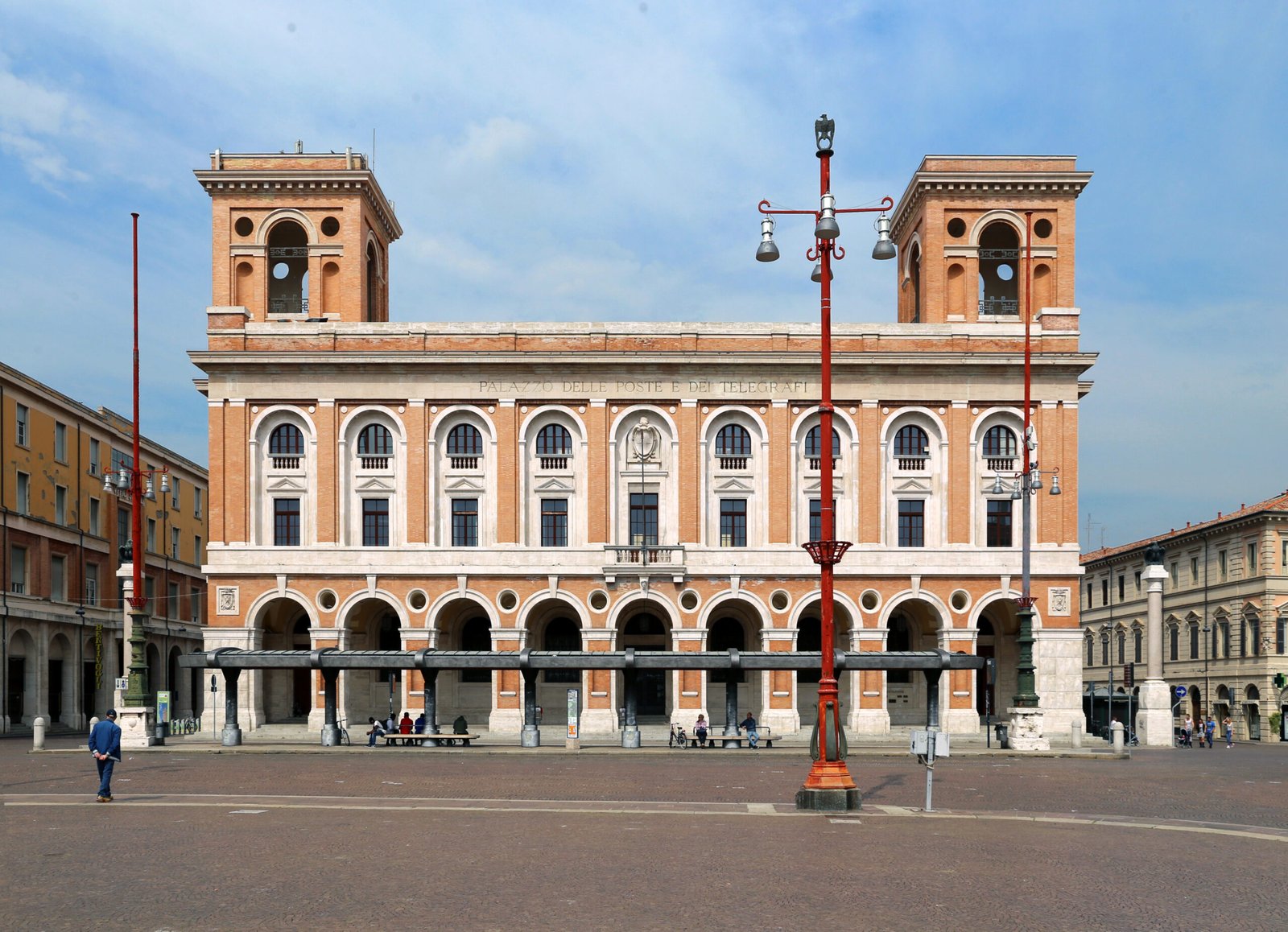
Start on Piazza Aurelio Saffi, the medieval civic square that the regime rewrote through the 1920s and 1930s. The Palazzo delle Poste anchors its southern edge: Cesare Bazzani signed the design on 12 January 1931 and the building opened on 30 October 1932, a single twenty-month sprint. It is stripped classicism of the most legible kind, built for the Ministero delle Comunicazioni by an architect who was by then an accademico d’Italia in his late fifties. Allied bombing damaged it on 25 August 1944; restoration was complete by 1950, and it has never stopped being the city’s post office.
A youth citadel with an 800-seat theatre
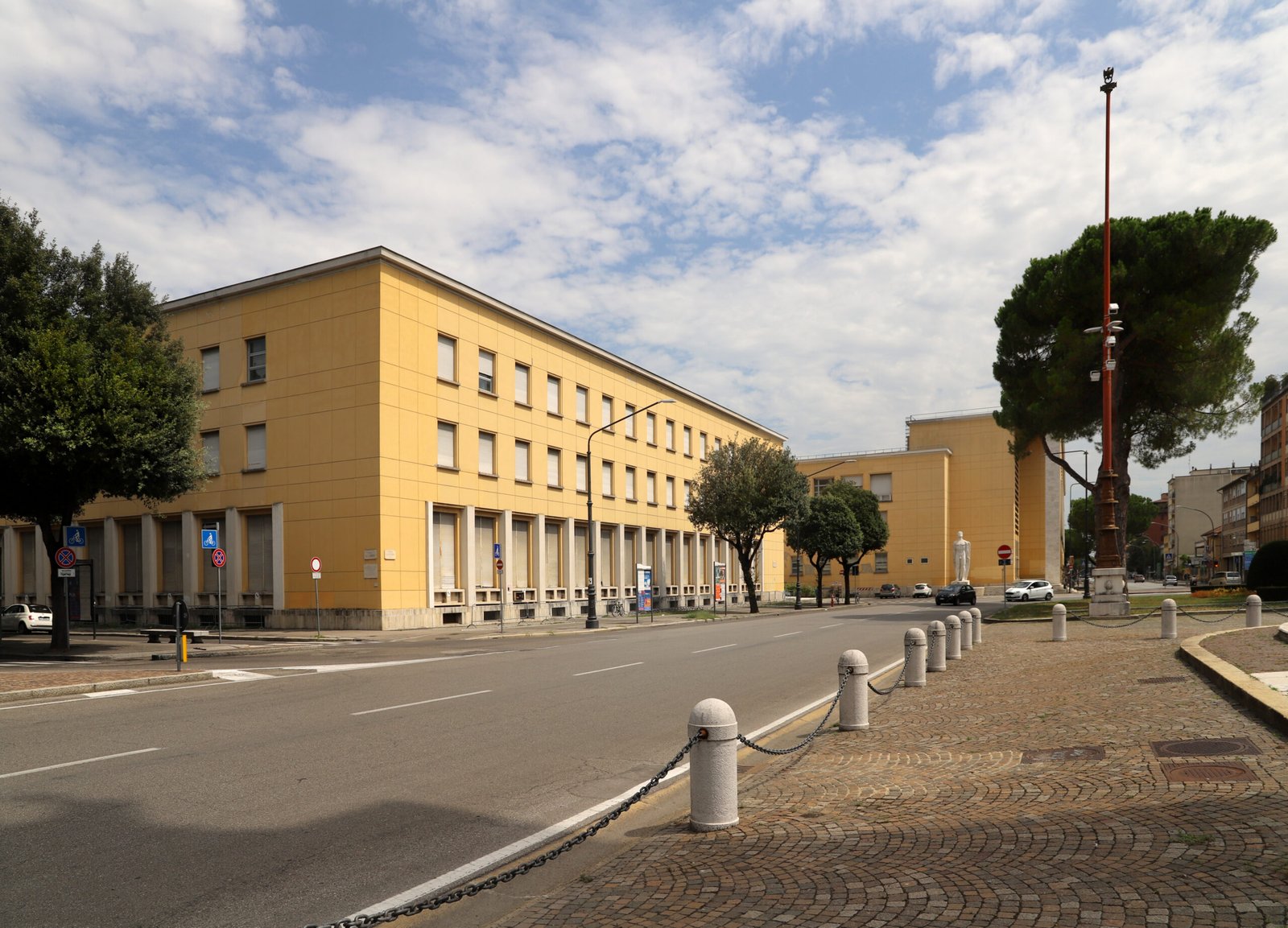
From Piazza Saffi the route joins Viale della Libertà, the axis of 1926. On it stands the Casa del Balilla, built between 1933 and 1935 by the Roman architect Cesare Valle for the Opera Nazionale Balilla, the regime’s youth organisation. It was conceived as a complete complex: a cinema-theatre of 800 seats, a gymnasium, a swimming pool, a library and a thirty-metre tower gathered into one rationalist composition. Giuseppe Pagano counted it among the most significant Italian rationalist works of the decade. Restored between 2010 and 2013, it remains in daily civic use, and it now houses, among sports halls and an auditorium, the seat of ATRIUM — the association that studies the architecture of twentieth-century regimes across Europe.
The cadets’ colonnade
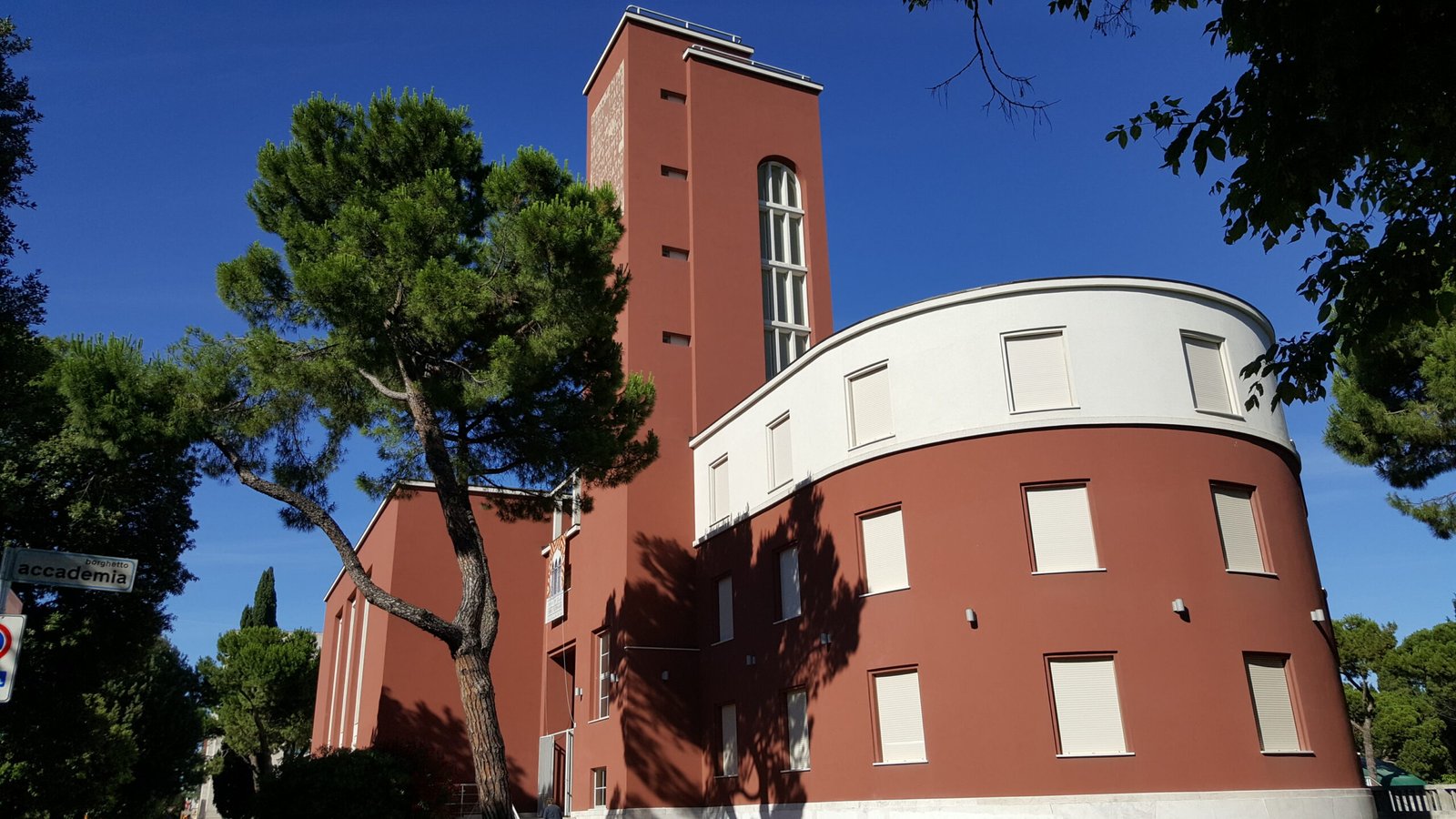
The axis ends at Piazzale della Vittoria, framed by Valle’s second and larger work here. The Collegio Aeronautico, designed and built between 1935 and 1939, was a boarding academy for Air Force cadets, and it is counted among the most ambitious rationalist works built outside Italy’s major capitals. A long colonnaded propylaeum faces the square; behind it opens a vast interior courtyard. After the war the state kept the complex in education, and it has been a school ever since. Today it is the Liceo Scientifico Morgagni, which means the colonnade fills twice a day with teenagers.
A planned town on the valley floor
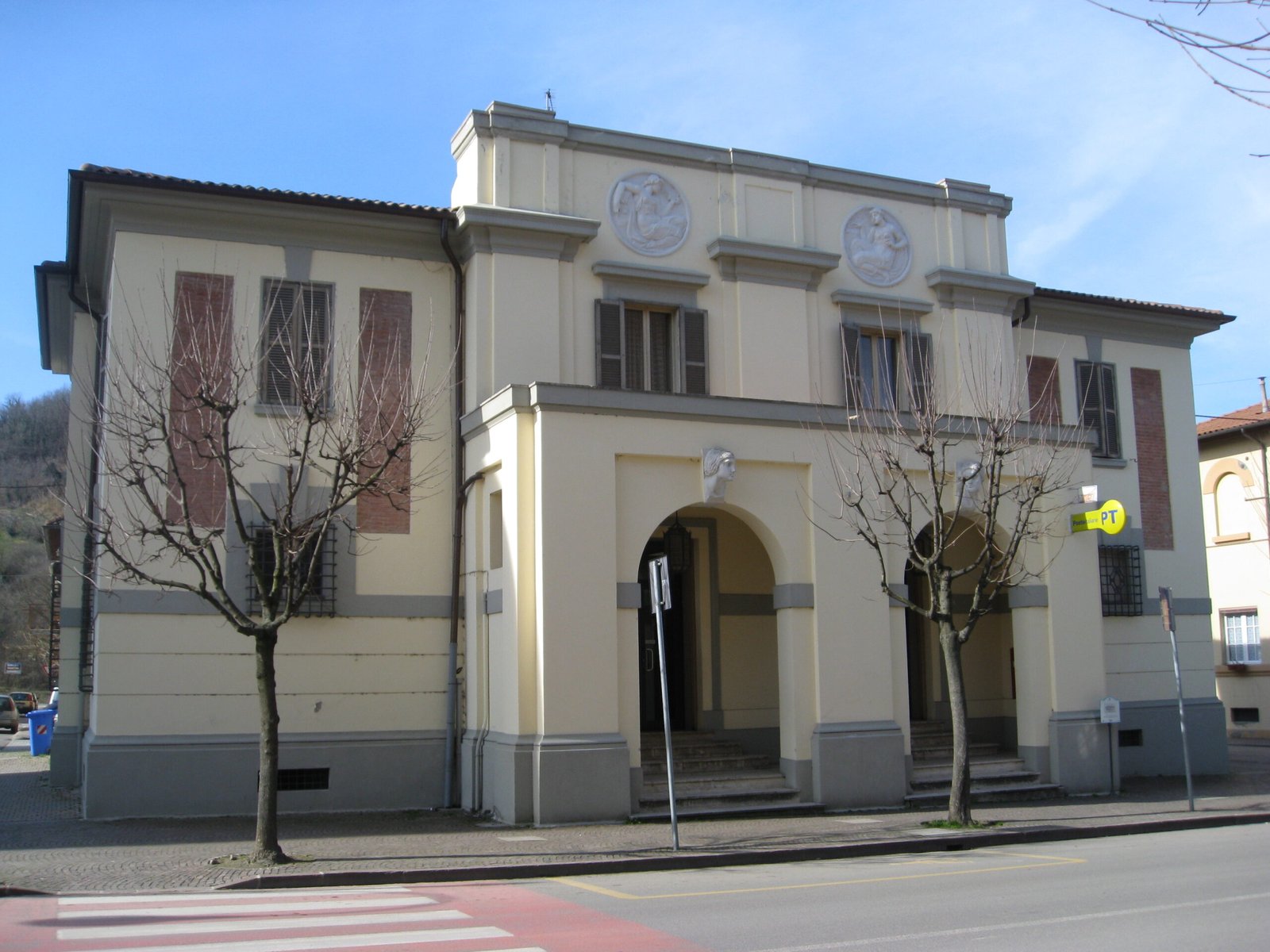
Predappio Nuova lies a short drive south, on the valley floor of the river Rabbi, below the older hilltop village of Predappio Alta. The state began laying it out in 1925, and Florestano Di Fausto was charged with the master plan in 1926. The Palazzo delle Poste was among the first pieces of the programme: a standard scheme drawn by the Genio Civile of Forlì, submitted in May 1925, which Di Fausto revised that December, adding the arcaded portico that still defines the piazza front. Decorative reliefs are by the Bolognese sculptor Ulderigo Conti. A century on, the ground floor is still a working post office.
The largest Casa del Fascio in any small town
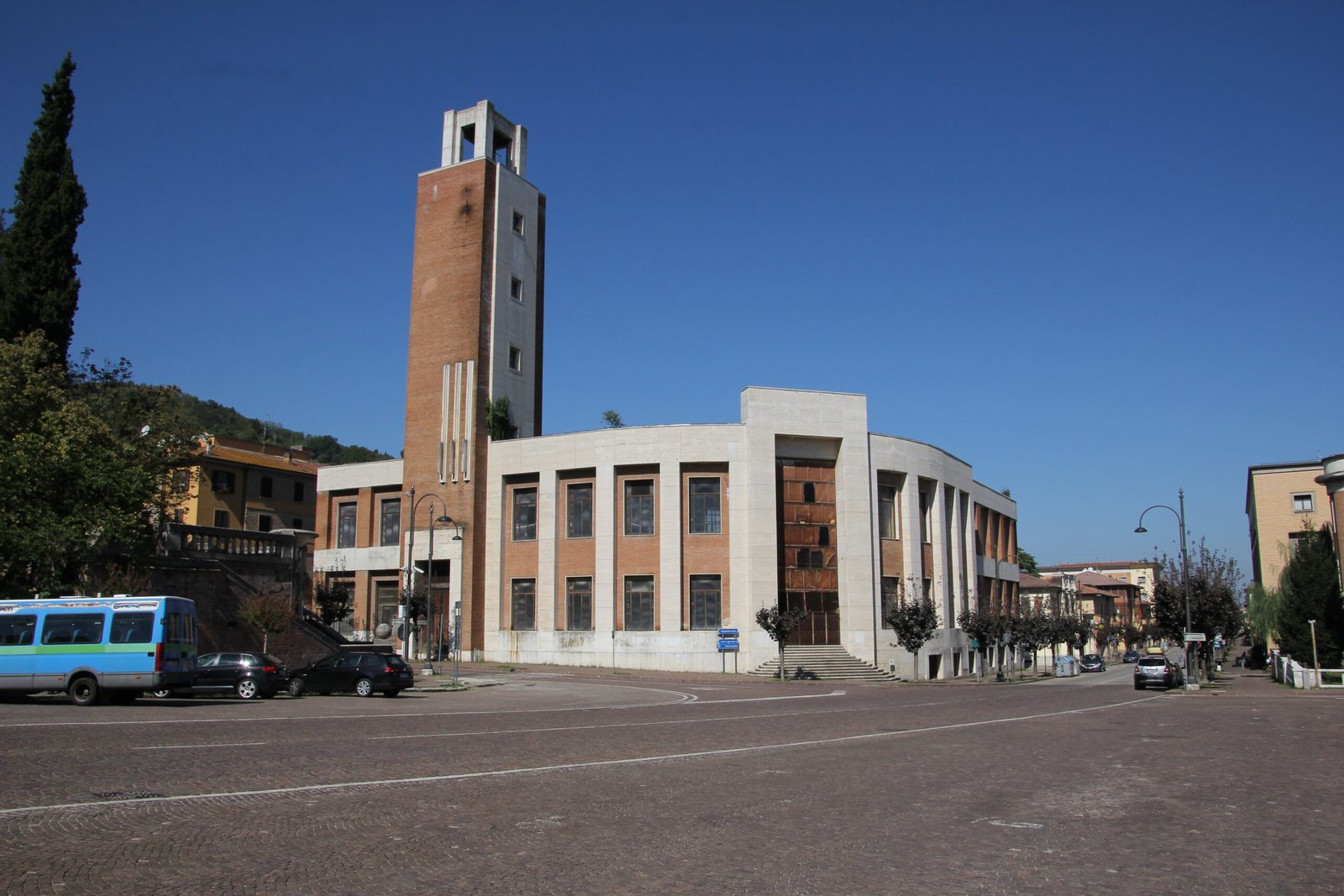
At the crossing of the two main streets of Predappio Nuova stands the building meant to anchor the whole plan. The ex Casa del Fascio is the largest party headquarters built in any small Italian town during the regime: fundraising began in 1926, construction ran from 1934, and the building was inaugurated in 1937 — a heavy brick volume faced in Roman travertine, with a tall littorio tower. The design is traditionally attributed to Arnaldo Fuzzi, though Italian sources are cautious on the point. Empty for decades and owned by the State, it sits at the centre of a long debate: in 2014 the municipality announced its conversion into a documentation centre on twentieth-century totalitarianism, a project supported by historians as a counterweight to political pilgrimage and contested by others wary of glorification. The building is on the European cultural route ATRIUM; the argument over what to do with it is part of its history now.
Drive it with the map
The five stops are collected in the curated itinerary Forlì–Predappio Rationalism RoadBook: an interactive map with the route, a play-through tour of the stops, and GPX and KML files for your own navigator. The three Forlì stops line up along one axis from Piazza Saffi to Piazzale della Vittoria; Predappio adds a short drive south. Each stop links back to its full entry in the archive, with history, sources and practical notes.
Reading the two towns
Forlì and Predappio hold the questions this heritage raises in their sharpest form. One axis is still the way to the station; one post office never closed; one school colonnade belongs to its students. And one building stands empty because Italy has not yet agreed on what it should become. These pages record all of it — dates, architects, uses and the debate itself — without celebration and without erasure. Read together with the colonie of the Romagna coast and the Italian Rationalism Grand Tour, the two towns complete the region’s picture: the coast built for the summers, the city built for show, and the small town that was meant to be a model.
Sources
- S1 — Gentile, Emilio. Fascismo di pietra. Laterza, 2007. ISBN 978-88-420-8422-8.
- S2 — Ciucci, Giorgio. Gli architetti e il fascismo: Architettura e città 1922–1944. Einaudi, 1989. ISBN 978-88-06-11656-9.
Spotted an error? Write to editorial@culturalheritageonline.com and we correct it the same day.