

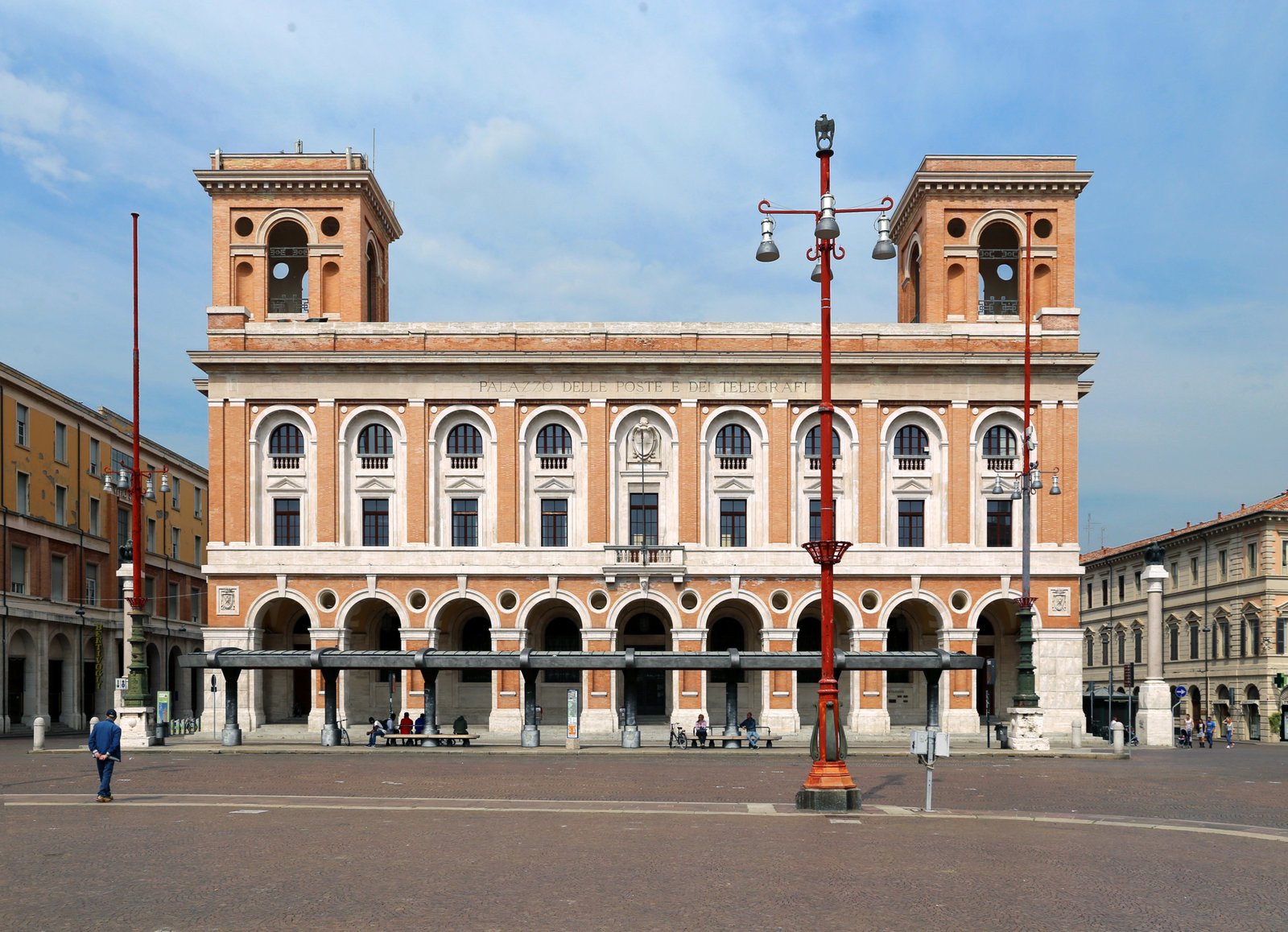
Cesare Bazzani signed the design in January 1931 and the building opened on 30 October 1932, a single twenty-month sprint that left Forlì with one of the most legible monumental post offices of the interwar Italian state. The palace anchors the southern edge of Piazza Aurelio Saffi, the medieval civic square that the regime rewrote during the 1920s and 1930s with a sequence of rationalist and stripped-classical interventions. Bazzani, an accademico d’Italia by then in his late fifties, handled the commission for the Ministero delle Comunicazioni.
- Address
- Piazza Aurelio Saffi, 47121 Forlì FC, Italy
- Period
- Designed 12 January 1931; built November 1931 – October 1932; inaugurated 30 October 1932
- Architect
- Cesare Bazzani (Roma, 1873 – Roma, 1939)
- Client
- Ministero delle Comunicazioni, with the Comune di Forlì
- Style
- Italian Rationalism (Razionalismo italiano), in its stripped-classical inflection
- Function
- Central post and telegraph office (original and current)
- Site
- Piazza Aurelio Saffi, southern edge, Zona A — Centro Storico
- Status
- Statutory monument protection (tutela monumentale ipso jure); damaged by Allied bombing on 25 August 1944, restored by 1950
- Coordinates
- 44.2232° N, 12.0418° E
Visit on the map
Piazza Aurelio Saffi, 47121 Forlì FC · 44.2232° N, 12.0418° E
Download for your navigator
A single waypoint, ready for GPS apps, navigators, and contacts.
Story
The commission landed on a charged site. Piazza Aurelio Saffi had been the political heart of Forlì since the Middle Ages, ringed by the Palazzo del Podestà, the Romanesque abbey of San Mercuriale and the nineteenth-century Palazzo del Comune. After 1922, the regime read the square as a stage for the new state and approved a sequence of monumental insertions that culminated with Bazzani’s post office on the south side. The architect, born in Rome in 1873 and already responsible for the Ministero della Pubblica Istruzione in viale Trastevere and the Galleria Nazionale d’Arte Moderna, was the regime’s preferred designer for institutional buildings that needed to read as modern without breaking the silhouette of older fabric. The brief asked for a complete postal and telegraph headquarters: counters, sorting halls, telephone exchange and offices, all behind a façade that could hold its own against the medieval brick of San Mercuriale across the piazza.
Bazzani answered with a six-bay travertine front organised around a tall rusticated base, a long mid-register of plain ashlar pilasters and a recessed attic. The volume is rationalist in its insistence on the wall as a continuous surface and on the suppression of cornices and decorative apparatus, but the rhythm of the openings, the symmetry of the entrance portal and the cladding belong to the parallel current of stripped classicism that ran through Italian official architecture between 1928 and 1936.
Window frames sit flush, without surrounds; the lettering “POSTE E TELEGRAFI” is incised directly into the stone above the entrance. Inside, the public hall opens behind a low colonnade, paved in coloured marbles and lit from a single high band of glazing — the type of restrained, geometric civic interior that Marcello Piacentini was promoting in the same years for the EUR competitions in Rome.
The palace took heavy damage on 25 August 1944, when Allied air raids on Forlì struck the centre and gutted the upper floors; repairs continued until 1950 and were carried out within the original drawings, so the façade today reads as Bazzani designed it. The building is protected ipso jure as a monument of the state and sits inside the Zona A — Centro Storico of the municipal master plan, with operational postal use that has continued without interruption since 1932. For visitors mapping the densest concentration of interwar rationalism in any provincial Italian city — Forlì had Mussolini’s home province behind it and absorbed an unusually high share of state-funded buildings between 1925 and 1940 — the Palazzo delle Poste is the canonical first stop, paired with the nearby Palazzo delle Esposizioni, the Collegio Aeronautico and the former Casa del Fascio.
Resources & References
Editorial picks across Wikipedia, photo archives, and architectural databases.
Find it on the map
See this place and what’s around it →Record researched and written by Stefano Vigolo for Cultural Heritage Online, 2026.

📷 Become a Cultural Heritage Online photographer
Share your photos of places: they stay published under your name as the author. The more they're seen, the more you get noticed — and soon a contest will reward the most appreciated photos.
Log in or sign up free to add a photoIs this page about you?
This page is read by travellers and heritage enthusiasts who find it on Google. Tell us how you are connected to this place and we will take it from there.