Sudan has three UNESCO World Heritage Sites: two cultural monuments along the Nile that rank among the most extraordinary archaeological landscapes in Africa, and one natural designation protecting a stretch of coral reef and marine habitat on the Red Sea. It is a short list for a country whose soil holds more ancient pyramids than Egypt, but each inscription carries enormous weight. From Cultural Heritage Online.
Why Sudan’s list looks the way it does
Sudan sits at the crossroads of sub-Saharan Africa and the ancient Mediterranean world, and its Nile corridor was home to a succession of powerful kingdoms — Kerma, Napata, Meroe — whose monumental architecture rivals anything produced in the ancient Near East. Despite that density of heritage, Sudan’s UNESCO tally remains at three sites, partly because sustained conflict, limited tourism infrastructure, and the complexity of nominating sites in an active archaeological zone have slowed submissions. The country also maintains a tentative list of fifteen further nominations, suggesting that the formal count may grow significantly in coming decades.
The two cultural inscriptions are both archaeological in character and both tied to Nile Valley civilisations that flourished after, and partly independently of, pharaonic Egypt. The single natural inscription protects a marine environment far removed from the Nile, on the Red Sea coast — a deliberate recognition that Sudan’s ecological heritage deserves standing alongside its archaeology.
The first inscriptions
Sudan’s entry on the World Heritage list opened in 2003, with a single cultural inscription that immediately signalled the ambition of what the country’s heritage could claim:
- Gebel Barkal and the Sites of the Napatan Region (2003, Cultural) — a cluster of temples, pyramids, and cemeteries centred on a sandstone butte that ancient Egyptians and Kushites alike regarded as the home of the god Amun. The site lies near the fourth Nile cataract in Northern State.
No further inscription followed for eight years, a gap that reflects both the logistical demands of nomination dossiers and the political turbulence of the period. When Sudan returned to the list, it did so with a site of still greater scale and international profile.
The most visited — and the alternatives
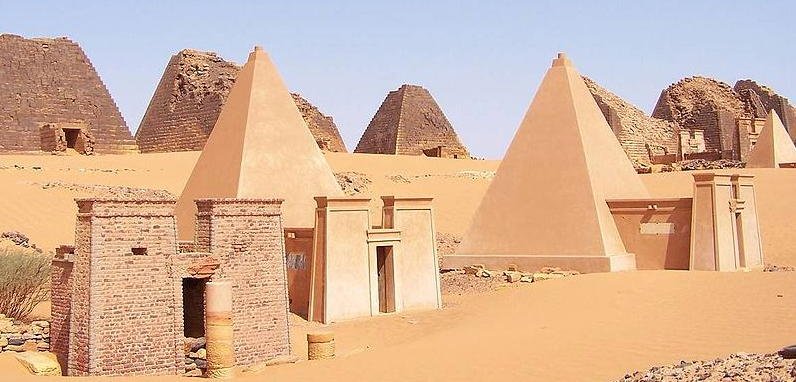
The Archaeological Sites of the Island of Meroe, inscribed in 2011, is the inscription most visitors associate with Sudan. The site encompasses the royal cemeteries of the Meroitic Kingdom, whose steep-sided pyramids — more than two hundred in number — cluster at Meroe, Naga, and Musawwarat es-Sufra across the Butana steppe. Naga contains a temple to the lion-headed god Apedemak alongside a structure whose façade combines Egyptian, Roman, and local Meroitic decorative vocabularies in a single composition that is difficult to parallel anywhere in the ancient world. The ensemble was the heartland of a kingdom that controlled trade between sub-Saharan Africa and the Mediterranean from roughly 300 BCE to 350 CE.
Beyond Meroe, Sudan holds a number of sites on its tentative list that illustrate the breadth of its heritage. Sai Island, the largest island in the Nile, carries evidence of settlement stretching from the Palaeolithic through the Egyptian New Kingdom, when a walled town was established there. Banganarti, also on the Nile, preserves a large Byzantine-style pilgrimage church built in the eleventh century, reflecting the Christianisation of the Nubian kingdoms long after the fall of Rome. Jebel Marra rises to 3,042 metres in the west of the country and contains crater lakes formed in a dormant volcanic caldera — a landscape of a completely different register from the Nile sites, and one that sits on the tentative list for natural designation.
Natural and shared sites
Sudan’s only inscribed natural site — Sanganeb Marine National Park and Dungonab Bay–Mukkawar Island Marine National Park, added in 2016 — protects two separate marine and coastal areas along the Red Sea coast in River Nile and Red Sea states. Sanganeb is an offshore coral atoll sitting roughly 25 kilometres from Port Sudan; Dungonab Bay and Mukkawar Island together shelter one of the world’s most significant populations of dugong, alongside nesting seabirds and critical coral reef ecosystems. The inscription marked the first natural World Heritage Site in Sudan and placed the country’s Red Sea coastline in a regional context alongside the coral environments recognised elsewhere along the Red Sea’s margins. No transnational or serial cultural inscriptions are currently active for Sudan, though the clustering of Nile Valley sites across the Sudanese-Egyptian border makes such nominations a plausible future avenue.
How to find them
All three inscribed sites are accessible, in principle, to independent travellers, though logistics differ considerably between them. The Meroitic pyramids at Meroe lie roughly 200 kilometres northeast of Khartoum and are reachable by road; the marine parks require a boat from Port Sudan. Gebel Barkal sits further north, near the town of Karima, and is often combined with visits to the nearby site of Kerma, itself on the tentative list.
Sudan’s World Heritage sites sit alongside thousands of other places on CHO’s interactive map, with GPS and sourced editorial history for each. See also our guides to Italy’s and France’s UNESCO sites, and our piece on cultural travel beyond mass tourism.
Frequently Asked Questions
How many UNESCO World Heritage Sites does Sudan have?
Sudan has three UNESCO World Heritage Sites: Gebel Barkal and the Sites of the Napatan Region (2003), the Archaeological Sites of the Island of Meroe (2011), and Sanganeb Marine National Park and Dungonab Bay–Mukkawar Island Marine National Park (2016). A further fifteen sites are on Sudan’s tentative list for future nomination.
What was Sudan’s first UNESCO World Heritage Site?
Gebel Barkal and the Sites of the Napatan Region was inscribed in 2003, making it Sudan’s first World Heritage Site. The designation covers a group of temples, royal pyramids, and cemeteries clustered around a sacred sandstone butte near the fourth Nile cataract, associated with the ancient Kushite kingdoms and the cult of the god Amun.
Does Sudan have any natural UNESCO World Heritage Sites?
Yes — Sanganeb Marine National Park and Dungonab Bay–Mukkawar Island Marine National Park, inscribed in 2016, is Sudan’s only natural World Heritage Site. It protects two distinct Red Sea marine environments, including a coral atoll and a bay sheltering one of the world’s most significant dugong populations.
What is the most recently inscribed World Heritage Site in Sudan?
The most recent inscription is Sanganeb Marine National Park and Dungonab Bay–Mukkawar Island Marine National Park, added to the World Heritage list in 2016. It was also the first natural site to be inscribed for Sudan, complementing the two cultural designations already on the list.
Sources used in this article
- UNESCO — State Party Sudan — World Heritage list.
- UNESCO — Sudan: World Heritage Sites.
- CHO magazine — What is a World Heritage Site?
- CHO — Interactive map of heritage sites.
Sources
- S1 — Welsby, Derek A. The Kingdom of Kush: The Napatan and Meroitic Empires. British Museum Press, 1996. ISBN 978-0-7141-0986-2.
- S2 — Adams, William Y. Nubia: Corridor to Africa. Princeton University Press, 1977. ISBN 978-0-691-09370-3.
Spotted an error? Write to editorial@culturalheritageonline.com and we correct it the same day.