Tunisia has 9 UNESCO World Heritage Sites, spanning Phoenician harbour towns, Roman amphitheatres, intact medieval medinas, a migratory-bird wetland, and a Mediterranean island shaped entirely by water scarcity — a compressed record of every civilisation that has held the Maghreb’s northern coast. From Cultural Heritage Online.
Why Tunisia’s list looks the way it does
Tunisia sits at one of the ancient world’s most contested crossroads. Phoenicians, Romans, Byzantines, Arab dynasties, and Ottoman governors each left physical imprints on the same narrow coastal strip and its interior plains. The result is a UNESCO list that is almost entirely cultural — 8 of 9 sites carry a cultural designation — because the built legacy here is simply exceptional in density and legibility.
The lone natural inscription, Ichkeul National Park, was added as early as 1980 and reflects a different kind of rarity: a freshwater lake and surrounding marshes that serve as a wintering ground for hundreds of thousands of migratory birds on the East Atlantic Flyway. Its story also illustrates UNESCO’s endangered-list mechanism: the park was listed as threatened between 1996 and 2006 after upstream dams altered the lake’s hydrology, and was removed from the danger list once conditions improved — a relatively rare example of a successful recovery.
The first inscriptions
Three sites entered the World Heritage List together in 1979, at the very first session after the Convention came into force. That opening cohort set an immediate tone of ambition, covering radically different periods and scales:
- Medina of Tunis (1979) — the historic urban fabric of the capital, with its souks, mosques, and palace compounds intact within the old walls.
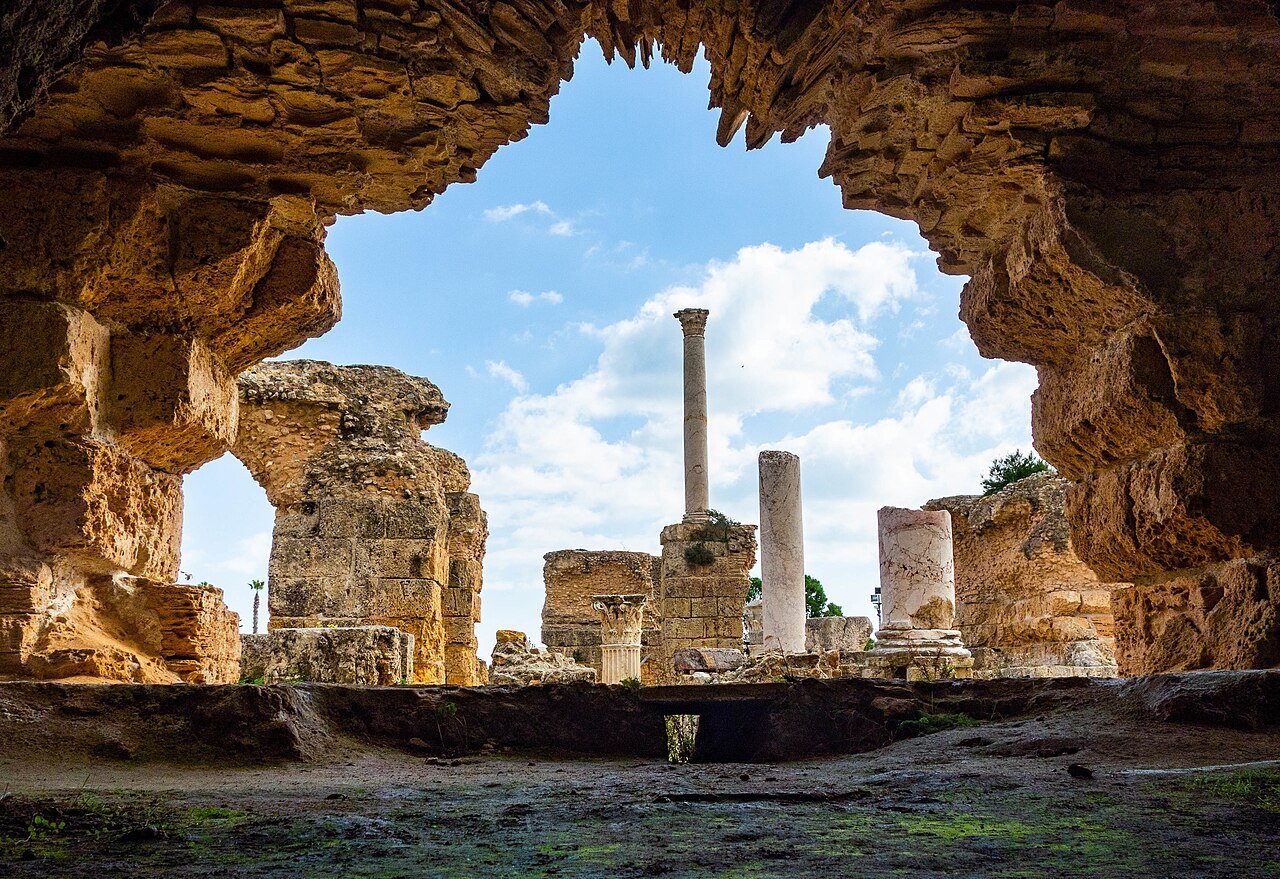
- Archaeological Site of Carthage (1979) — the layered remains of the Phoenician city and its Roman successor, spread across a headland above the Gulf of Tunis.
- Amphitheatre of El Jem (1979) — a third-century Roman structure seating around 35,000 spectators, one of the largest in the ancient world, rising from the flat Sahel plain with little else around it.
The speed of Tunisia’s early nominations reflected genuine institutional capacity: the country had ratified the World Heritage Convention in 1975 and had a functioning national antiquities authority ready to submit dossiers. A fourth site, Ichkeul, followed the very next year.
The most visited — and the alternatives
Carthage and the Medina of Tunis draw the largest visitor numbers, for understandable reasons: they are accessible from the capital, well-documented, and connected to school curricula across much of the world. El Jem also attracts consistent traffic, partly because the amphitheatre hosts a summer music festival that brings it back to active use. Kairouan, inscribed in 1988, is another household name in Islamic heritage circles — the city’s Great Mosque is among the oldest in the Muslim west, and the medina retains a working urban life alongside its monuments.
Less visited, but no less significant, are three sites that reward the effort of reaching them. The Punic Town of Kerkuane, inscribed in 1985, is the only Phoenician-Punic urban settlement that was abandoned rather than rebuilt by Roman conquerors — its street grid, house plans, and hygiene infrastructure survive in a form found nowhere else. Dougga/Thugga (1997), in the Medjerda valley, preserves a Roman town whose bilingual and trilingual inscriptions record the negotiation between Berber, Punic, and Latin administrative cultures on the imperial frontier. And the Medina of Sousse, added in 1988, retains its ribat — a fortified monastery-barracks — and Great Mosque in a coastal setting that makes the defensive logic of early medieval Islamic urban planning immediately readable.
Natural and shared sites
Beyond Ichkeul, Tunisia’s natural heritage is not represented on the World Heritage List, though the country holds significant desert, salt-flat, and mountain landscapes that appear in other international frameworks. Ichkeul’s importance lies in a chain of ecological relationships: ducks, geese, coots, and flamingos arrive in hundreds of thousands each winter, feeding on aquatic vegetation sustained by a precise balance of freshwater inflow and sea-salt intrusion. Managing that balance against upstream irrigation demands has been the site’s central conservation challenge since inscription.
Tunisia holds no transnational or serial inscriptions — each of its nine sites was nominated and is managed independently. This distinguishes it from neighbours such as Morocco and Algeria, which participate in shared Saharan nominations. The 2023 inscription of Djerba, an island recognised for its distinctive settlement morphology shaped by the management of scarce freshwater, brings the list to its current total and represents the most recent addition to North Africa’s UNESCO map.
How to find them
The nine sites range from the northern coast to the interior plateau and down to a southern island, covering roughly 600 kilometres of territory. Several — Carthage, the Medina of Tunis, Sidi Bou Said — can be reached by the Tunis suburban rail network. El Jem sits on the main coastal rail line between Tunis and Sfax. Kerkuane and Dougga require road transport and are typically paired with other sites in the northwest and Cap Bon peninsula respectively. Djerba is served by its own airport and by ferry from Jorf on the mainland.
Tunisia’s World Heritage sites sit alongside thousands of other places on CHO’s interactive map, with GPS and sourced editorial history for each. See also our guides to Italy’s and France’s UNESCO sites, and our piece on cultural travel beyond mass tourism.
Frequently Asked Questions
How many UNESCO World Heritage Sites does Tunisia have?
Tunisia has 9 UNESCO World Heritage Sites as of 2023. Eight carry a cultural designation and one — Ichkeul National Park — is inscribed as a natural site. The most recent addition is Djerba, inscribed in 2023.
What was Tunisia’s first UNESCO World Heritage Site?
Three sites were inscribed simultaneously in 1979, making them jointly the first: the Medina of Tunis, the Archaeological Site of Carthage, and the Amphitheatre of El Jem. They were among the earliest nominations after the World Heritage Convention came into force.
Does Tunisia have any natural UNESCO World Heritage Sites?
Yes — Ichkeul National Park, inscribed in 1980, is Tunisia’s only natural World Heritage Site. The park protects a freshwater lake and surrounding wetlands that provide critical wintering habitat for migratory birds on the East Atlantic Flyway, and was successfully removed from UNESCO’s endangered list in 2006 after a period of ecological recovery.
What makes the Punic Town of Kerkuane unique among Tunisia’s World Heritage Sites?
Kerkuane is the only known Phoenician-Punic city that was abandoned rather than rebuilt after its destruction in the third century BC, meaning its original urban layout was never overwritten by Roman construction. This makes it an exceptional source of evidence for pre-Roman urban planning and domestic architecture in the western Mediterranean.
Sources used in this article
- UNESCO — State Party Tunisia — World Heritage list.
- UNESCO — Tunisia: World Heritage Sites.
- CHO magazine — What is a World Heritage Site?
- CHO — Interactive map of heritage sites.
Sources
- S1 — Lancel, Serge. Carthage: A History. Blackwell Publishers, 1995. ISBN 978-1-55786-468-0.
- S2 — Perkins, Kenneth J. A History of Modern Tunisia. Cambridge University Press, 2004. ISBN 978-0-521-81180-4.
Spotted an error? Write to editorial@culturalheritageonline.com and we correct it the same day.