Mali has four UNESCO World Heritage Sites, each one a record of civilisations that shaped sub-Saharan Africa long before the modern era — from the mud-brick mosque towers of Djenné to the cliffside villages of Bandiagara. Compact in number, the list is outsized in historical weight. From Cultural Heritage Online.
Why Mali’s list looks the way it does
Four sites represent a small count for a country the size of Western Europe, and there are reasons for it. Mali’s formal UNESCO nominations have proceeded slowly, in part because the country’s extraordinary living heritage — oral traditions, sacred groves, seasonal architecture — does not always translate easily into the criteria UNESCO applies to immovable monuments. The sites that did reach inscription are, for the most part, urban and architectural: the great earthen cities and the Sudano-Sahelian mosque tradition they embody.
A further complicating factor is security. As of 2023, three of Mali’s four inscribed sites appear on the UNESCO List of World Heritage in Danger, reflecting years of armed conflict, governance disruption, and inadequate resources for conservation. The “in danger” designation does not diminish their significance; if anything, it underscores why documenting and mapping them now matters.
The first inscriptions
Two sites entered the World Heritage List together in 1988, making them Mali’s founding inscriptions:
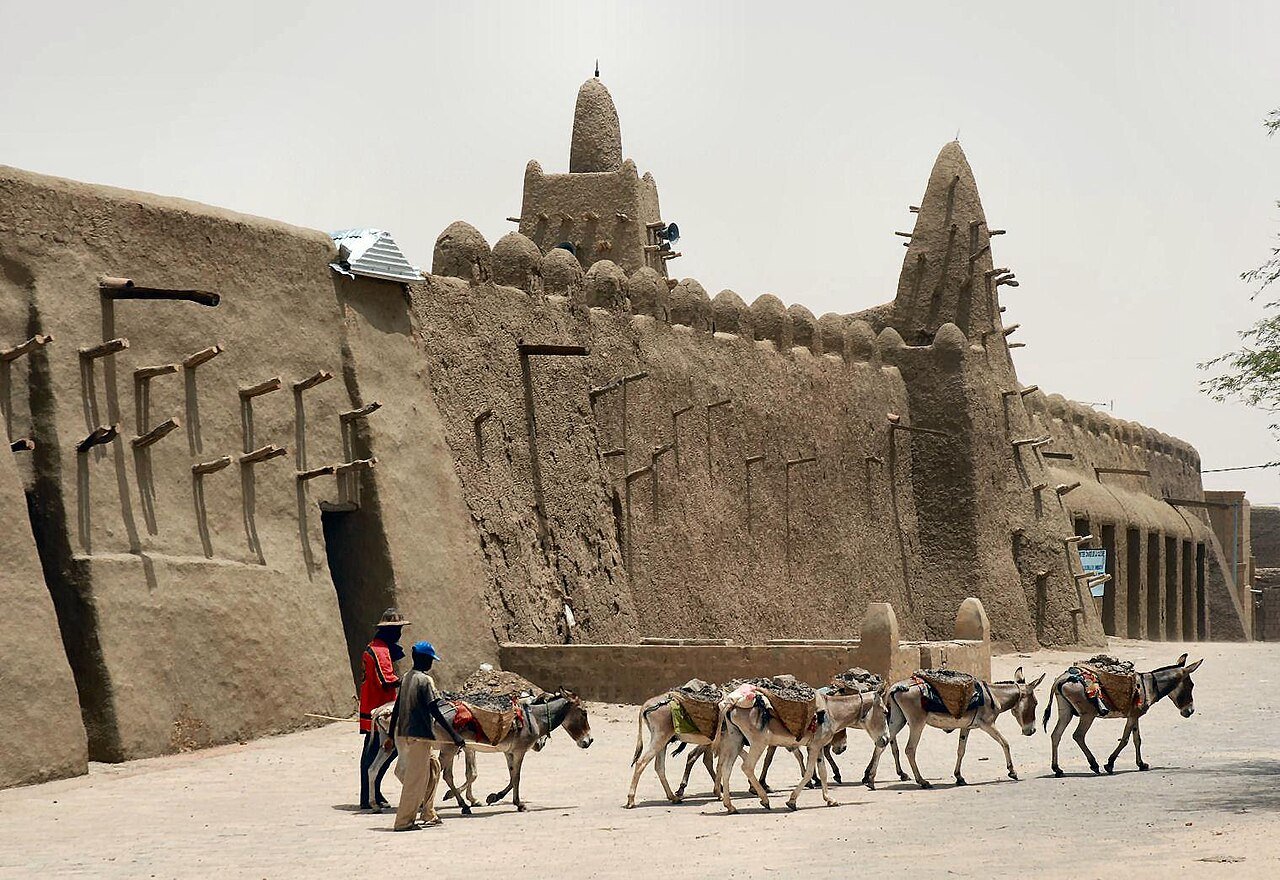
- Old Towns of Djenné (1988) — a living city built almost entirely in banco, the sun-dried mud brick that defines the Sudano-Sahelian architectural tradition. The Great Mosque of Djenné, rebuilt in its current form in 1907, is the largest mud-brick building in the world.
- Timbuktu (1988) — the storied city on the southern edge of the Sahara, which served as a major centre of Islamic scholarship and trans-Saharan trade between the 13th and 17th centuries. Its mosques and mausoleums represent a tradition of earthen sacred architecture unique in the world.
The following year, in 1989, the Cliff of Bandiagara — Land of the Dogons joined the list, rounding out a concentrated burst of West African inscription in the late 1980s. The fourth and most recent site, the Tomb of Askia in Gao, was inscribed in 2004.
The most visited — and the alternatives
Timbuktu carries the weight of centuries of European myth and scholarly reality in equal measure. Its three great mosques — Djinguereber, Sankore, and Sidi Yahia — along with 16 cemeteries and mausoleums of Islamic saints, form the inscribed core. The city’s manuscripts, hundreds of thousands of them, constitute one of the largest pre-colonial African literary archives anywhere. International attention after the 2012–2013 conflict, during which Islamist armed groups systematically destroyed mausoleums, brought Timbuktu unusual visibility for a heritage site in genuine peril.
For those looking beyond Timbuktu, the other three sites each offer a different register of experience:
- Old Towns of Djenné — the city is built on three ancient mounds, and annual community replastering of the Great Mosque is itself a recognised cultural event, one of the most visually striking acts of collective heritage maintenance anywhere in Africa.
- Cliff of Bandiagara — Land of the Dogons — a 150-kilometre sandstone escarpment in central Mali, where the Dogon people have maintained their villages, agricultural terraces, and cosmological traditions on cliff faces and plateau edges for centuries. The mixed cultural-natural designation reflects both the landscape and the living culture it shelters.
- Tomb of Askia — located in Gao, the tomb of Muhammad Askia, ruler of the Songhai Empire at its 15th-century peak, is a pyramidal earthen monument rising 17 metres above the surrounding plain. It is the only surviving testimony to the once-vast Songhai Empire, and its form — an angular stepped pyramid in banco — is unlike anything else in West African funerary architecture.
Natural and shared sites
Mali has no sites inscribed under natural criteria alone. The Cliff of Bandiagara holds a mixed designation, recognising both the geological drama of the escarpment — a fault line that drops sharply across the Sahel — and the cultural landscape the Dogon have shaped within and around it. The biodiversity of the escarpment, including significant plant diversity and wildlife that depends on the cliff’s microclimates, contributed to the mixed rather than purely cultural inscription.
None of Mali’s inscribed sites form part of a transnational or serial nomination. Each stands as a self-contained property, though Timbuktu and Djenné are sometimes discussed in the broader context of Sudano-Sahelian architecture that extends into Burkina Faso, Niger, and Senegal. Any future nominations from this shared tradition could take a serial form, though no such inscription is currently on the Tentative List.
How to find them
All four sites are located in Mali’s interior: Djenné and Timbuktu in the Niger Inland Delta region, Bandiagara on the Sahel plateau to the south-east, and the Tomb of Askia in Gao near the river’s great bend. Ground access to several sites has been restricted or inadvisable due to ongoing security conditions, and travellers should consult current governmental travel advisories before planning any visit.
Mali’s World Heritage sites sit alongside thousands of other places on CHO’s interactive map, with GPS and sourced editorial history for each. See also our guides to Italy’s and France’s UNESCO sites, and our piece on cultural travel beyond mass tourism.
Frequently Asked Questions
How many UNESCO World Heritage Sites does Mali have?
As of 2023, Mali has four UNESCO World Heritage Sites: Old Towns of Djenné, Timbuktu, the Cliff of Bandiagara — Land of the Dogons, and the Tomb of Askia in Gao. Three of the four are currently listed as World Heritage in Danger due to the country’s ongoing security situation.
What was Mali’s first UNESCO World Heritage Site?
Mali’s first inscriptions came in 1988, when two sites joined the World Heritage List simultaneously: the Old Towns of Djenné and Timbuktu. Both are earthen-architecture cities on or near the Niger River, and both have since been placed on the List of World Heritage in Danger.
Does Mali have any natural UNESCO World Heritage Sites?
Mali has no sites inscribed under natural criteria alone. The Cliff of Bandiagara — Land of the Dogons holds a mixed cultural-natural designation, recognising both the Dogon people’s living cultural landscape and the ecological significance of the sandstone escarpment they inhabit.
What is the Tomb of Askia and why is it significant?
The Tomb of Askia is a 17-metre earthen pyramid in Gao, built for Muhammad Askia, ruler of the Songhai Empire at its height in the late 15th century. Inscribed in 2004, it is the only surviving monumental testimony to the Songhai Empire — once one of the largest in African history — and its stepped banco form is unique in West African funerary architecture.
Sources used in this article
- UNESCO — State Party Mali — World Heritage list.
- UNESCO — Mali: World Heritage Sites.
- CHO magazine — What is a World Heritage Site?
- CHO — Interactive map of heritage sites.
Sources
- S1 — McIntosh, Susan Keech, ed. Beyond Chiefdoms: Pathways to Complexity in Africa. Cambridge University Press, 1999. ISBN 978-0-521-63074-0.
- S2 — Imperato, Pascal James, and Gavin H. Imperato. Historical Dictionary of Mali. Scarecrow Press, 2008. ISBN 978-0-8108-5601-1.
Spotted an error? Write to editorial@culturalheritageonline.com and we correct it the same day.