Palau has one UNESCO World Heritage Site, inscribed in 2012 — yet that single designation covers more than 100,000 hectares of limestone islands, coral reefs, and marine lakes that rank among the most biodiverse waters on the planet. For a Pacific island nation of fewer than 20,000 people, the weight of that listing is extraordinary. From Cultural Heritage Online.
Why Palau’s list looks the way it does
Palau ratified the UNESCO World Heritage Convention on 11 June 2002, making it a relatively late signatory among Pacific states. The country’s heritage nomination process has been deliberate and slow by design: rather than putting forward multiple sites, authorities concentrated their resources on building the strongest possible case for one property of outstanding universal value. That strategy paid off in 2012 with the inscription of the Rock Islands Southern Lagoon under both natural and cultural criteria — the rarer “mixed” category that fewer than forty sites worldwide hold.
The tentative list shows where Palau’s attention may turn next. Four properties are currently under consideration: the Ouballang ra Ngebedech agricultural terraces, the Imeong Conservation Area, the Yapease Quarry Sites connected to the ancient rai stone currency trade, and the Tet el Bad Stone Coffin site. Each represents a distinct facet of the archipelago’s cultural and ecological depth, though none has yet reached the formal nomination stage.
The first inscription
Palau’s first — and so far only — World Heritage inscription came in 2012, when the Rock Islands Southern Lagoon was added to the list. It is also the country’s first inscription in every sense: there is no earlier site against which to compare it.
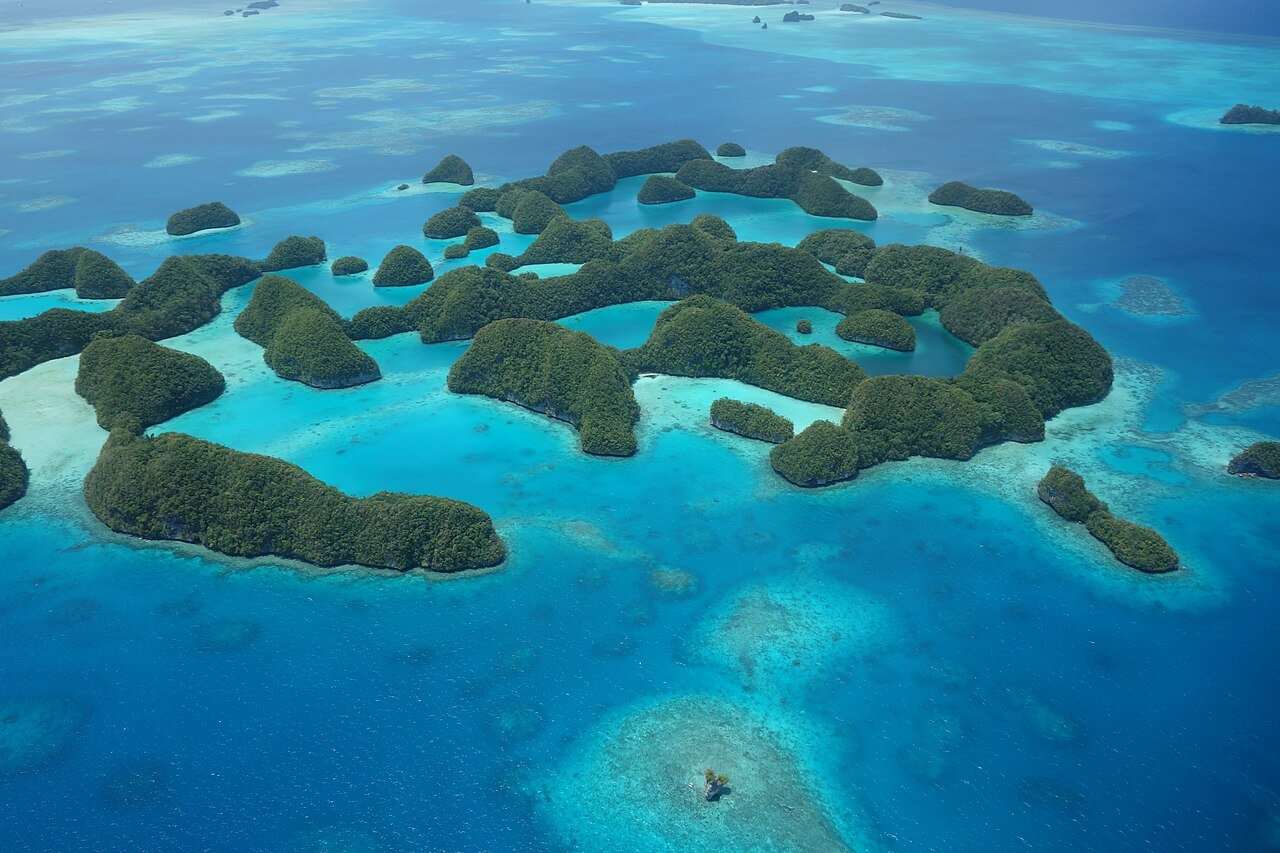
- Rock Islands Southern Lagoon (2012) — mixed natural and cultural site; 100,200 hectares of uninhabited limestone islands, coral reefs, and marine lakes in Palau’s western lagoon.
The site satisfied criteria across both the natural and cultural tracks of the World Heritage assessment: outstanding marine biodiversity and geological formation on one side, and millennia of human settlement evidence on the other. That dual recognition reflects the inseparability of the Palauan people’s history from the sea that surrounds them.
The most visited — and the alternatives
The Rock Islands Southern Lagoon draws divers, snorkellers, and sea kayakers from across the world, drawn by the visibility of the water, the density of the coral cover, and the surreal profile of the mushroom-shaped limestone outcrops. Jellyfish Lake — one of the marine lakes within the site, where a landlocked population of golden jellyfish evolved without stingers — is the image most associated with the destination internationally.
Visitors who look beyond the most-photographed spots find a site of considerable archaeological texture. Among the less-publicised features worth knowing:
- Stonework villages within the lagoon area — the remains of settlements dating back roughly three thousand years, mostly overgrown but traceable through mapped surveys.
- Burial sites distributed across the island group, representing the funerary practices of communities that inhabited these islands long before colonial contact.
- Marine lakes beyond Jellyfish Lake — the Rock Islands contain the world’s highest documented concentration of these isolated saltwater bodies, each evolving its own micro-ecosystem over centuries of separation from the open ocean.
Natural and shared sites
The Rock Islands Southern Lagoon is classified as a mixed site, meaning it qualifies under both natural and cultural World Heritage criteria. On the natural side, the figures are striking: over 385 coral species have been recorded within the site’s waters, along with thirteen shark species and a marine vertebrate diversity that scientists describe as among the highest in the world for an enclosed lagoon system. The limestone geology itself — karst formations carved by millennia of wave action and slightly acidic rainwater — gives the islands their distinctive undercut profiles.
Palau holds no purely cultural World Heritage Sites and no transnational serial inscriptions as of 2025. The country’s geographic position in Micronesia, however, places it at a crossroads of Pacific exchange routes, and the Yapease Quarry Sites on its tentative list speak to a trade network that once connected Palau with the island of Yap, where the famous rai stone discs were used as currency. Whether that cross-island connection might eventually form the basis of a transnational nomination remains an open question.
How to find them
The Rock Islands Southern Lagoon is reached primarily from Koror, Palau’s commercial centre, by boat. Day trips into the lagoon are widely available; overnight liveaboard itineraries allow access to the more remote corners of the inscribed area. Entry to Jellyfish Lake and several other zones within the site requires a Rock Islands permit, which also contributes to the conservation funds that underpin the site’s management.
Palau’s World Heritage sites sit alongside thousands of other places on CHO’s interactive map, with GPS and sourced editorial history for each. See also our guides to Italy’s and France’s UNESCO sites, and our piece on cultural travel beyond mass tourism.
Frequently Asked Questions
How many UNESCO World Heritage Sites does Palau have?
Palau has one UNESCO World Heritage Site: the Rock Islands Southern Lagoon, inscribed in 2012. It is classified as a mixed site, recognised for both its exceptional natural biodiversity and its archaeological evidence of three thousand years of human settlement.
What was Palau’s first UNESCO World Heritage Site?
The Rock Islands Southern Lagoon, inscribed in 2012, is Palau’s first and only World Heritage Site to date. Palau ratified the World Heritage Convention in 2002, and the Rock Islands nomination was the country’s first formal submission to reach inscription.
What makes the Rock Islands Southern Lagoon a mixed World Heritage Site?
The site qualifies under both natural and cultural UNESCO criteria, a combination fewer than forty properties worldwide hold. It is recognised for outstanding marine biodiversity — including over 385 coral species and the world’s highest concentration of marine lakes — alongside stonework village remains and burial sites dating back approximately three millennia.
What UNESCO sites might Palau inscribe in the future?
Palau’s tentative list includes four properties under consideration: the Ouballang ra Ngebedech agricultural terraces, the Imeong Conservation Area, the Yapease Quarry Sites associated with the ancient rai stone currency trade, and the Tet el Bad Stone Coffin site. None has yet reached the formal nomination stage.
Sources used in this article
- UNESCO — State Party Palau — World Heritage list.
- UNESCO — Palau: World Heritage Sites.
- CHO magazine — What is a World Heritage Site?
- CHO — Interactive map of heritage sites.
Sources
- S1 — Parmentier, Richard J. The Sacred Remains: Myth, History, and Polity in Belau. University of Chicago Press, 1987. ISBN 978-0-226-64695-4.
- S2 — Clark, Geoffrey, et al., eds. Islands of Inquiry: Colonisation, Seafaring and the Archaeology of Maritime Landscapes. ANU E Press, 2008. ISBN 978-1-921313-89-9.
Spotted an error? Write to editorial@culturalheritageonline.com and we correct it the same day.