Solomon Islands has 1 UNESCO World Heritage Site, a single natural inscription that carries more ecological weight than many countries manage across a dozen entries. East Rennell, inscribed in 1998, protects the southern end of the world’s largest raised coral atoll — a limestone plateau thick with forest, ringed by cliffs, and centred on Lake Tegano, the largest lake in the Pacific Islands. For a nation of scattered atolls far from the main circuits of international travel, that one site speaks volumes. From Cultural Heritage Online.
Why Solomon Islands’s list looks the way it does
The Solomon Islands archipelago stretches across roughly 1,500 kilometres of the southwest Pacific, encompassing volcanic islands, atolls, and reef systems of extraordinary biological richness. Yet the country’s UNESCO footprint consists of a single site. This is not an oversight — it reflects the particular character of how nominations reach the World Heritage Committee, requiring sustained government investment in documentation, boundary mapping, and conservation planning that small island states often struggle to resource alongside more immediate development priorities.
East Rennell’s selection also reflects a deliberate choice to anchor the inscription to outstanding universal value rather than casting a wide net. Rennell Island itself has a geological and ecological profile unlike anywhere else on Earth, and the natural criteria under which it was inscribed are demanding. A single site meeting those criteria at the highest level is a more credible representation than multiple nominations that stretch the bar.
The first inscription
East Rennell received its World Heritage designation in 1998, the first and so far only inscription for Solomon Islands. The full official name under which it appears on the UNESCO list is simply “East Rennell” — a designation covering the eastern portion of Rennell Island and its surrounding waters. It was inscribed under criterion (ix), which recognises outstanding examples of ecological and biological processes in the evolution and development of terrestrial, freshwater, coastal, and marine ecosystems. The site covers 37,000 hectares.
Rennell Island is the southernmost island in the Solomons chain and is described by UNESCO as the world’s largest raised coral atoll. Unlike a submerged atoll, it has been lifted above sea level by tectonic forces, leaving a limestone plateau honeycombed with caves and fissured ridges. Lake Tegano, which sits at the heart of the inscribed area, was once the atoll’s lagoon. Over millennia, geological uplift converted it into a brackish inland sea — today the largest lake in the Pacific Islands — ringed by cliffs and small limestone islets.
The most visited — and what to know before you go
East Rennell is the only World Heritage Site in Solomon Islands, so the question of which site draws the most visitors answers itself — though “most visited” is relative in this context. Rennell Island sits well outside the main visitor infrastructure of Honiara and the Western Province dive destinations. Reaching it typically involves a short domestic flight from Honiara to Rennell’s airstrip, followed by road and boat travel to reach the lake and forest areas. Around 800 people live in four villages on the eastern part of the island, and community-managed guesthouses provide the principal accommodation options.
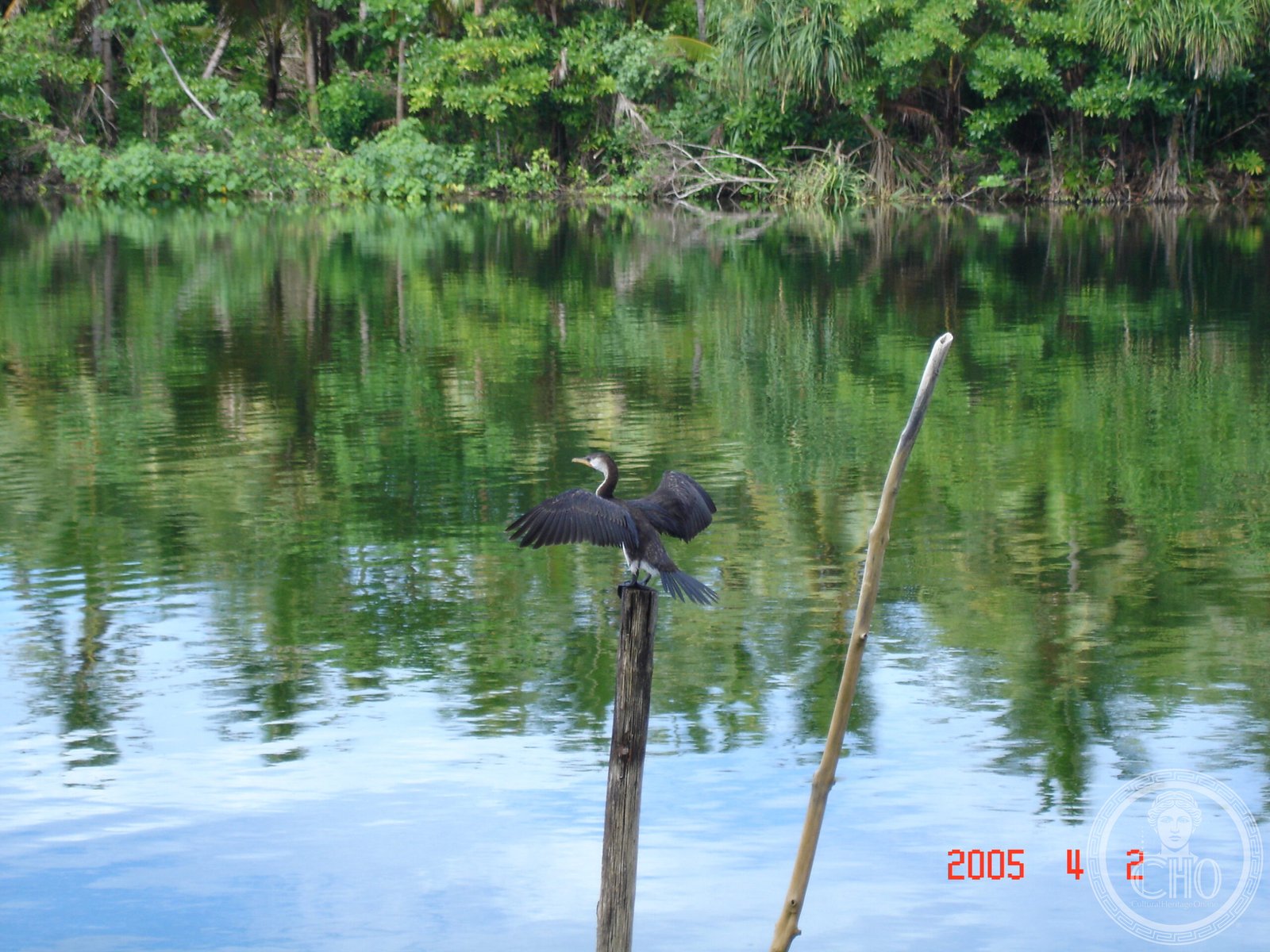
Visitors come for the birdlife, the lake, and the rare experience of a landscape almost entirely free of mass tourism infrastructure. The forest holds 50 recorded bird species, 21 of them endemic to the island. Eleven bat species have been documented, along with 27 land snail species (seven endemic) and approximately 730 insect species, many found nowhere else. The lake itself supports more than 300 diatom and algae species. There are no resort facilities within the site boundary, and that is, for the traveller willing to make the journey, precisely the point.
Natural and conservation status
East Rennell’s ecological credentials rest on a combination of isolation and geological singularity. The raised atoll platform has acted as a natural barrier to species dispersal for long enough that Rennell has developed its own endemic fauna at rates unusual even by Pacific island standards. The 21 endemic bird species include the Rennell shrikebill and the Rennell fantail, species found nowhere else on the planet. The brackish chemistry of Lake Tegano — neither fully freshwater nor marine — has produced its own suite of adapted organisms, including endemic fish.
Conservation concerns have been significant. In 2013, UNESCO added East Rennell to the List of World Heritage in Danger, citing the threat posed by logging activities to the site’s outstanding universal value. Commercial logging on the western end of the island, outside the protected boundary, directly affects bird populations and threatens the integrity of the forest buffer around the inscribed area. The site remains on the Danger List as of the time of writing, a designation that places it under heightened international scrutiny and calls for corrective measures from the Solomon Islands government.
How to find it
The practical route to East Rennell begins in Honiara, Solomon Islands’s capital, with domestic flights operated by Solomon Airlines serving Rennell (Tingoa) Airport. From the airstrip, community transport and boat travel across Lake Tegano are the standard modes of access into the inscribed area. Advance coordination with local community operators is strongly recommended; independent arrival without pre-arranged logistics is difficult given the island’s limited facilities.
Solomon Islands’s World Heritage site sits alongside thousands of other places on CHO’s interactive map, with GPS and sourced editorial history for each. See also our guides to Italy’s and France’s UNESCO sites, and our piece on cultural travel beyond mass tourism.
Frequently Asked Questions
How many UNESCO World Heritage Sites does Solomon Islands have?
Solomon Islands has one UNESCO World Heritage Site: East Rennell, inscribed in 1998. It is a natural site, recognised for its outstanding ecological and biological significance as the world’s largest raised coral atoll and home to Lake Tegano, the largest lake in the Pacific Islands.
What was Solomon Islands’s first UNESCO World Heritage Site?
East Rennell was Solomon Islands’s first — and only — UNESCO inscription, achieving World Heritage status in 1998. It was nominated under criterion (ix), which covers outstanding examples of ecological and biological processes, and covers 37,000 hectares in the southern part of Rennell Island.
Is East Rennell on the UNESCO List of World Heritage in Danger?
Yes. East Rennell was placed on the List of World Heritage in Danger in 2013, primarily due to the threat posed by commercial logging activities on Rennell Island. The designation draws international attention to the conservation challenges facing the site and calls on Solomon Islands to implement corrective measures to protect the site’s outstanding universal value.
How do visitors access East Rennell?
The most practical route is a domestic flight from Honiara to Rennell (Tingoa) Airport, followed by road and boat travel into the inscribed area around Lake Tegano. Accommodation is community-managed, and pre-arranging transport and lodging with local operators before arrival is essential given the limited on-island infrastructure.
Sources used in this article
- UNESCO — State Party Solomon Islands — World Heritage list.
- UNESCO — Solomon Islands: World Heritage Sites.
- CHO magazine — What is a World Heritage Site?
- CHO — Interactive map of heritage sites.
Sources
- S1 — Kirch, Patrick Vinton. The Lapita Peoples: Ancestors of the Oceanic World. Blackwell, 1997. ISBN 978-1-55786-112-2.
- S2 — Hviding, Edvard. Guardians of Marovo Lagoon: Practice, Place, and Politics in Maritime Melanesia. University of Hawaii Press, 1996. ISBN 978-0-8248-1664-3.
Spotted an error? Write to editorial@culturalheritageonline.com and we correct it the same day.