North Korea has 3 UNESCO World Heritage Sites, a compact but striking list that spans ancient dynastic burial grounds, a medieval capital built in stone and ritual geometry, and a coastal mountain range of extraordinary topographic variety. The country’s inscriptions range from 2004 to 2025, making its engagement with the World Heritage programme both recent and still unfolding. Two sites are classified as cultural, one as mixed cultural and natural — a combination that signals how tightly landscape and history are intertwined on this peninsula. From Cultural Heritage Online.
Why North Korea’s list looks the way it does
North Korea became a State Party to the World Heritage Convention in 1998, making its first inscription in 2004 relatively prompt. The resulting list reflects the country’s particular heritage strengths: the legacy of the Koguryo kingdom, which once dominated the northern half of the Korean Peninsula and parts of Manchuria, and the urban and ceremonial fabric of Kaesong, the last capital of the Goryeo dynasty. These are not peripheral footnotes to East Asian history but defining chapters of it.
Access constraints and the country’s limited participation in international tourism have kept these sites largely outside the mainstream travel conversation. That invisibility is itself historically significant: monuments that in another country would generate substantial scholarly tourism instead sit in a kind of enforced quiet, which arguably preserves them from the pressures of visitor erosion that affect comparable sites elsewhere in Asia.
The first inscriptions
North Korea’s initial inscription came in 2004, when UNESCO recognised the following site:
- Complex of Koguryo Tombs (2004) — a group of 30 tombs dating from the 3rd century BC to the 7th century AD, containing elaborate wall paintings depicting court life, hunting scenes, and cosmological diagrams that survive in remarkably vivid condition.
The Koguryo tombs stood alone on the list for nearly a decade before a second inscription followed. The gap reflects the careful, site-by-site approach North Korea has taken with nominations, submitting detailed dossiers rather than pursuing the large serial nominations that have characterised the strategies of some neighbouring states.
The most visited — and the alternatives
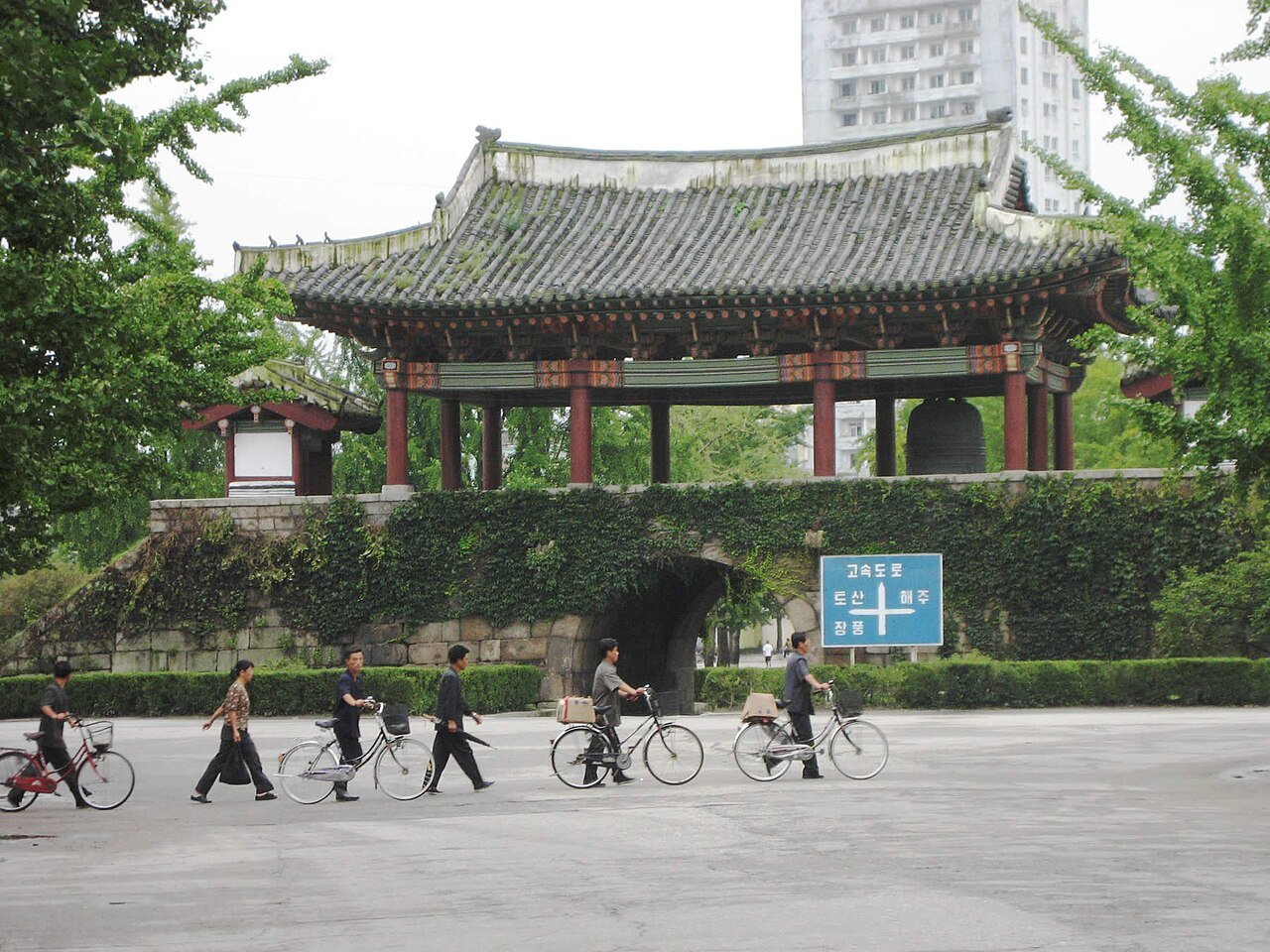
Of the three inscribed sites, the Historic Monuments and Sites in Kaesong (2013) carries the broadest historical resonance for travellers already familiar with Korean history. Kaesong served as the capital of the Goryeo dynasty from 918 to 1392 and preserves a dense ensemble of palaces, schools, shrines, and royal tombs laid out according to Confucian principles of orientation and hierarchy. The site documents the full arc of a dynasty that gave Korea its name.
Less discussed, though no less significant, is the sheer variety within the Koguryo tombs complex. Individual tomb chambers — some with ceilings painted to represent the night sky, others with processional murals of four hundred-year-old colours — offer one of the most direct windows into daily aristocratic life anywhere in ancient East Asia. Mount Kumgang (2025), the newest inscription, adds a landscape dimension: roughly 1,200 waterfalls and ponds set against granite peaks, with a flora ranging from temperate broadleaf to subarctic species within a compact elevation range.
Natural and shared sites
Mount Kumgang — known in English as Diamond Mountain from the Sea — is North Korea’s only mixed cultural and natural inscription, added to the World Heritage List in 2025. The mountain has been a site of Buddhist pilgrimage and artistic inspiration for at least a thousand years; its natural attributes, including dramatic coastal cliffs and the layered biodiversity of its valleys, were evaluated alongside its cultural landscape. The site has no natural-only inscription in North Korea’s current list, though several natural areas, including the karstic cave systems of the Kujang area and the coastal wetlands of Mundok, appear on the country’s Tentative List.
North Korea does not currently participate in any transnational or serial World Heritage inscription. Given that the Koguryo kingdom extended historically into what is now northeastern China — and that China inscribed its own Koguryo sites in 2004, the same year as North Korea — the potential for a shared inscription exists on paper, though diplomatic and political conditions would need to align considerably for such a nomination to proceed.
How to find them
All three of North Korea’s World Heritage Sites can be located precisely by coordinates, and each carries a substantial historiographical record that is accessible independently of travel to the country itself. Scholars, educators, and heritage professionals working on Korean history, Buddhist art, or East Asian dynastic culture will find all three sites directly relevant to their fields.
North Korea’s World Heritage sites sit alongside thousands of other places on CHO’s interactive map, with GPS and sourced editorial history for each. See also our guides to Italy’s and France’s UNESCO sites, and our piece on cultural travel beyond mass tourism.
Frequently Asked Questions
How many UNESCO World Heritage Sites does North Korea have?
As of 2025, North Korea has 3 UNESCO World Heritage Sites. Two are classified as cultural — the Complex of Koguryo Tombs and the Historic Monuments and Sites in Kaesong — and one, Mount Kumgang, is classified as mixed cultural and natural.
What was North Korea’s first UNESCO World Heritage Site?
The Complex of Koguryo Tombs was inscribed in 2004, making it North Korea’s first World Heritage Site. The complex encompasses 30 tombs from the 3rd century BC to the 7th century AD and is particularly notable for its preserved wall paintings depicting court life, hunting, and cosmological imagery.
What is North Korea’s most recently inscribed World Heritage Site?
Mount Kumgang — Diamond Mountain from the Sea — was inscribed in 2025, making it the most recent addition to North Korea’s World Heritage list. The site is recognised for its coastal mountain landscape, approximately 1,200 waterfalls and ponds, and its long history as a place of Buddhist pilgrimage and cultural significance.
Does North Korea have any natural UNESCO World Heritage Sites?
North Korea does not have a purely natural World Heritage Site. Mount Kumgang holds a mixed classification, recognised for both its cultural heritage and its natural landscape, which includes diverse temperate and subarctic flora and dramatic coastal terrain.
Sources used in this article
- UNESCO — State Party North Korea — World Heritage list.
- UNESCO — North Korea: World Heritage Sites.
- CHO magazine — What is a World Heritage Site?
- CHO — Interactive map of heritage sites.
Sources
- S1 — Nelson, Sarah Milledge. The Archaeology of Korea. Cambridge University Press, 1993. ISBN 978-0-521-40783-0.
- S2 — Portal, Jane. Korea: Art and Archaeology. Thames & Hudson, 2000. ISBN 978-0-500-28202-1.
Spotted an error? Write to editorial@culturalheritageonline.com and we correct it the same day.